Beyond Community Notes: A Framework for Understanding and Building Crowdsourced Context Systems for Social Media
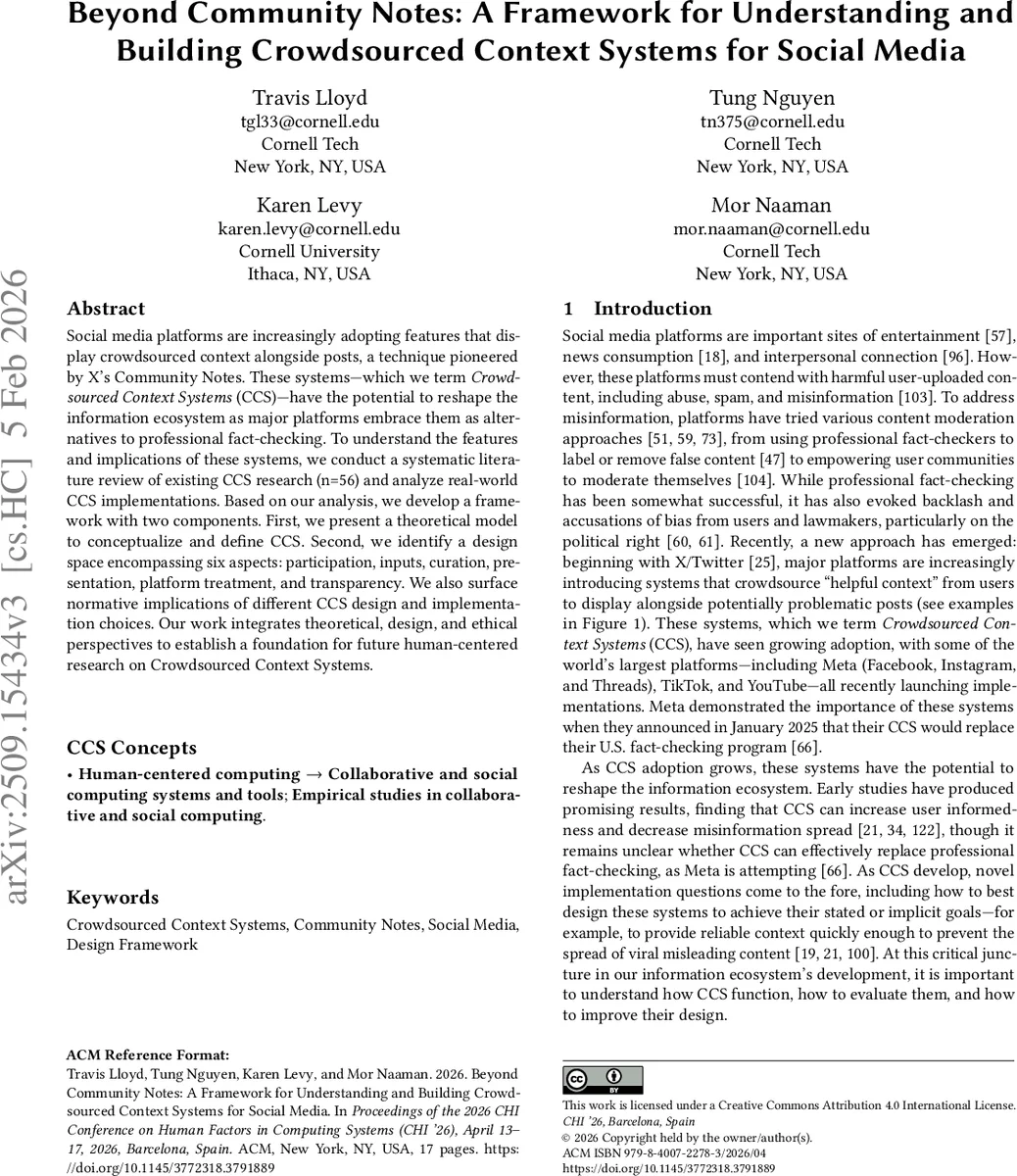
Social media platforms are increasingly adopting features that display crowdsourced context alongside posts, a technique pioneered by X’s Community Notes. These systems – which we term Crowdsourced Context Systems (CCS) – have the potential to reshape the information ecosystem as major platforms embrace them as alternatives to professional fact-checking. To understand the features and implications of these systems, we conduct a systematic literature review of existing CCS research (n=56) and analyze real-world CCS implementations. Based on our analysis, we develop a framework with two components. First, we present a theoretical model to conceptualize and define CCS. Second, we identify a design space encompassing six aspects: participation, inputs, curation, presentation, platform treatment, and transparency. We also surface normative implications of different CCS design and implementation choices. Our work integrates theoretical, design, and ethical perspectives to establish a foundation for future human-centered research on Crowdsourced Context Systems.
💡 Research Summary
The paper “Beyond Community Notes: A Framework for Understanding and Building Crowdsourced Context Systems for Social Media” offers a comprehensive examination of a newly emerging class of content‑moderation tools that the authors term Crowdsourced Context Systems (CCS). CCS are defined as platform‑integrated mechanisms that allow users to create short explanatory “notes” that appear alongside potentially misleading posts, providing additional factual, motivational, or socio‑political context without removing the original content. The authors trace the origin of CCS to X’s (formerly Twitter) Community Notes (originally Birdwatch) and note that major platforms—including Meta (Facebook, Instagram, Threads), YouTube, and TikTok—have launched analogous pilots (Meta’s Community Notes, YouTube’s Notes, TikTok’s Footnotes).
To ground their analysis, the authors conduct two complementary investigations. First, they perform a PRISMA‑style systematic literature review, searching six major HCI and social‑media databases plus arXiv for works mentioning “Community Notes” or “Birdwatch” published from 2021 onward. From an initial 590 hits, they filter down to 56 original research articles that study the X‑style CCS either in the wild or in controlled experiments. The review reveals a concentration on contributor behavior, note‑rating dynamics, and short‑term impacts on user informedness, while highlighting gaps in research on algorithmic curation, cross‑platform design, and longitudinal societal effects.
Second, the authors carry out an inductive thematic analysis of publicly available design documents, blog posts, API specifications, and code repositories for the four major CCS implementations. This analysis yields a six‑dimensional design space that captures the most consequential implementation decisions:
- Participation – who can author notes, eligibility criteria, identity verification, and incentive structures.
- Inputs – the media formats allowed (text, images, video, AI‑generated snippets) and any constraints on length or style.
- Curation – the rating mechanisms (up/down votes, helpfulness scores), aggregation algorithms (majority, weighted trust), and the degree of algorithmic transparency.
- Presentation – visual placement (inline, sidebar, pop‑up), emphasis (color, icons), and interaction affordances (expand, hide, report).
- Platform Treatment – how notes influence feed ranking, search results, ad targeting, and whether they trigger downstream moderation actions.
- Transparency – openness of code, data dumps, decision logs, and the availability of external audit processes.
Mapping existing platforms onto this space reveals notable divergences. X’s Community Notes is the most transparent: its curation algorithm is open‑source, and note/rating datasets are periodically released. Meta and TikTok adopt the same underlying algorithmic logic but keep both code and data proprietary, limiting external scrutiny. YouTube’s pilot introduces AI‑generated notes and focuses on video‑specific contexts, yet it provides minimal public documentation. These differences illustrate how design choices directly shape the normative outcomes of CCS.
The authors propose a theoretical model that abstracts CCS into four stages: (1) user posts content, (2) crowd contributors create notes, (3) a separate crowd rates note helpfulness, and (4) the platform algorithm selects “helpful” notes for public display. This model distinguishes CCS from traditional comment sections or crowd‑sourced fact‑checking by emphasizing the explicit goal of facilitating interpretation rather than merely aggregating opinions or removing content.
In the discussion, the paper foregrounds three inter‑related normative concerns:
- User Informedness – effective note design can increase critical assessment of misinformation, but overly dense or poorly placed notes risk information overload.
- Distribution of Power – when platforms retain exclusive control over curation algorithms, they concentrate editorial power; transparency and external audits can mitigate this risk.
- Fairness – the demographic composition of note authors and raters influences bias; inclusive participation policies and bias‑mitigation techniques are essential to avoid systematic skew.
The authors argue that design decisions across the six dimensions have direct implications for these normative goals. For example, lowering participation barriers may broaden perspective diversity but also open avenues for coordinated manipulation; richer input modalities (e.g., images, video) can convey nuance but increase moderation complexity; opaque curation can erode trust, while transparent algorithms can invite gaming.
Finally, the paper outlines a research agenda: (1) systematic evaluation of algorithmic transparency mechanisms and third‑party auditing frameworks; (2) comparative studies of cross‑platform interoperability and standardization of note formats; (3) longitudinal assessments of CCS impact on misinformation diffusion, public discourse quality, and policy outcomes; and (4) exploration of hybrid models that combine professional fact‑checking with crowd‑generated context.
In sum, this work provides the first unified theoretical and design framework for CCS, situates them within broader HCI literature on moderation and crowd‑sourced verification, and offers concrete guidance for researchers, platform designers, and policymakers seeking to harness crowdsourced context as a scalable, democratic alternative to traditional fact‑checking.
Comments & Academic Discussion
Loading comments...
Leave a Comment