Flux-pump induced degradation of $T_1$ for dissipative cat qubits
Dissipative stabilization of cat qubits autonomously corrects for bit flip errors by ensuring that reservoir-engineered two-photon losses dominate over other mechanisms inducing phase flip errors. To describe the latter, we derive an effective master equation for an asymmetrically threaded SQUID based superconducting circuit used to stabilize a dissipative cat qubit. We analyze the dressing of relaxation processes under drives in time-dependent Schrieffer-Wolff perturbation theory for weakly anharmonic bosonic degrees of freedom, and in numerically exact Floquet theory. We find that spurious single-photon decay rates can increase under the action of the parametric pump that generates the required interactions for cat-qubit stabilization. Our analysis feeds into mitigation strategies that can inform current experiments, and the methods presented here can be extended to other circuit implementations.
💡 Research Summary
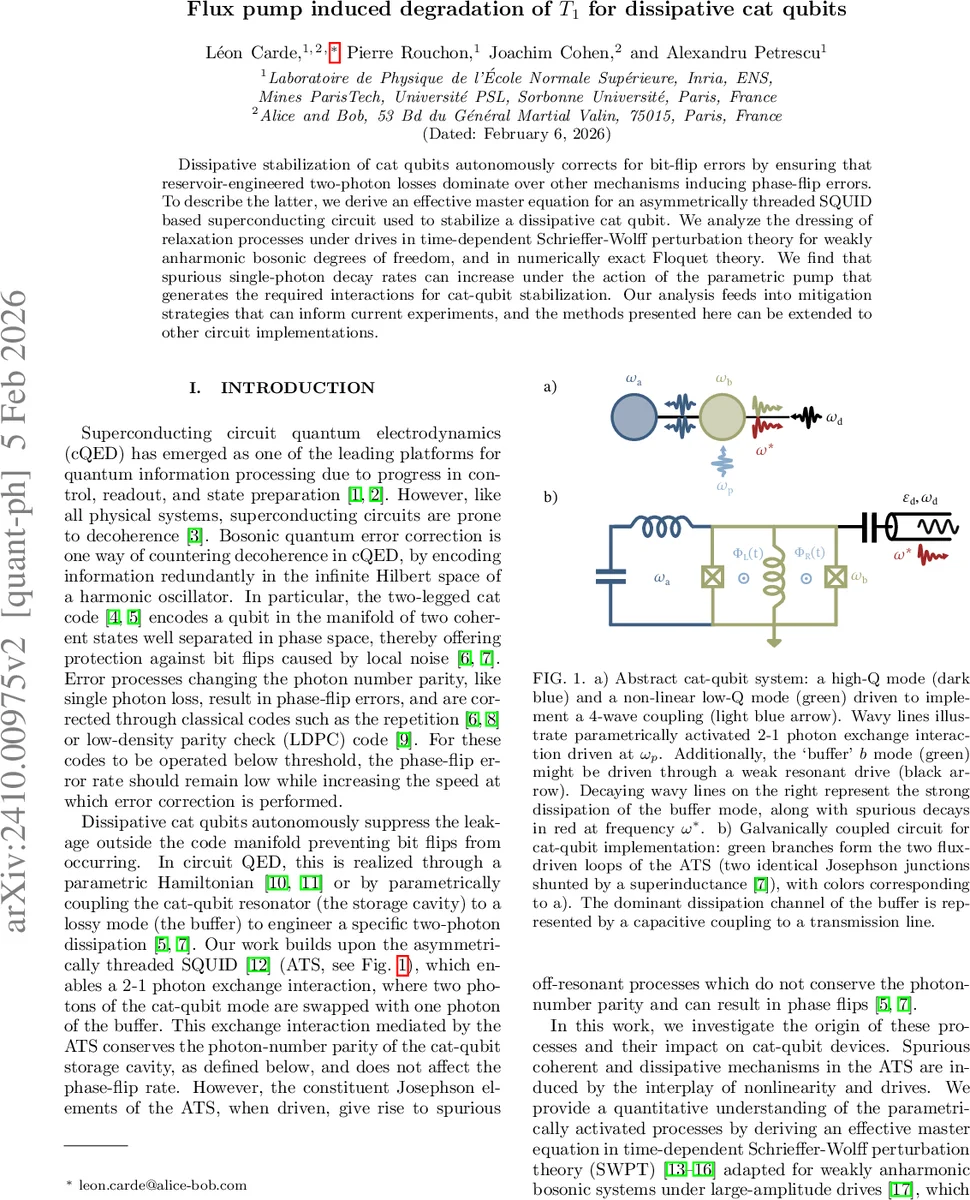
This paper investigates a subtle yet critical source of decoherence in dissipative cat‑qubit architectures that rely on an asymmetrically threaded SQUID (ATS) to mediate a two‑photon exchange between a high‑Q memory mode and a low‑Q buffer mode. The authors focus on the degradation of the memory‑mode energy relaxation time (T₁) caused by the parametric flux pump that is required to generate the stabilizing two‑photon loss channel.
First, they formulate the full circuit Hamiltonian, including the linear LC modes, the Josephson non‑linearity of the ATS, a flux‑pump drive at frequency ωₚ, and a weak charge drive on the buffer. By assuming small phase excursions (ϵₚ, φₐ, φ_b ≪ π) they expand the Josephson term using a Taylor series combined with a Jacobi‑Anger expansion, which yields a hierarchy of multi‑wave mixing terms whose amplitudes scale as powers of a single small parameter λ.
To obtain a tractable description they apply time‑dependent Schrieffer‑Wolff perturbation theory (SWPT). A unitary transformation e^{S(t)} is constructed order‑by‑order in λ so that the transformed Hamiltonian becomes time‑independent up to the chosen truncation order. The same transformation dresses the system‑bath coupling, producing effective collapse operators C(ω_j) that appear in a Lindblad master equation of the form
L_eff(ρ)= -i
Comments & Academic Discussion
Loading comments...
Leave a Comment