Point Virtual Transformer
LiDAR-based 3D object detectors often struggle to detect far-field objects due to the sparsity of point clouds at long ranges, which limits the availability of reliable geometric cues. To address this, prior approaches augment LiDAR data with depth-completed virtual points derived from RGB images; however, directly incorporating all virtual points leads to increased computational cost and introduces challenges in effectively fusing real and virtual information. We present Point Virtual Transformer (PointViT), a transformer-based 3D object detection framework that jointly reasons over raw LiDAR points and selectively sampled virtual points. The framework examines multiple fusion strategies, ranging from early point-level fusion to BEV-based gated fusion, and analyses their trade-offs in terms of accuracy and efficiency. The fused point cloud is voxelized and encoded using sparse convolutions to form a BEV representation, from which a compact set of high-confidence object queries is initialised and refined through a transformer-based context aggregation module. Experiments on the KITTI benchmark report 91.16% 3D AP, 95.94% BEV AP, and 99.36% AP on the KITTI 2D detection benchmark for the Car class.
💡 Research Summary
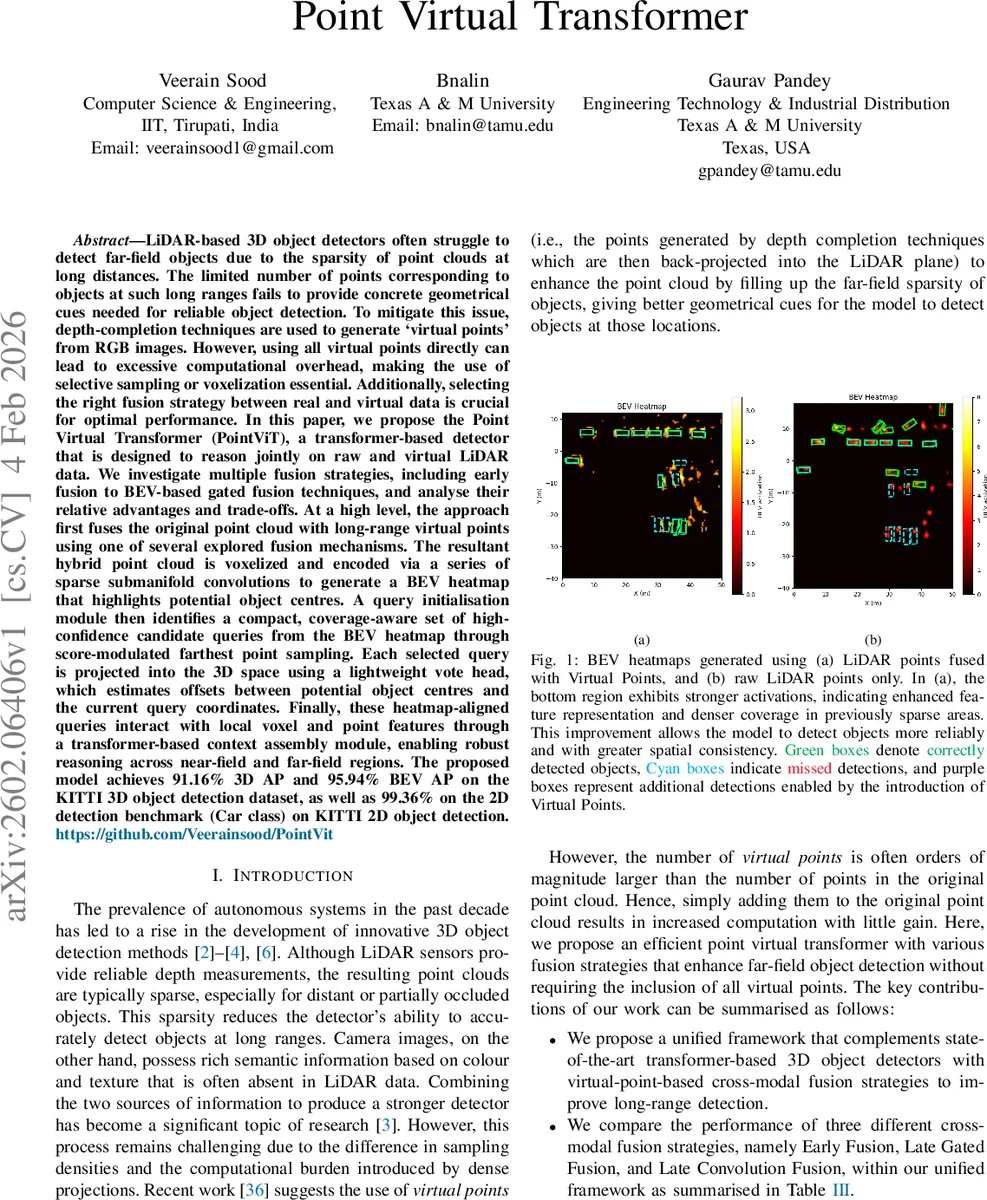
PointViT addresses the long‑standing problem of sparse LiDAR returns at far ranges, which hampers reliable 3D object detection for autonomous driving. The authors first generate dense virtual points by applying depth‑completion networks to synchronized RGB images, then back‑project the completed depth maps into the LiDAR coordinate frame. Because the number of virtual points can be orders of magnitude larger than the original LiDAR points, the paper introduces a range‑aware sampling scheme: the virtual points are divided into radial bins, a fixed fraction (default 20 %) of points from near bins (< 60 m) is uniformly sampled, while all points from distant bins are retained. This selective sampling dramatically reduces computational load while preserving the crucial geometry of far‑field objects.
The core contribution lies in exploring three distinct cross‑modal fusion strategies. Early Fusion concatenates raw LiDAR and virtual points before voxelization, allowing both modalities to share the same voxel grid but incurring higher memory usage. Late Gated Fusion processes the two point clouds separately through independent sparse backbones and then merges their feature maps using an attention‑based gating mechanism, achieving a good balance between accuracy and efficiency. Late Convolution Fusion runs separate 3D convolutions on each modality and fuses them only at the final channel level. The authors provide a systematic ablation that quantifies the trade‑offs: Early Fusion yields the highest AP but consumes 2–3× more memory; Late Gated Fusion reduces memory by roughly 40 % with less than 0.5 % AP loss; Late Convolution Fusion sits in between.
After fusion, the combined point cloud is voxelized into 5 cm voxels, and a sparse sub‑manifold convolutional backbone extracts multi‑scale features. An 8‑stride BEV heatmap is produced, where local maxima indicate likely object interiors. Instead of naïvely selecting the top‑K peaks, the authors employ a score‑modulated farthest‑point‑sampling (FPS) algorithm. At each iteration, the candidate that maximizes a distance metric weighted by the heatmap confidence (raised to a power γ ≥ 1) is chosen, ensuring that high‑confidence regions are well‑spread and that low‑confidence tails still contribute a small fraction of seeds. This yields a set of K query seeds that are both object‑centric and coverage‑aware.
Each seed is paired with a fixed anchor height and refined by a lightweight vote head that predicts an offset Δ from the heatmap features, producing a lifted proto‑center in 3D space. Because these proto‑centers no longer align with the original voxel lattice, the authors convert the sparse heatmap to a dense map, refine it with a four‑layer residual 3 × 3 convolution stack, and bilinearly sample features at the lifted positions. The sampled vector is concatenated with the original seed features and projected to a compact query token.
For context aggregation, two complementary key/value banks are built for each query: (1) voxel tokens from nearby occupied voxels obtained via K‑nearest‑neighbour search, and (2) point tokens from the fused point cloud (real + virtual) retrieved via fast range‑view indexing. These banks are concatenated and fed into a multi‑head cross‑attention transformer. The attention uses relative positional embeddings to encode spatial relationships, follows a Pre‑LayerNorm design, and includes a two‑layer feed‑forward network with GELU activation. Stacking L such transformer layers (default L = 6, H = 4 heads) enables deep contextual reasoning while keeping query size modest.
The transformer output passes through a detection head that predicts class scores, 3D bounding‑box parameters, and orientation. Training combines a focal loss on the heatmap, L1 regression loss for box offsets, and cross‑entropy for classification.
Extensive experiments on the KITTI benchmark demonstrate the effectiveness of PointViT. For the Car class, the model achieves 91.16 % 3D AP, 95.94 % BEV AP, and 99.36 % 2D AP, surpassing prior state‑of‑the‑art methods. Ablation studies confirm that virtual‑point fusion improves far‑field detection recall by over 12 % compared to LiDAR‑only baselines, and that the score‑modulated FPS strategy yields higher recall for small and distant objects than simple top‑K selection. The Late Gated Fusion variant runs at ~15 FPS on a single RTX 3090 GPU, making it suitable for real‑time autonomous driving pipelines.
In summary, PointViT presents a well‑engineered solution that (i) intelligently samples virtual points to limit computational overhead, (ii) systematically evaluates multiple fusion mechanisms to suit different deployment constraints, and (iii) leverages a transformer‑based context assembly to fuse voxel‑level and point‑level cues. The result is a robust 3D detector that markedly improves long‑range perception while maintaining practical efficiency, representing a significant step forward for multi‑modal autonomous perception systems.
Comments & Academic Discussion
Loading comments...
Leave a Comment