Multi-Sensor Scheduling for Remote State Estimation over Wireless MIMO Fading Channels with Semantic Over-the-Air Aggregation
In this work, we study multi-sensor scheduling for remote state estimation over wireless multiple-input multiple-output (MIMO) fading channels using a novel semantic over-the-air (SemOTA) aggregation approach. We first revisit Kalman filtering with conventional over-the-air (OTA) aggregation and highlight its transmit power limitations. To balance power efficiency and estimation performance, we formulate the scheduling task as a finite-horizon dynamic programming (DP) problem. By analyzing the structure of the optimal Q-function, we show that the resulting scheduling policy exhibits a semantic structure that adapts online to the estimation error covariance and channel variations. To obtain a practical solution, we derive a tractable upper bound on the Q-function via a positive semidefinite (PSD) cone decomposition, which enables an efficient approximate scheduling policy and a low-complexity remote estimation algorithm. Numerical results confirm that the proposed scheme outperforms existing methods in both estimation accuracy and power efficiency.
💡 Research Summary
This paper addresses the problem of remote state estimation in wireless networks where multiple sensors communicate with a remote estimator over a multiple‑input multiple‑output (MIMO) fading channel. Conventional over‑the‑air (OTA) aggregation, which lets all sensors transmit their analog measurements simultaneously, yields high spectral efficiency but incurs prohibitive transmit‑power costs as the number of active sensors grows. To overcome this limitation, the authors propose a semantic OTA (SemOTA) aggregation scheme that selectively activates only those sensors whose measurements are expected to provide significant information gain for the estimator.
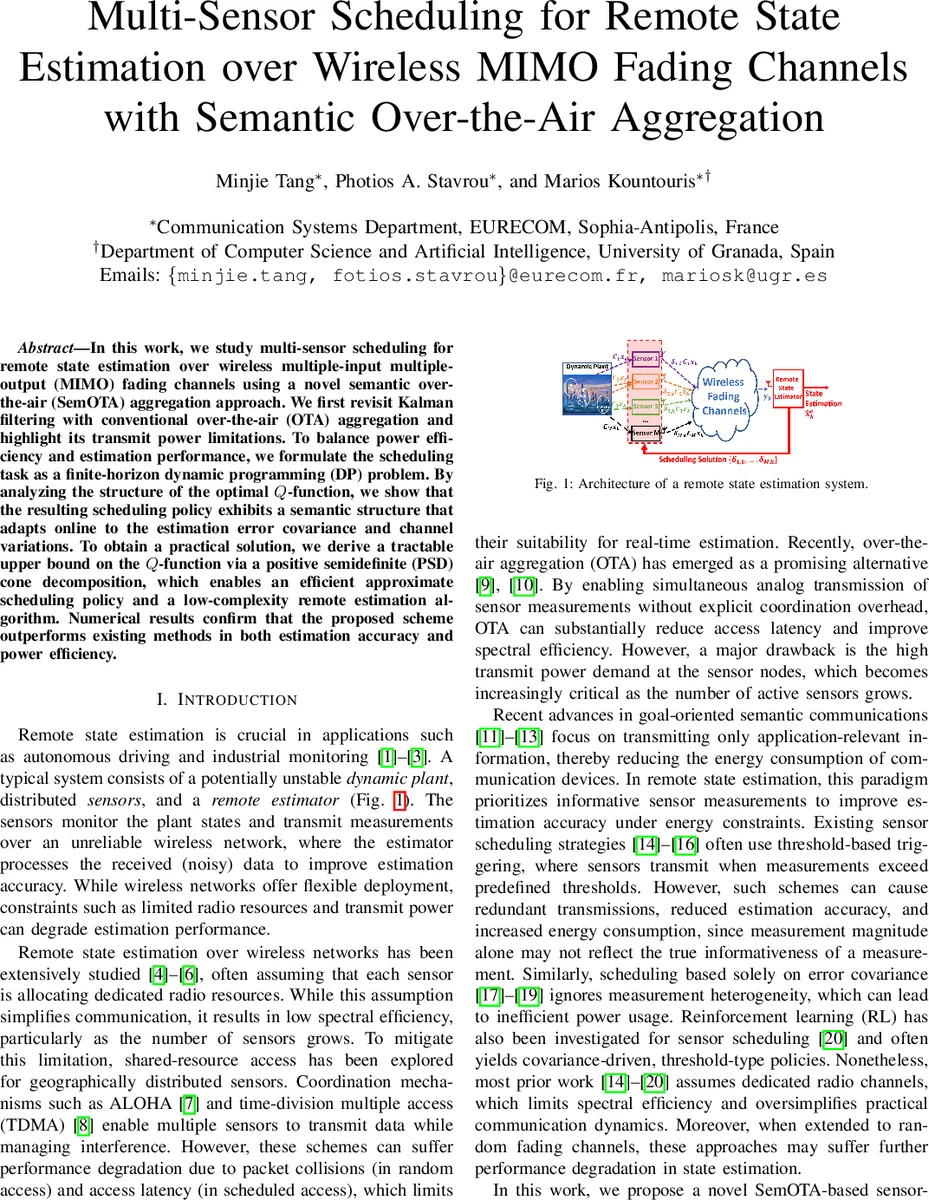
The plant dynamics are modeled as a first‑order linear time‑variant discrete‑time system, (x_{k+1}=A x_k + w_k), with Gaussian process noise. Each of the (M) sensors possesses (N_t) transmit antennas and observes the state through a matrix (C_m). The wireless link to the estimator (with (N_r) receive antennas) is represented by an i.i.d. Rayleigh MIMO matrix (H_{m,k}). The received signal at time (k) is (y_k = \sum_{m=1}^M \delta_{m,k} H_{m,k} C_m x_k + v_k), where (\delta_{m,k}\in{0,1}) denotes the scheduling decision. The estimator runs a Kalman filter, maintaining a prior covariance (\Sigma_k) and a posterior covariance (\Sigma_{e,k}).
The design objective is a weighted sum of the expected trace of the error covariance (a proxy for estimation accuracy) and the expected total transmit power, (\sum_m \delta_{m,k},\text{tr}(C_m C_m^\top)), over a finite horizon of (K) slots. This leads to a stochastic finite‑horizon optimization problem. By treating the pair ((\Sigma_k, H_k)) as the system state and the vector (\pi_k={\delta_{1,k},\dots,\delta_{M,k}}) as the control action, the authors formulate a dynamic programming (DP) recursion with Q‑functions.
Theorem 1 shows that the optimal policy has a “semantic” structure: sensor (m) is activated if the marginal reduction in the trace of the error covariance (computed via the function (f(\cdot)) and a future‑cost term (\Delta_k)) exceeds the weighted power cost (\gamma,\text{tr}(C_m C_m^\top)). This condition depends explicitly on the current covariance (\Sigma_k) and the instantaneous channel state (H_k), enabling online adaptation. However, evaluating (\Delta_k) requires solving a nested DP, which is computationally prohibitive.
To obtain a tractable solution, the authors introduce a positive semidefinite (PSD) cone decomposition of the aggregated channel matrix (\sum_m \delta_{m,k}\bar H_{m,k}). By ordering the eigenvalues and retaining only the dominant (\gamma_k) modes, they derive a closed‑form upper bound on (\Delta_k). Theorem 2 leverages this bound to produce a simple decision rule (equation 12) that can be evaluated with linear algebraic operations, avoiding the recursive DP.
Algorithm 1 implements the SemOTA scheme: at each slot the estimator computes the approximate scheduling decisions using the bound, broadcasts the binary activation vector to the sensors, the selected sensors transmit their measurements via OTA, and the Kalman filter updates the state estimate and covariance. Theorem 3 guarantees that the total cost incurred by this algorithm does not exceed the minimum of the approximated Q‑function at the initial state, i.e., the algorithm is provably near‑optimal with respect to the derived bound.
Numerical experiments compare the proposed SemOTA policy against three baselines: (1) measurement‑threshold ALOHA, (2) error‑covariance‑threshold random TDMA, and (3) conventional OTA where all sensors transmit. The plant is a 3‑dimensional system with randomly generated observation matrices, (N_t=N_r=2), and a horizon (K=1000). Results show that as the number of sensors increases, conventional OTA’s power consumption grows linearly while its NMSE improvement saturates. In contrast, SemOTA maintains low power consumption by activating only the most informative sensors and achieves substantially lower NMSE across all sensor counts. The trade‑off parameter (\gamma) allows designers to balance energy usage against estimation fidelity.
Key contributions of the work are: (i) a novel SemOTA aggregation mechanism tailored to MIMO fading channels, reducing transmit power without sacrificing spectral efficiency; (ii) a rigorous DP analysis revealing a semantic, covariance‑and‑CSI‑aware scheduling structure; (iii) a PSD‑based upper‑bound technique that yields a low‑complexity, near‑optimal scheduling algorithm; and (iv) extensive simulations demonstrating superior performance over existing threshold‑based and full‑OTA schemes. Limitations include the assumption of perfect instantaneous CSI at the estimator and the finite‑horizon formulation; future research directions suggested are partial CSI handling, infinite‑horizon average‑cost optimization, extensions to nonlinear or non‑Gaussian dynamics, and experimental validation on real wireless testbeds.
Comments & Academic Discussion
Loading comments...
Leave a Comment