A Darboux classification of homogeneous Pfaffian forms on graded manifolds
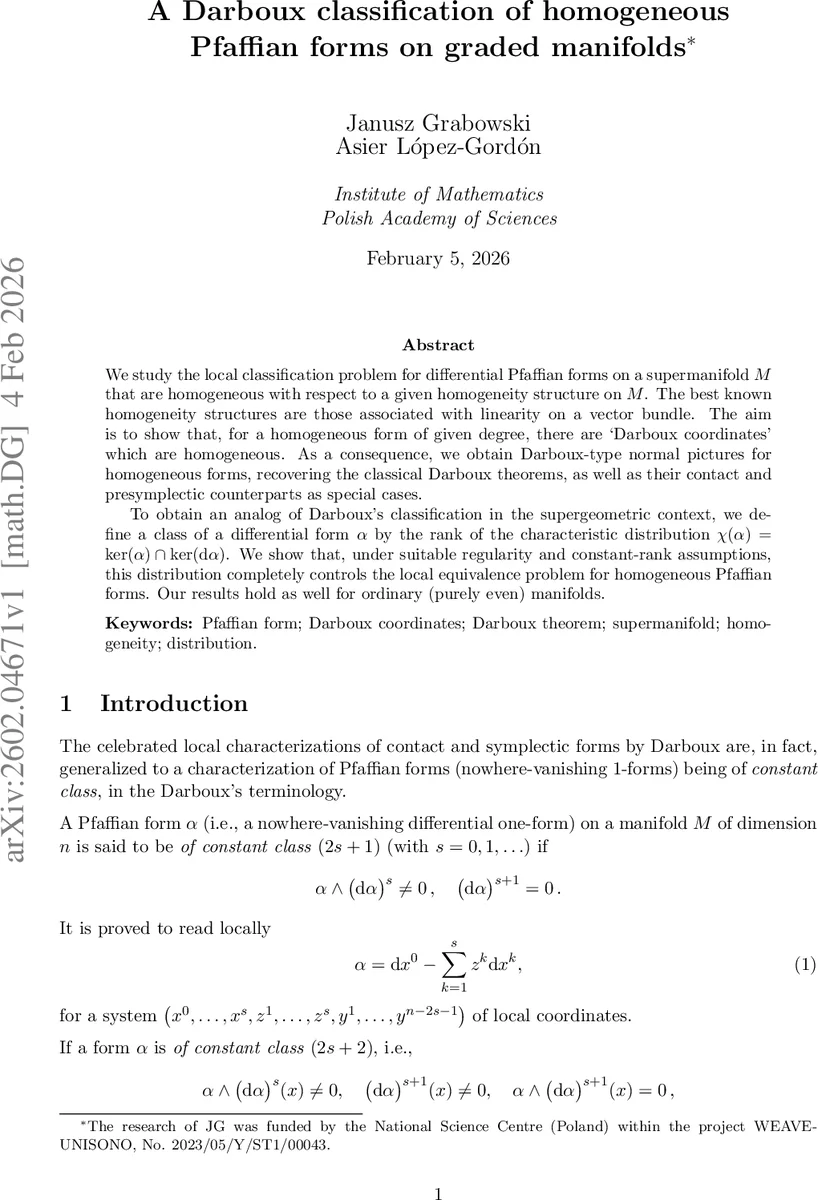
We study the local classification problem for differential Pfaffian forms on a supermanifold $M$ that are homogeneous with respect to a given homogeneity structure on $M$. The best-known homogeneity structures are those associated with linearity on a vector bundle. The aim is to show that, for a homogeneous form of given degree, there are `Darboux coordinates’ which are homogeneous. As a consequence, we obtain Darboux-type normal pictures for homogeneous forms, recovering the classical Darboux theorems, as well as their contact and presymplectic counterparts as special cases. To obtain an analog of Darboux’s classification in the supergeometric context, we define a class of a differential form $α$ by the rank of the characteristic distribution $χ(α)$, being the intersection of kernels of $α$ and $dα$. We show that, under suitable regularity and constant-rank assumptions, this distribution completely controls the local equivalence problem for homogeneous Pfaffian forms. Our results hold as well for ordinary (purely even) manifolds.
💡 Research Summary
The paper “A Darboux classification of homogeneous Pfaffian forms on graded manifolds” investigates the local equivalence problem for differential Pfaffian forms (including higher‑degree forms) on supermanifolds equipped with a homogeneity structure defined by an even weight vector field ∇. A weight vector field is locally of the form ∇ = Σ w_i x_i ∂_{x_i}, where the real numbers w_i are the weights of the coordinates x_i. The authors first review the basic theory of homogeneity supermanifolds, showing that when ∇ vanishes at a point its linearisation D_m∇ is diagonalizable, while away from its zero set one can straighten ∇ and construct homogeneous coordinate charts with arbitrary prescribed weights (provided the first weight is non‑zero).
To replace the classical notion of “constant class” (which relies on top‑degree forms that do not exist in the super setting), the paper defines the class of a differential form α as the corank of its characteristic distribution χ(α) = ker α ∩ ker dα. This definition, originally due to Godbillon, works for any form and any parity, and coincides with the usual Darboux class for contact (odd‑dimensional) and presymplectic (even‑dimensional) cases.
The central result is a Darboux‑type theorem for homogeneous Pfaffian forms. Assuming that α has a fixed class (i.e. χ(α) has constant rank) and that α is homogeneous of weight w with respect to ∇, the authors prove that χ(α) itself is a homogeneous distribution. By applying a homogeneous version of the Frobenius theorem they integrate χ(α) to obtain homogeneous coordinates adapted to the distribution. In these coordinates α takes one of the standard normal forms:
-
For class = 2s + 1 (contact‑type)
α = d x₀ − ∑_{k=1}^{s} z_k d x_k, -
For class = 2s + 2 (presymplectic‑type)
α = ∑_{k=1}^{s} x_k d y_k.
All coordinates appearing in the normal form are homogeneous with respect to the same weight vector field ∇, so the “Darboux coordinates” respect the underlying grading. The theorem works for non‑polynomial homogeneous forms as well; the paper illustrates this with the example α = dz − (p² + sin(pq)) dq on the cylinder with weights (0, 1, −1), showing how to construct homogeneous Darboux coordinates explicitly.
Section 3 treats vector superbundles as prototypical homogeneity supermanifolds. The Euler vector field on a vector bundle provides a canonical weight vector field; linear functions are 1‑homogeneous, basic functions are 0‑homogeneous, and the dual bundle structure yields a natural pairing of linear functions. This viewpoint unifies the treatment of tangent and cotangent bundles, and extends to N‑manifolds (graded manifolds with integer weights) where homogeneous symplectic structures, Courant algebroids, and odd homological Hamiltonians appear naturally.
Finally, the authors emphasize that their classification holds verbatim for ordinary (purely even) manifolds, thereby recovering the classical Darboux theorems for contact, symplectic, and presymplectic forms as special cases. By identifying the class of a form with the corank of χ(α), the paper provides a robust invariant that controls the local equivalence problem in the graded setting. This work opens the way for further applications to higher‑order geometric structures, graded Poisson geometry, and the study of homogeneous structures in mathematical physics.
Comments & Academic Discussion
Loading comments...
Leave a Comment