L^2-Betti numbers in prime characteristic and a conjecture of Wise
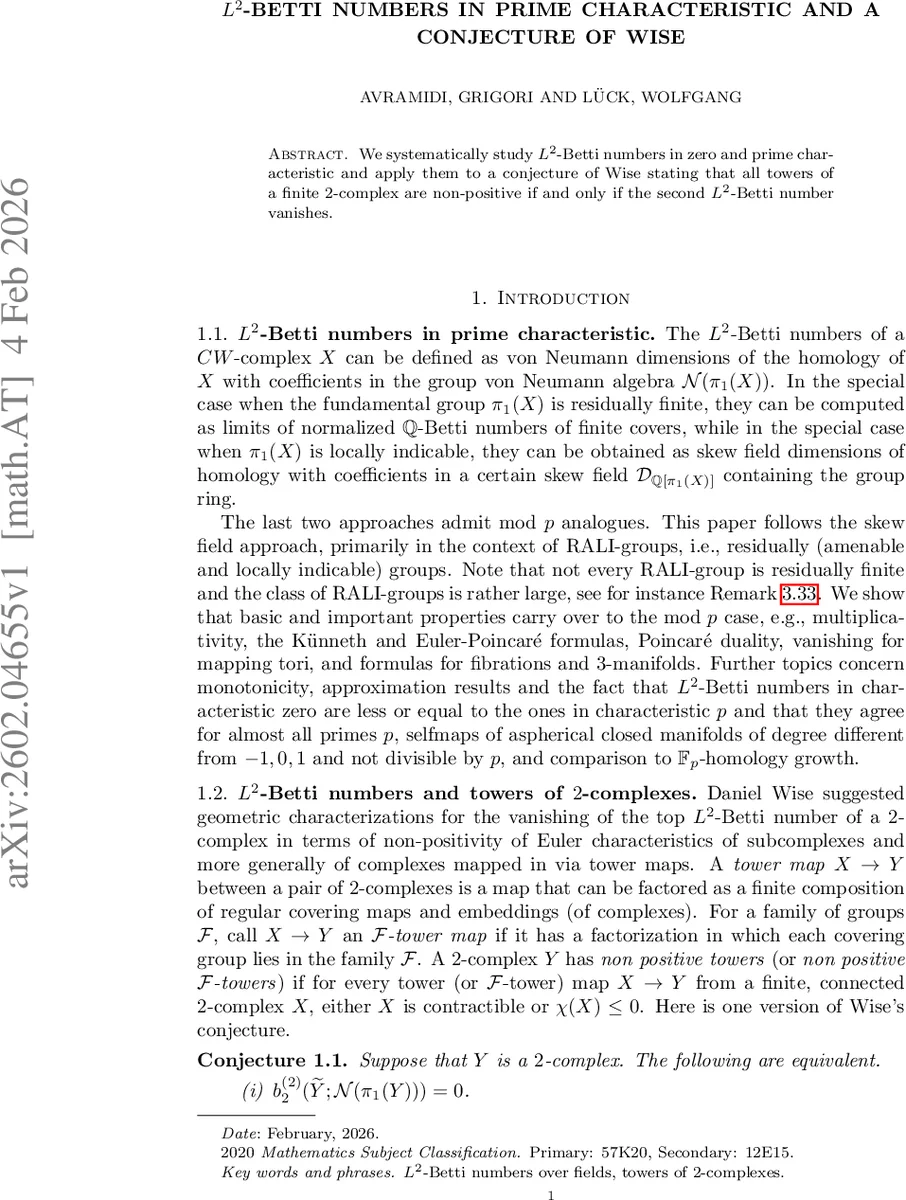
We systematically study L^2-Betti numbers in zero and prime characteristic and apply them to a conjecture of Wise stating that all towers of a finite 2-complex are non-positive if and only if the second L^2-Betti number vanishes.
💡 Research Summary
The paper develops a systematic theory of L²‑Betti numbers in both characteristic 0 and positive characteristic p, and applies this theory to a conjecture of Daniel Wise concerning finite 2‑complexes.
Background and Motivation
Classically, L²‑Betti numbers are defined using the group von Neumann algebra N(G) and are known to be computable via limits of normalized rational Betti numbers for residually finite groups or via skew‑field dimensions for locally indicable groups. The authors adopt the skew‑field (division‑ring) approach, which readily admits analogues in characteristic p.
Skew‑Field Framework
For a locally indicable group G and a field F (ℚ ⊂ F ⊂ ℂ), one embeds the group ring F G into a division closure D(F G ⊂ U(G)) inside the algebra of affiliated operators U(G). The dimension over this division ring yields an integer‑valued invariant that coincides with the usual L²‑Betti number when F has characteristic 0. This identification relies on the strong Atiyah conjecture proved for locally indicable groups by Jaikin‑Zapirain and López‑Álvarez.
(Weak) Linnell and (Weak) Hughes Groups
The authors introduce two hierarchies of groups: Linnell groups, for which a Linnell division ring exists for every field, and Hughes groups, which require a “free” Hughes division ring (a stronger condition). They prove that every RALI‑group (residually amenable and locally indicable) is a weak Lewin group, hence a weak Linnell and weak Hughes group. Consequently, the skew‑field construction works for a very large class of groups, far beyond the residually finite case.
Definition of L²‑Betti Numbers over Fields
For a weak Hughes group G and any field F, the n‑th L²‑Betti number over F is defined as
b₂⁽²⁾ₙ(X; D_F G) = dim_{D_F G} Hₙ(D_F G ⊗{ℤG} C*(X)).
When F⊂ℂ, this agrees with the classical N(G)‑based invariant.
Fundamental Properties
The paper shows that all standard properties of L²‑Betti numbers survive in the new setting: multiplicativity under finite coverings, Künneth formula, Euler‑Poincaré identity, Poincaré duality for aspherical complexes, vanishing for mapping tori, behavior under fibrations, and formulas for 3‑manifolds. Moreover, self‑maps of aspherical closed manifolds whose degree is not –1, 0, 1 and is not divisible by p have trivial L²‑Betti numbers in the corresponding characteristic.
Monotonicity and Approximation
A key result is that characteristic‑0 L²‑Betti numbers are always ≤ their characteristic‑p counterparts, and for all but finitely many primes the two agree. Approximation theorems are proved: L²‑Betti numbers can be recovered as limits over finite‑index subgroups, and the definitions via skew‑fields coincide with earlier ad‑hoc constructions.
Wise’s Conjecture
Wise conjectured that for a finite 2‑complex Y the following are equivalent:
- b₂⁽²⁾(Y; N(π₁Y)) = 0,
- every tower map X → Y (finite composition of regular coverings and embeddings) satisfies χ(X) ≤ 0 unless X is contractible.
The conjecture is known in special cases (one‑relator complexes, spines of aspherical 3‑manifolds with boundary, certain Davis complexes) but remains open in general because it would imply several classical conjectures (Whitehead’s asphericity, Howie’s locally indicable fundamental group, Kervaire‑Laudenbach contractibility).
Main Results
- Theorem 1.2 (RALI‑case): If X and Y are finite connected 2‑complexes with RALI fundamental groups and X → Y is a ℤ‑tower (or more generally an RALI‑tower), then b₂⁽²⁾(Y)=0 forces either χ(X) ≤ 0 or X to be contractible. This establishes the “⇒” direction of Wise’s conjecture for the large class of RALI groups.
- Proposition 1.3 (mod p‑case): For finite connected 2‑complexes with residually p‑finite fundamental groups, if the infimum over all regular finite p‑covers Y′ → Y of b₂(Y′; 𝔽ₚ)/|Y′→Y| equals zero, then the same dichotomy (χ(X) ≤ 0 or X contractible) holds for any ℤ‑tower X → Y. This provides a characteristic‑p analogue of Wise’s statement.
Further Developments
Sections 5.4–5.7 discuss maximal residually C‑coverings, translate between L²‑Betti numbers and tower properties, and give additional evidence for Wise’s conjecture. Section 6 treats groups of cohomological dimension 2 with vanishing second L²‑Betti number, linking the theory to classical group‑theoretic problems.
Conclusion
By extending L²‑Betti numbers to prime characteristic via division‑ring methods and proving that the essential algebraic and topological formulas persist, the authors create a robust toolkit that bridges analytic invariants and combinatorial topology. Their results confirm Wise’s conjecture in the important settings of RALI and residually p‑finite groups, thereby advancing our understanding of the interplay between L²‑invariants, tower maps, and long‑standing conjectures in low‑dimensional topology.
Comments & Academic Discussion
Loading comments...
Leave a Comment