Aortic Valve Disease Detection from PPG via Physiology-Informed Self-Supervised Learning
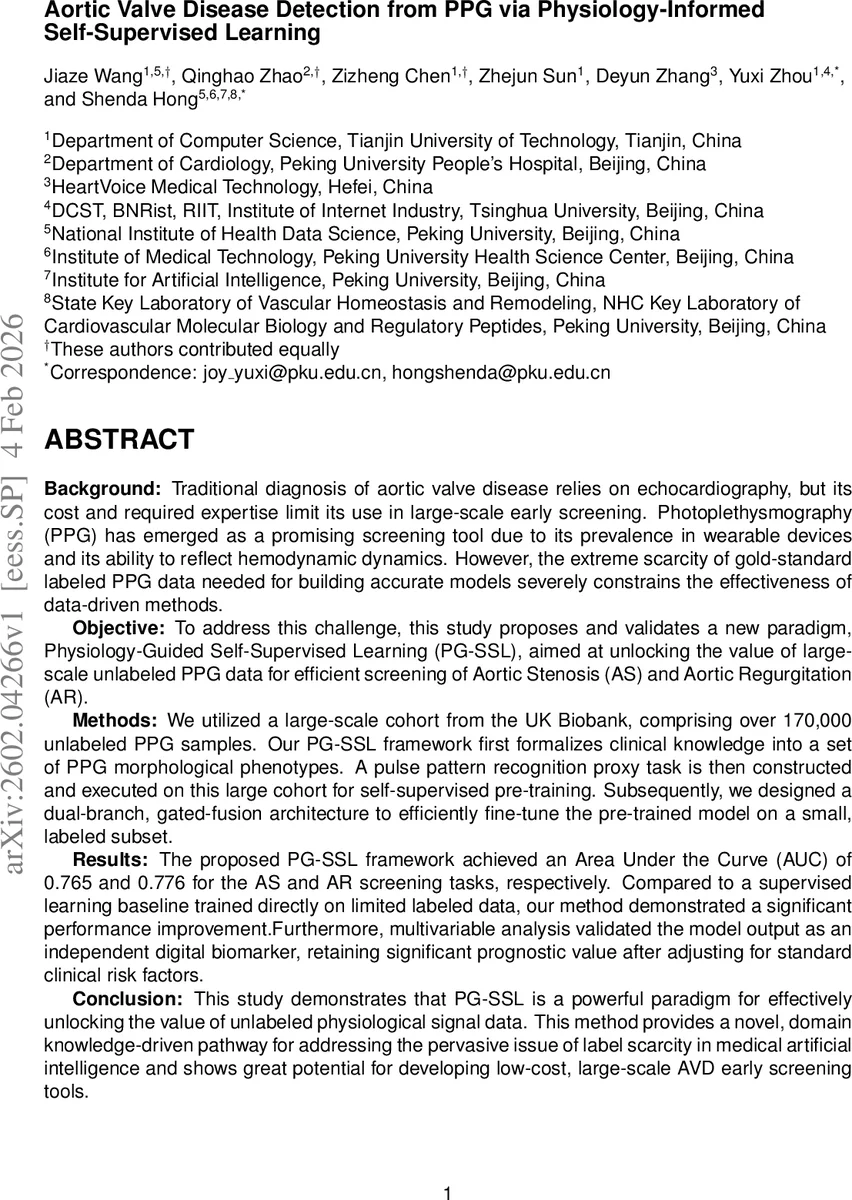
Traditional diagnosis of aortic valve disease relies on echocardiography, but its cost and required expertise limit its use in large-scale early screening. Photoplethysmography (PPG) has emerged as a promising screening modality due to its widespread availability in wearable devices and its ability to reflect underlying hemodynamic dynamics. However, the extreme scarcity of gold-standard labeled PPG data severely constrains the effectiveness of data-driven approaches. To address this challenge, we propose and validate a new paradigm, Physiology-Guided Self-Supervised Learning (PG-SSL), aimed at unlocking the value of large-scale unlabeled PPG data for efficient screening of Aortic Stenosis (AS) and Aortic Regurgitation (AR). Using over 170,000 unlabeled PPG samples from the UK Biobank, we formalize clinical knowledge into a set of PPG morphological phenotypes and construct a pulse pattern recognition proxy task for self-supervised pre-training. A dual-branch, gated-fusion architecture is then employed for efficient fine-tuning on a small labeled subset. The proposed PG-SSL framework achieves AUCs of 0.765 and 0.776 for AS and AR screening, respectively, significantly outperforming supervised baselines trained on limited labeled data. Multivariable analysis further validates the model output as an independent digital biomarker with sustained prognostic value after adjustment for standard clinical risk factors. This study demonstrates that PG-SSL provides an effective, domain knowledge-driven solution to label scarcity in medical artificial intelligence and shows strong potential for enabling low-cost, large-scale early screening of aortic valve disease.
💡 Research Summary
This paper tackles the pressing problem of early detection of aortic valve disease—specifically aortic stenosis (AS) and aortic regurgitation (AR)—using photoplethysmography (PPG), a signal that is already embedded in millions of consumer wearables. Traditional diagnosis relies on transthoracic echocardiography, which is expensive and requires specialist expertise, making population‑scale screening infeasible. While PPG offers a low‑cost, direct window into arterial pressure waveforms, the scarcity of gold‑standard labeled PPG data (i.e., recordings paired with echocardiographic confirmation) has limited the performance of purely supervised machine‑learning approaches.
To overcome this label bottleneck, the authors propose Physiology‑Guided Self‑Supervised Learning (PG‑SSL), a paradigm that converts established clinical knowledge about aortic valve hemodynamics into a set of computable PPG morphological phenotypes. These phenotypes capture features such as rise time, fall time, peak‑to‑peak interval, amplitude ratios, and waveform asymmetry—attributes that reflect the classic “pulsus parvus et tardus” of AS and the “water‑hammer” pulse of AR. By treating these phenotypes as pseudo‑labels, the authors construct a massive proxy classification task on 170,702 unlabeled PPG recordings from the UK Biobank (each a single‑beat waveform sampled at 100 Hz from a 10–15 s recording). The sheer scale of this dataset provides statistical robustness, allowing the model to learn fundamental hemodynamic patterns despite the inherent noise of individual signals.
The self‑supervised backbone employs a dual‑branch architecture. One branch is a 1‑D convolutional network (ResNet‑like) that extracts local waveform details; the second branch is a Transformer‑based attention module that captures long‑range temporal dependencies. A gated‑fusion layer dynamically weights the two streams, effectively integrating fine‑grained and contextual information while allowing the model to adapt to patient‑specific physiological variations (e.g., age‑related arterial stiffening).
After pre‑training, the model is fine‑tuned on a modestly sized labeled cohort (5,460 participants) that includes 245 AS cases, 213 AR cases, and 81 mixed‑disease cases, identified via ICD‑10 codes and self‑reported medical history, with a one‑year follow‑up window to capture latent disease. The data are split 64 %/16 %/20 % for training, validation, and testing.
Performance evaluation demonstrates that the proposed PG‑SSL model—named PiLA—achieves area‑under‑the‑curve (AUC) scores of 0.7645 for AS and 0.7756 for AR on an independent test set. At a specificity of 60 %, sensitivities reach 77.6 % (AS) and 78.6 % (AR), substantially outperforming supervised baselines such as ResNet1D‑18. Calibration curves show that predicted probabilities align closely with observed prevalence across the risk spectrum, indicating reliable risk estimation. Enrichment analysis reveals that screening the top 5 % of individuals with the highest PiLA risk scores yields a 4.68‑fold increase in AS detection and a 3.45‑fold increase for AR, underscoring the model’s utility for cost‑effective, targeted follow‑up testing.
The authors also benchmark generic self‑supervised methods (SimCLR contrastive learning, signal reconstruction tasks) on the same data; these approaches fail to improve—or even degrade—performance, highlighting the importance of embedding domain‑specific physiological priors into the pretext task.
Multivariable Cox regression confirms that the PiLA risk score remains an independent predictor of incident cardiovascular events after adjusting for traditional risk factors (age, hypertension, diabetes, etc.), establishing the output as a novel digital biomarker.
In summary, the study makes three key contributions: (1) a systematic translation of clinical hemodynamic knowledge into pseudo‑labels for massive self‑supervised pre‑training, (2) a dual‑branch gated‑fusion network that balances local and global temporal features while mitigating over‑fitting on small labeled sets, and (3) rigorous validation on a real‑world, large‑scale cohort demonstrating both diagnostic accuracy and prognostic relevance. The work paves the way for deploying AI‑enhanced PPG screening on everyday wearables, potentially enabling population‑wide early detection of aortic valve disease at a fraction of the cost of conventional imaging.
Comments & Academic Discussion
Loading comments...
Leave a Comment