Existence and Spatial Decay of Forced Waves for the Fisher-KPP Equation with a Degenerate Shifting Environment
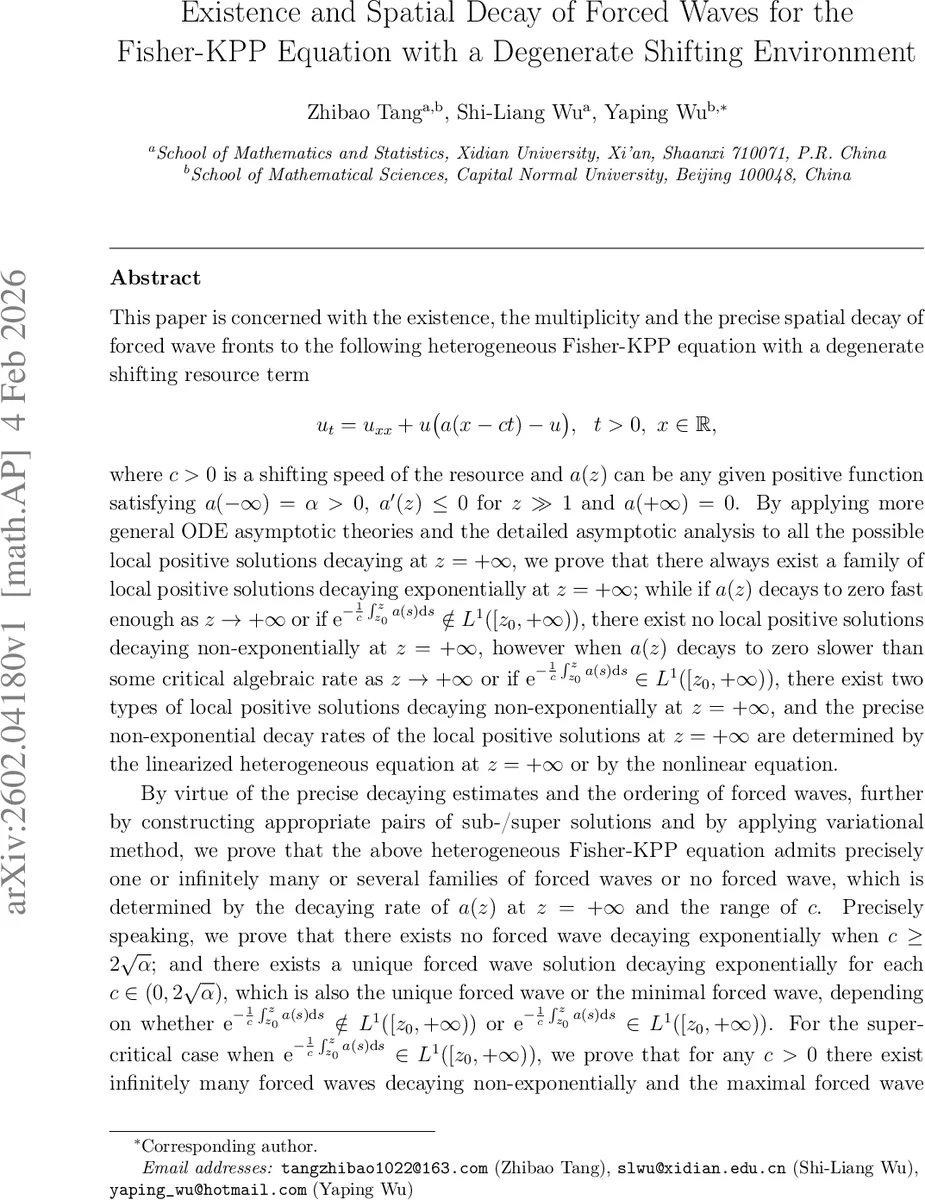
This paper studies forced waves for the heterogeneous Fisher-KPP equation $u_t = u_{xx} + u(a(x-ct)-u)$, where $c>0$ and $a(z)>0$ satisfies $a(-\infty)=α>0=a(+\infty)$, $a’(z)\le0$ ($z\gg1$). Using ODE asymptotic analysis, we classify all local positive solutions near $z=+\infty$. Exponential decay solutions always exist; non-exponential decay solutions exist if and only if $\mathrm{e}^{-\frac{1}{c}\int_{z_0}^z a(s)ds}\in L^1$ (or equivalently, when $a(z)$ decays slower than a critical algebraic rate). We establish a complete existence, multiplicity and spatial decay theory for forced waves. For each $c\in(0,2\sqrtα)$, there exists a unique exponentially decaying forced wave. This wave is either the unique forced wave or the minimal forced wave, depending on the integrability condition. In the super-critical case $\mathrm{e}^{-\frac{1}{c}\int_{z_0}^z a(s)ds}\in L^1$, for any $c>0$ there exist infinitely many non-exponentially decaying forced waves. The maximal wave is not in $L^1$, and for nearly all such $a(z)$ we establish the existence, multiplicity and precise decay of these waves. These results provide nearly complete answers to open problems concerning the existence, uniqueness, multiplicity and spatial decay rates of forced waves in Fisher-KPP models with degenerate moving environments.
💡 Research Summary
The paper investigates forced travelling wave solutions of the heterogeneous Fisher–KPP equation
\
Comments & Academic Discussion
Loading comments...
Leave a Comment