Restart-Free (Accelerated) Gradient Sliding Methods for Strongly Convex Composite Optimization
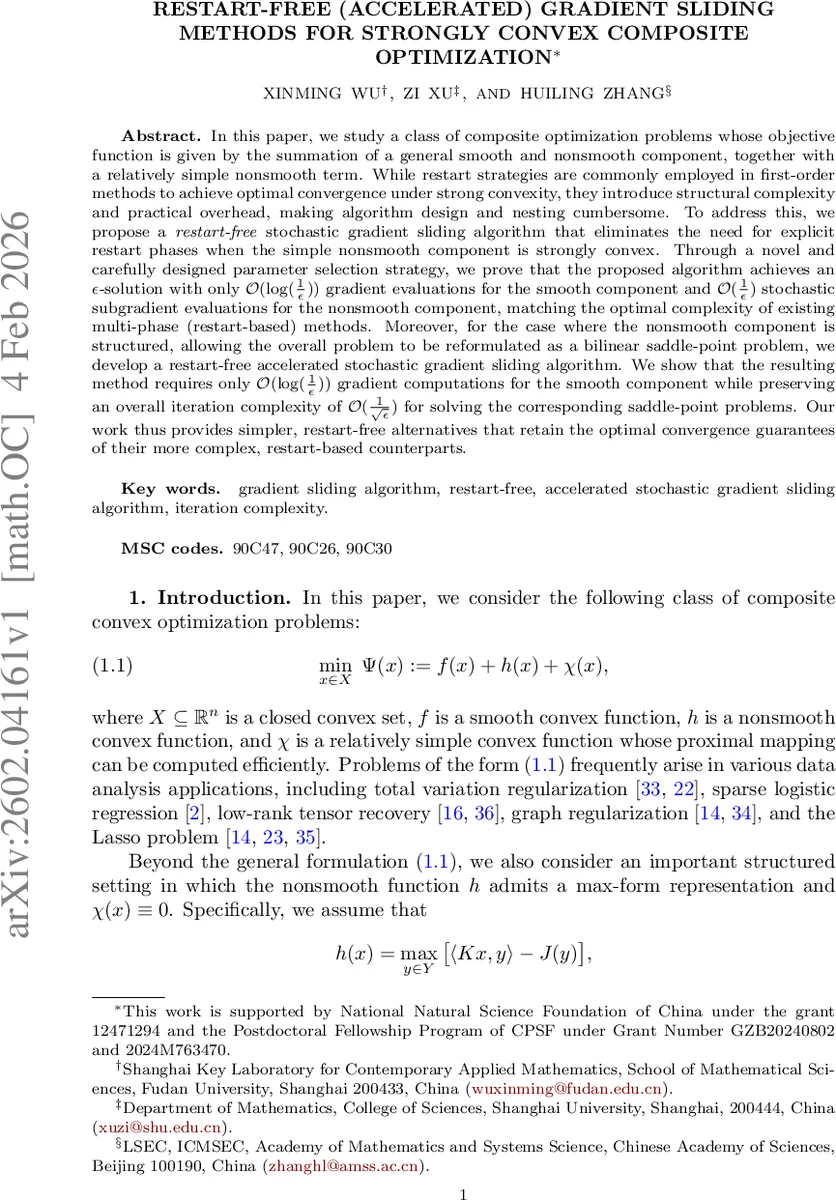
In this paper, we study a class of composite optimization problems whose objective function is given by the summation of a general smooth and nonsmooth component, together with a relatively simple nonsmooth term. While restart strategies are commonly employed in first-order methods to achieve optimal convergence under strong convexity, they introduce structural complexity and practical overhead, making algorithm design and nesting cumbersome. To address this, we propose a \emph{restart-free} stochastic gradient sliding algorithm that eliminates the need for explicit restart phases when the simple nonsmooth component is strongly convex. Through a novel and carefully designed parameter selection strategy, we prove that the proposed algorithm achieves an $ε$-solution with only $\mathcal{O}(\log(\frac{1}ε))$ gradient evaluations for the smooth component and $\mathcal{O}(\frac{1}ε)$ stochastic subgradient evaluations for the nonsmooth component, matching the optimal complexity of existing multi-phase (restart-based) methods. Moreover, for the case where the nonsmooth component is structured, allowing the overall problem to be reformulated as a bilinear saddle-point problem, we develop a restart-free accelerated stochastic gradient sliding algorithm. We show that the resulting method requires only $\mathcal{O}(\log(\frac{1}ε))$ gradient computations for the smooth component while preserving an overall iteration complexity of $\mathcal{O}(\frac{1}{\sqrtε})$ for solving the corresponding saddle-point problems. Our work thus provides simpler, restart-f
💡 Research Summary
The paper addresses the problem of minimizing a composite convex function of the form
\
Comments & Academic Discussion
Loading comments...
Leave a Comment