Asynchronous Reasoning: Training-Free Interactive Thinking LLMs
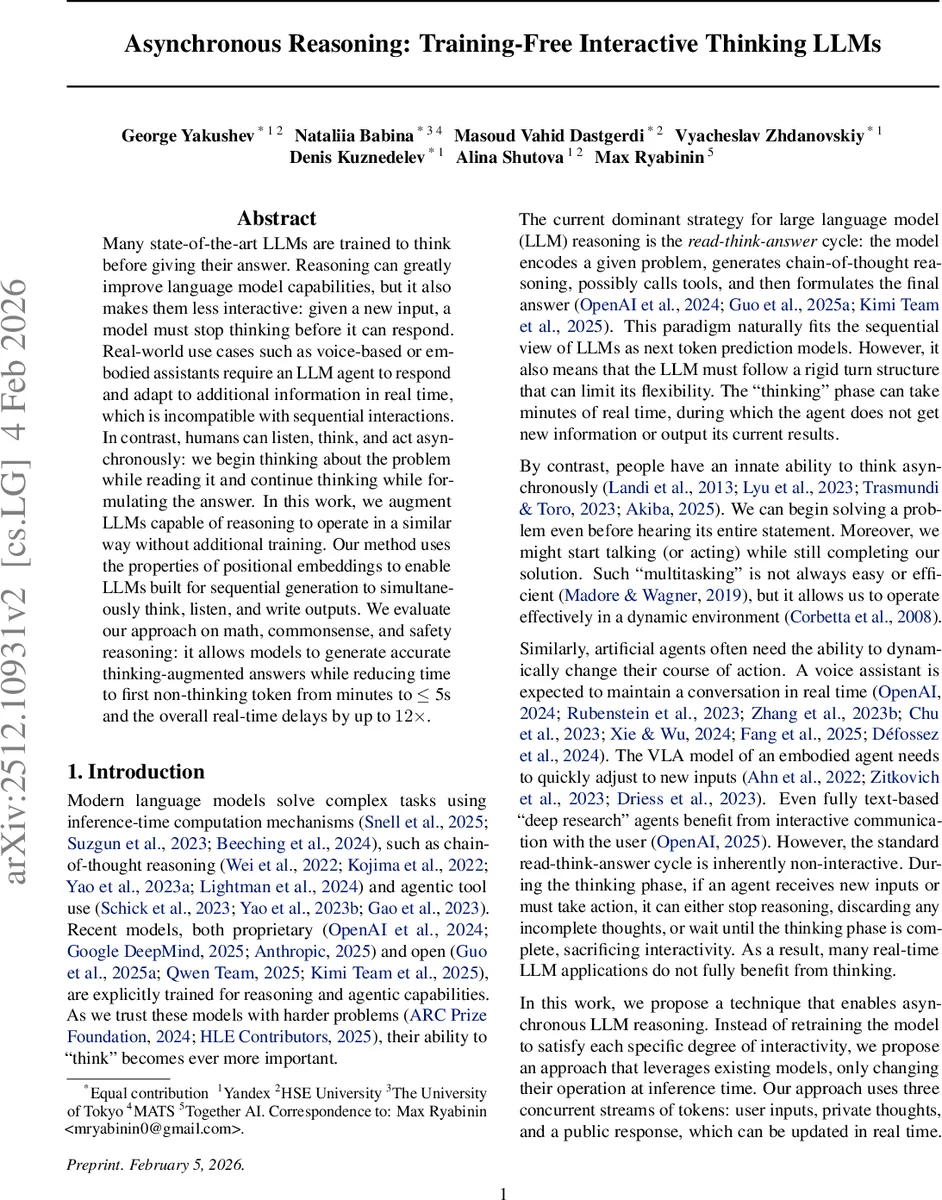
Many state-of-the-art LLMs are trained to think before giving their answer. Reasoning can greatly improve language model capabilities, but it also makes them less interactive: given a new input, a model must stop thinking before it can respond. Real-world use cases such as voice-based or embodied assistants require an LLM agent to respond and adapt to additional information in real time, which is incompatible with sequential interactions. In contrast, humans can listen, think, and act asynchronously: we begin thinking about the problem while reading it and continue thinking while formulating the answer. In this work, we augment LLMs capable of reasoning to operate in a similar way without additional training. Our method uses the properties of positional embeddings to enable LLMs built for sequential generation to simultaneously think, listen, and write outputs. We evaluate our approach on math, commonsense, and safety reasoning: it allows models to generate accurate thinking-augmented answers while reducing time to first non-thinking token from minutes to ${\le}$ 5s and the overall real-time delays by up to $12{\times}$.
💡 Research Summary
The paper addresses a fundamental limitation of current large language models (LLMs) that rely on a sequential “read‑think‑answer” cycle. While chain‑of‑thought reasoning dramatically improves performance on complex tasks, it also forces the model to pause for minutes while it thinks, preventing it from receiving new inputs or producing partial outputs in real time. This latency is unacceptable for applications such as voice assistants, embodied robots, or interactive research agents that must react continuously to user speech, sensor data, or clarification requests.
To overcome this, the authors propose AsyncReasoning, a zero‑shot inference‑time technique that enables existing reasoning‑capable LLMs to think, listen, and write concurrently without any additional training. The method hinges on the observation that transformers only encode order through positional embeddings. By dynamically manipulating the relative positions of tokens in the model’s KV cache, the system can present two logical streams— a private “think” stream (enclosed in
A key component is mode switching. At regular intervals (e.g., after every 20 thinking tokens or at paragraph boundaries) the system inserts a special prompt asking the model whether its private thoughts are still ahead of the public response. By comparing the probabilities of “yes” versus “no” for the next token, the model decides autonomously whether to keep thinking asynchronously or to pause the writer until more reasoning is completed. This self‑regulated synchronization eliminates the need for external control signals and lets the model balance speed and depth of reasoning on the fly.
From an engineering perspective, AsyncReasoning reuses the existing KV cache, only altering positional indices, which incurs negligible memory overhead. The authors implement concurrent attention kernels that process both streams in parallel, integrating seamlessly with popular inference frameworks such as vLLM and FlashAttention. This design ensures that the approach scales to large models (e.g., GPT‑4, LLaMA‑2, Qwen) and runs efficiently on typical GPU hardware.
Empirical evaluation spans three domains: mathematical problem solving (e.g., GSM‑8K, ARC), commonsense reasoning, and safety assessment. Results show that the time to the first non‑thinking token drops from several minutes to ≤ 5 seconds—a speed‑up of up to 80×—and overall user‑perceived latency improves by up to 12×. Accuracy remains on par with or slightly exceeds the baseline read‑think‑answer pipeline, demonstrating that overlapping generation does not sacrifice reasoning quality. In safety experiments, the private think stream can evaluate potential risks while the public response streams harmless content, effectively preventing jailbreak or harmful outputs without delaying the user‑facing answer.
The paper also highlights practical benefits for interactive scenarios. When a user supplies clarification or correction mid‑reasoning, the writer can immediately incorporate the new information, while the thinker continues refining its internal chain of thought. This mirrors human multitasking, where we can speak while still solving a problem mentally.
A reference implementation, including GPU kernels for concurrent attention and a minimal voice‑assistant demo, is released on GitHub. The code demonstrates how to plug AsyncReasoning into existing LLM deployments with only a few lines of inference‑wrapper code, making the technique readily adoptable for industry and research.
In summary, AsyncReasoning introduces a conceptually simple yet powerful way to transform any pre‑trained reasoning LLM into an asynchronous, real‑time conversational agent. By leveraging positional‑embedding geometry to interleave thinking and writing streams, it achieves dramatic latency reductions while preserving (or even enhancing) reasoning performance and safety. This work opens a new avenue for deploying LLMs in latency‑sensitive, interactive environments without the cost of additional fine‑tuning or architectural overhaul.
Comments & Academic Discussion
Loading comments...
Leave a Comment