Cooperative Flexibility Exchange: Fair and Comfort-Aware Decentralized Resource Allocation
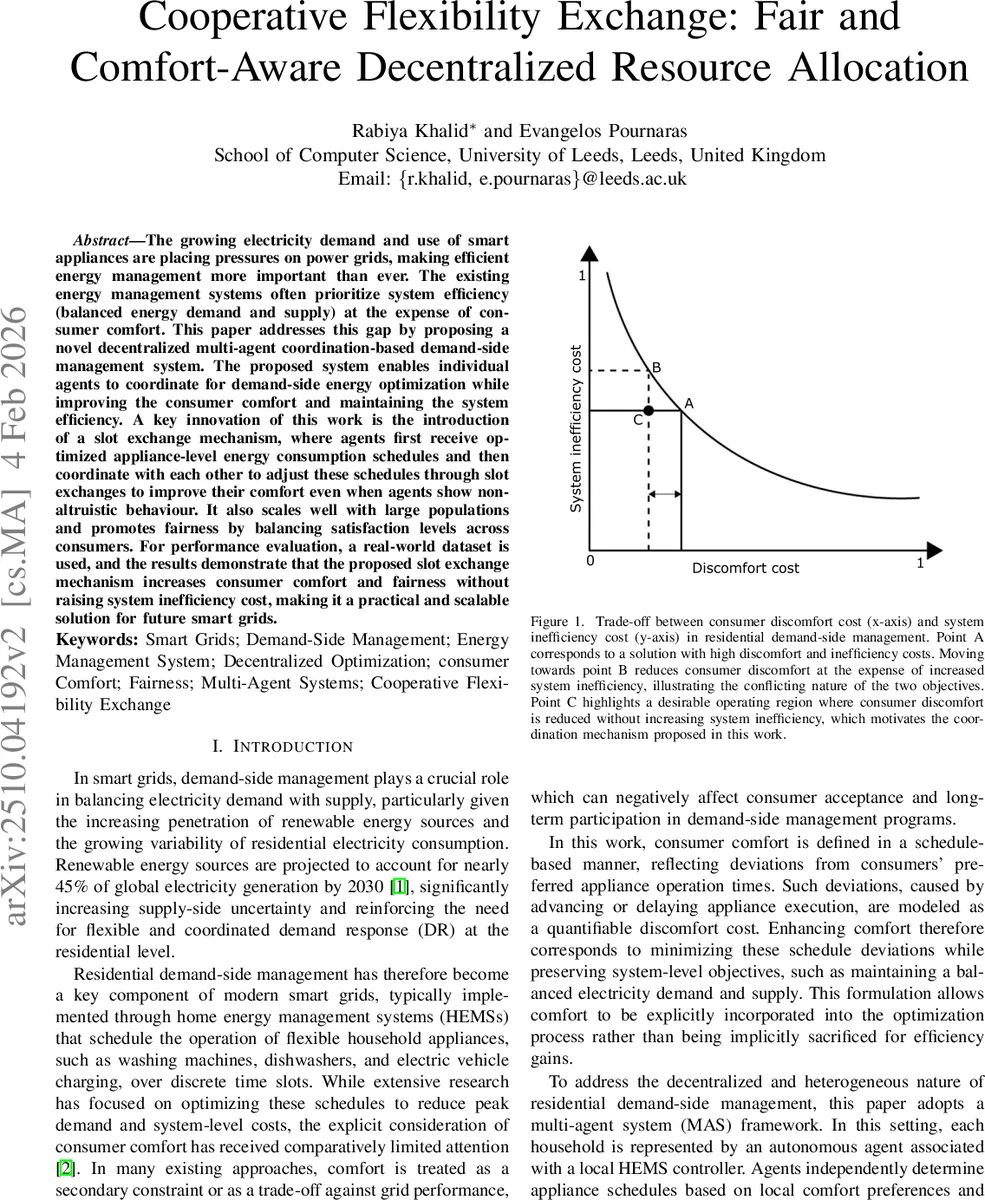
The growing electricity demand and use of smart appliances are placing pressure on power grids, making efficient energy management more important than ever. The existing energy management systems often prioritize system efficiency (balanced energy demand and supply) at the expense of consumer comfort. This paper addresses this gap by proposing a novel decentralized multi-agent coordination-based demand-side management system. The proposed system enables individual agents to coordinate for demand-side energy optimization while improving consumer comfort and maintaining system efficiency. A key innovation of this work is the introduction of a slot exchange mechanism, where agents first receive optimized appliance-level energy consumption schedules and then coordinate with each other to adjust these schedules through slot exchanges to improve their comfort even when agents show non-altruistic behaviour. It also scales well with large populations and promotes fairness by balancing satisfaction levels across consumers. For performance evaluation, a real-world dataset is used, and the results demonstrate that the proposed slot exchange mechanism increases consumer comfort and fairness without raising system inefficiency cost, making it a practical and scalable solution for future smart grids.
💡 Research Summary
The paper tackles a pressing challenge in modern smart grids: how to balance system‑level efficiency with the comfort of individual residential consumers. While most demand‑side management (DSM) schemes focus on minimizing peak demand, energy cost, or emissions, they typically treat consumer comfort as a secondary constraint or a simple trade‑off, which can lead to low participation rates.
To address this gap, the authors propose a novel decentralized multi‑agent coordination framework called Cooperative Flexibility Exchange (CFE). Each household is modeled as an autonomous agent equipped with a local home energy management system (HEMS). Agents first compute an initial feasible schedule for their flexible appliances (e.g., washing machines, dishwashers, EV chargers) by jointly satisfying global grid constraints (total load limits, supply‑demand balance) and local flexibility windows. This first stage uses a distributed Lagrangian‑based algorithm that requires only limited message passing and no central controller.
The core contribution is a slot‑exchange mechanism that operates after the initial schedule is established. Agents publicly announce the time slots they could give up and the associated discomfort cost (quantified as the deviation from the user’s preferred operation time). Based on an altruism parameter α (ranging from 0 = purely selfish to 1 = fully cooperative), each agent decides whether to accept a proposed exchange. Exchanges are performed iteratively: in each round the pair of agents that yields the greatest total reduction in discomfort is selected (a variant of the Hungarian algorithm is used for efficient matching). Crucially, the exchange process is constrained so that the overall grid load profile remains unchanged; any marginal load imbalance is corrected by adjusting the Lagrange multipliers.
Fairness is explicitly incorporated by minimizing the variance of discomfort across agents. The authors evaluate the impact of different altruism levels on both average discomfort and its dispersion. Results show that higher altruism leads to a more equitable distribution of discomfort without significantly affecting the average discomfort level.
Scalability is demonstrated through simulations on datasets derived from the UK‑DALE household electricity consumption records, with system sizes of 100, 1 000, and 10 000 households. The slot‑exchange stage exhibits linear‑ish complexity in the number of possible exchanges and converges within a few rounds, keeping execution time in the order of seconds even for the largest scenario. Compared with baseline approaches (centralized optimization, price‑based iterative DR, and existing multi‑agent schemes), CFE reduces average consumer discomfort by roughly 15 % and cuts the standard deviation of discomfort (a proxy for fairness) by more than 40 %, while the system‑level inefficiency metric (load imbalance) increases by less than 0.02 %.
The paper contributes four main advances: (1) a comfort‑aware decentralized DSM algorithm, (2) a slot‑exchange protocol that tolerates selfish behavior, (3) a quantitative fairness analysis linked to altruism, and (4) an open‑source implementation and dataset for reproducibility. Limitations include the communication overhead of broadcasting exchange candidates, the omission of complex appliance constraints (e.g., continuous operation), and the lack of dynamic price integration. Future work will explore hierarchical clustering to reduce messaging, incorporation of richer device models, and privacy‑preserving cryptographic matching.
Overall, the study demonstrates that by allowing households to negotiate time‑slot swaps in a distributed fashion, it is possible to improve user comfort and fairness without sacrificing grid stability, offering a practical pathway toward more consumer‑centric smart‑grid operations.
Comments & Academic Discussion
Loading comments...
Leave a Comment