Advection selects pattern in multistable emulsions of active droplets
Controlling the size of droplets, for example in biological cells, is challenging because large droplets typically outcompete smaller droplets due to surface tension. This coarsening is generally accelerated by hydrodynamic effects, but active chemical reactions can suppress it. We show that the interplay of these processes leads to three different dynamical regimes: (1) Advection dominates the coalescence of small droplets, (2) diffusion leads to Ostwald ripening for intermediate sizes, and (3) reactions finally suppress coarsening. Interestingly, a range of final droplet sizes is stable, of which one is selected depending on initial conditions. Our analysis demonstrates that hydrodynamic effects control initial droplet sizes, but they do not affect the later dynamics, in contrast to passive emulsions.
💡 Research Summary
In this paper the authors investigate how the size and spatial organization of droplets in multistable emulsions are controlled when both hydrodynamic advection and active chemical reactions are present. They consider a minimal model of an isothermal, incompressible fluid containing two chemical species A and B. The state of the system is described by the concentration field c(r,t) of species A, which evolves according to a material derivative that includes advection by the velocity field v, diffusion with mobility Λ, and a linear, non‑thermodynamic reaction term k(c‑c₀) that drives the system away from the thermodynamic equilibrium concentration c₀. The free energy F has a Ginzburg–Landau form, providing a double‑well bulk term and a gradient term that yields an interfacial tension γ and a characteristic interface width w.
The fluid velocity obeys the Stokes equations (viscous stresses balanced by pressure and the body force c∇µ) because inertial effects are negligible. By estimating the characteristic velocity scale v ~ γ/η, the authors define a Péclet number Pe = w²ac_in²/(Dη). Using realistic molecular parameters they find Pe ≈ 19, indicating that advection can be significant.
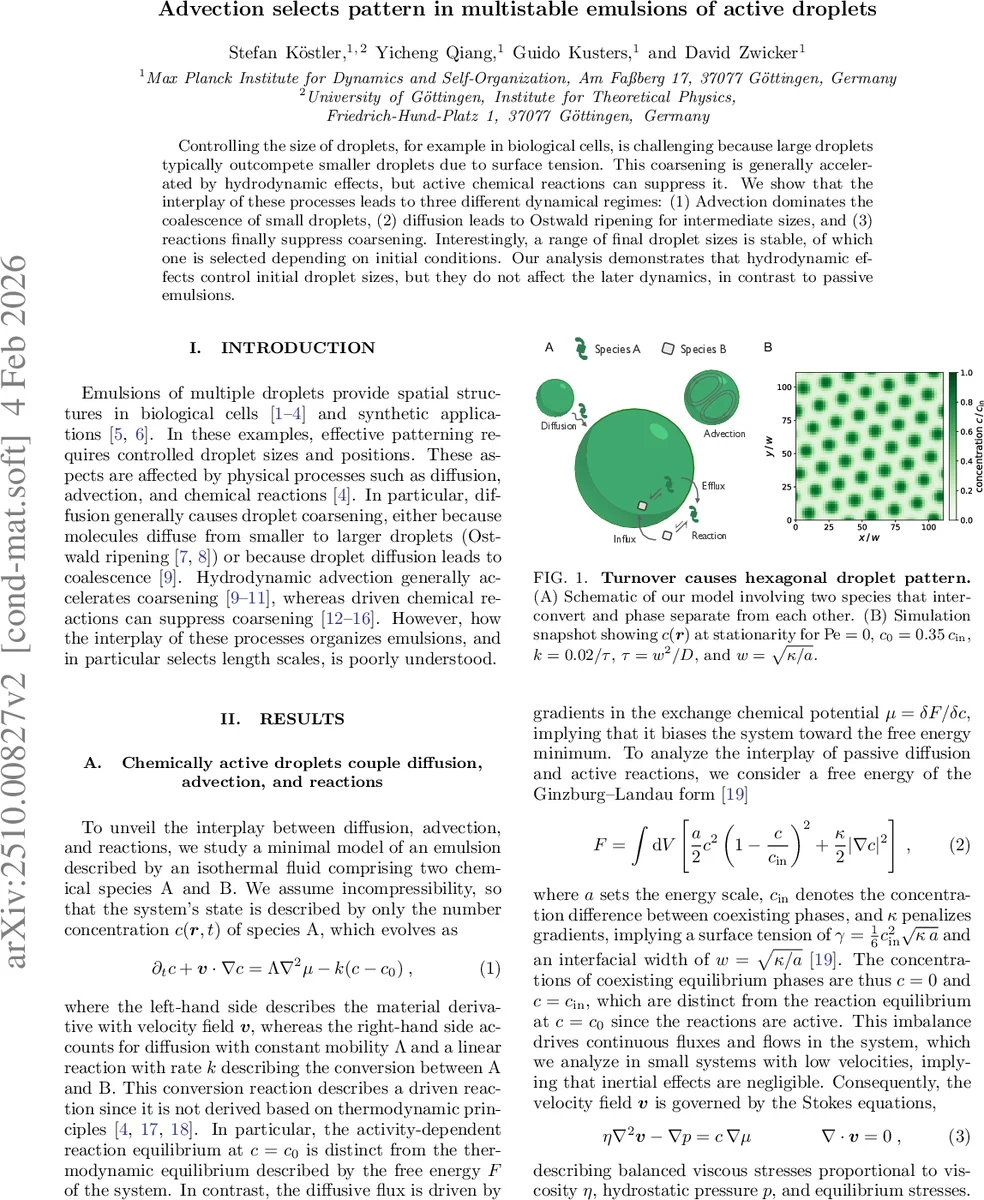
First, the authors set Pe = 0 (no flow) and explore the interplay of diffusion and reactions. Numerical simulations in two dimensions show that active reactions suppress coarsening and lead to a hexagonal droplet lattice. By mapping the active system onto an equivalent passive system with a non‑local interaction potential ψ that satisfies a Poisson equation, they interpret droplets as positively charged disks surrounded by a negative charge cloud extending over the reaction‑diffusion length ξ = D/k. Minimizing the surrogate free energy ˜F yields an analytical expression for the equilibrium lattice spacing L_eq, which scales as k⁻¹/³. This prediction matches simulation data across a range of reaction rates and average concentrations c₀.
Next, the authors examine the dynamics toward the stationary state. Starting from a slightly perturbed homogeneous phase, spinodal decomposition generates droplets with a narrow size distribution. The mean pattern size ¯L grows as t¹ᐟ³, consistent with Lifshitz–Slyozov–Wagner Ostwald ripening, before saturating at a value set by the reaction rate. The droplet‑size distribution follows the universal form expected for coarsening, but becomes sharply peaked near the stationary state.
A crucial observation is that the final pattern size depends on the initial droplet size. By varying the initial average droplet radius while keeping the total material constant, the authors find that small initial droplets coarsen, whereas large droplets remain essentially unchanged. This indicates a continuum of metastable states bounded below by a minimal stable size L_min, which depends on c₀ (and scales as k⁻¹/³). Linear stability analysis of a droplet surrounded by neighbors yields an expression for the minimal stable radius R_min, and the corresponding L_min captures the trend observed in simulations. For very large droplets, shape instabilities (splitting, elongation) appear, defining a maximal stable size L_max.
The role of advection is then investigated by re‑introducing a finite Pe. Direct numerical integration of the full coupled equations (1)–(3) shows that hydrodynamic flow accelerates coarsening for all reaction rates. In the passive case (k = 0) the early stage follows the viscous coalescence regime with ¯L ∝ t, then crosses over to Ostwald ripening (¯L ∝ t¹ᐟ³). A transient plateau where the pattern size changes little is observed, suggesting that advection delays the onset of diffusion‑driven ripening. When reactions are present, the early dynamics are essentially identical to the passive case, but the coarsening eventually halts at a reaction‑controlled size. For weak reactions the Ostwald regime is still visible; for strong reactions it disappears entirely. Importantly, the final pattern size becomes independent of Pe for weak reactions but shows a systematic dependence on Pe for stronger reactions, reflecting the multistability described earlier.
Energy dissipation analysis reveals that viscous (advective) dissipation dominates early on but decays rapidly, while diffusive dissipation peaks early and then declines more slowly. During the plateau both contributions are comparable, indicating that both advection and diffusion are active throughout coarsening. In the stationary state, diffusive dissipation remains much larger than viscous dissipation, confirming that the flow field becomes negligible while reactions continue to drive chemical potential gradients.
Overall, the study identifies three distinct dynamical regimes in active emulsions: (1) advection‑dominated coalescence of small droplets, (2) diffusion‑driven Ostwald ripening for intermediate sizes, and (3) reaction‑induced arrest of coarsening leading to a family of stable droplet lattices. Hydrodynamic advection selects the initial pattern length scale but does not dictate the final size, which is set by the reaction kinetics and the average composition. These findings provide a mechanistic framework for understanding size control in biological condensates and for designing synthetic active emulsions with tunable droplet sizes.
Comments & Academic Discussion
Loading comments...
Leave a Comment