General Theory for Group Resetting with Application to Avoidance
We present a general theoretical framework for group resetting dynamics in a potential landscape. While traditional resetting models typically focus on a single particle, we consider a group of particles whose collective dynamics govern the resetting. We extend existing resetting theories to cover extreme-value group resetting. This has applications from bacterial evolution under antibiotic pressure to swarm-search optimization. Using renewal theory, we derive a Fokker-Planck equation for the spatial distribution of the group’s center of mass, treated as an effective particle. This formalism yields analytical expressions for key observables such as the stationary mean position and variance. We also study a group avoidance problem, where the particles must avoid an undesirable region. Such problems have recently been studied in contexts such as preventing critically high water levels in dams and controlling excessive financial leverage. Our framework offers new insight into how resetting can optimize group-level search and avoidance strategies.
💡 Research Summary
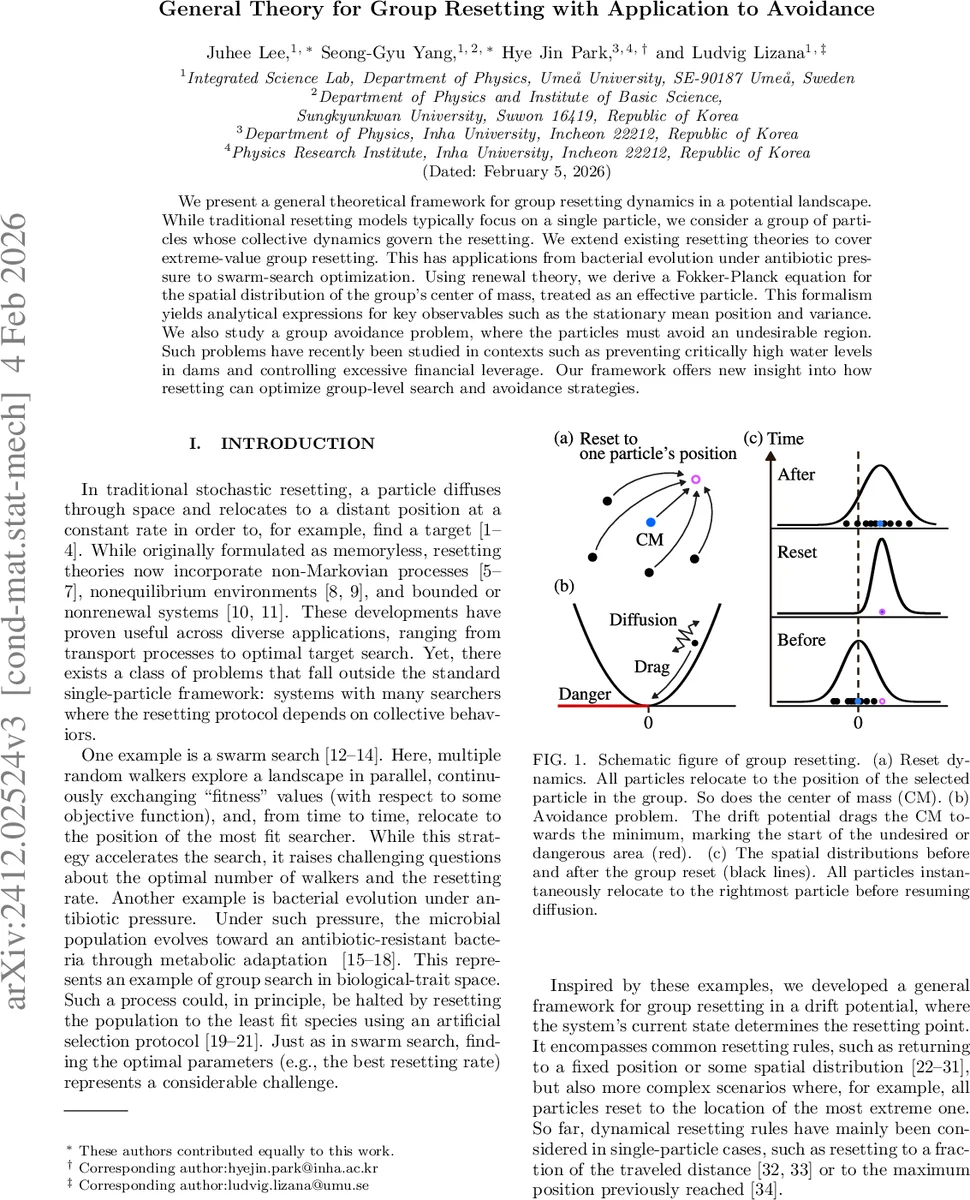
The manuscript introduces a comprehensive theoretical framework for “group resetting,” a process in which a collection of diffusing particles is collectively relocated according to a rule that depends on the instantaneous configuration of the whole group. While most existing resetting studies focus on a single particle that intermittently jumps to a fixed point or a prescribed distribution, many real‑world systems involve many searchers whose resetting protocol is determined by a collective extreme‑value statistic (e.g., the position of the rightmost particle). The authors formalize this situation for n overdamped Brownian particles moving in a one‑dimensional potential V(x) and subject to a constant resetting rate r.
The key methodological step is to treat the center of mass (CM) ζ(t)= (1/n)∑_{i=1}^{n} x_i(t) as an “effective particle.” The probability density P(ζ,t) obeys a Fokker‑Planck equation (Eq. 1) that includes drift, diffusion, and the loss‑gain terms associated with resetting. The reinjection distribution R(ζ,t) is obtained via renewal theory (Eq. 2), which requires the kernel K_n(ζ|ζ′;τ) – the probability that after a time τ the effective particle is reset to the extreme value of the underlying n particles. For large n this kernel converges to a Gumbel distribution, a classic result of extreme‑value statistics (Fisher‑Tippett‑Gnedenko theorem).
To make the problem analytically tractable the authors specialize to a harmonic potential V(x)=k x²/2, which renders each particle an Ornstein‑Uhlenbeck (OU) process. The OU propagator provides explicit expressions for the mean x(ζ′,τ)=ζ′ e^{‑kτ} and variance σ²(ζ′,τ)= D/k
Comments & Academic Discussion
Loading comments...
Leave a Comment