Local strong solutions in a quasilinear Moore-Gibson-Thompson type model for thermoviscoelastic evolution in a standard linear solid
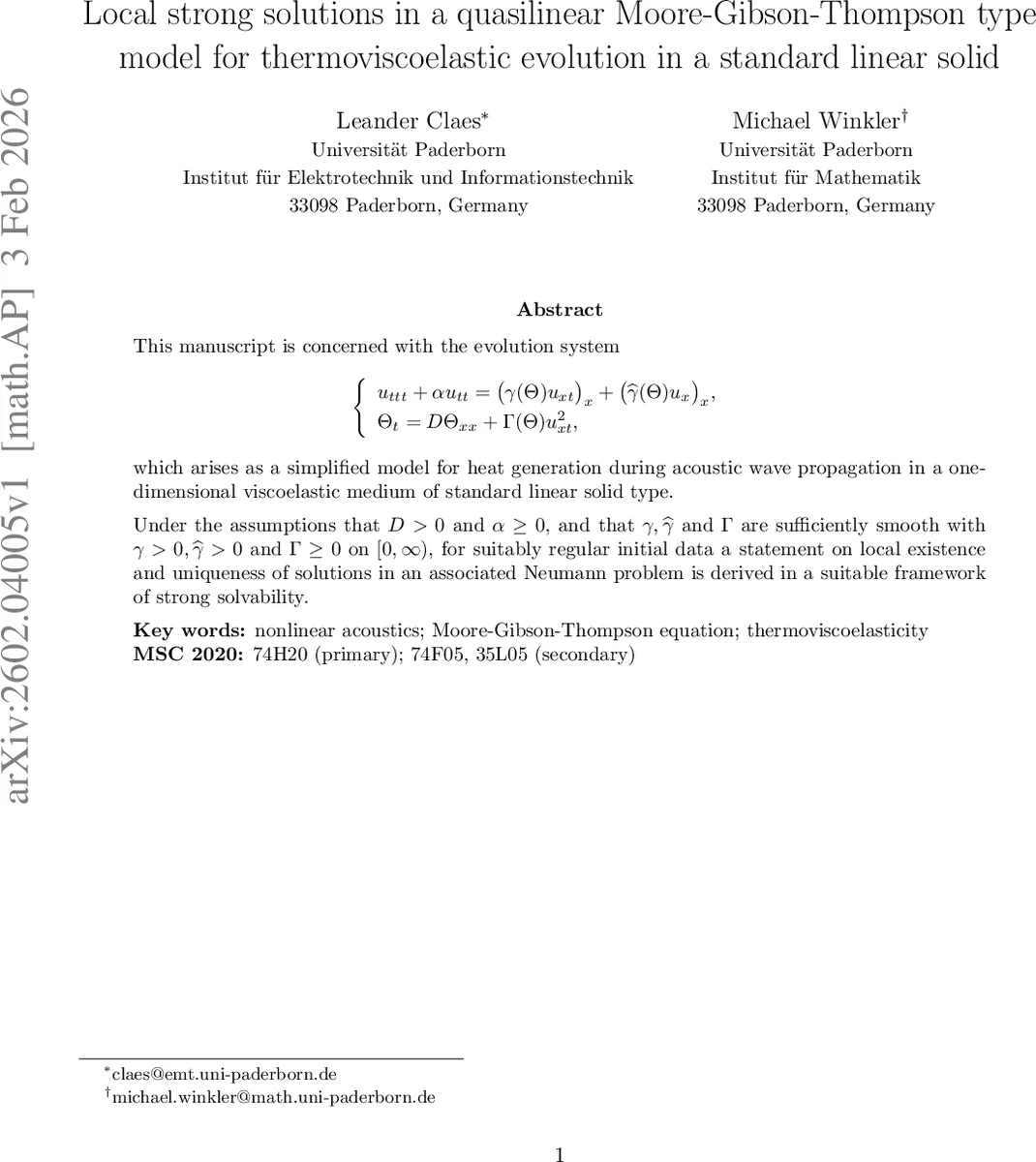
This manuscript is concerned with the evolution system [ \left{ \begin{array}{l} u_{ttt} + αu_{tt} = \big(γ(Θ) u_{xt}\big)x + \big( \widehatγ(Θ) u_x\big)x, Θ_t = D Θ{xx} + Γ(Θ) u{xt}^2, \end{array} \right. ] which arises as a simplified model for heat generation during acoustic wave propagation in a one-dimensional viscoelastic medium of standard linear solid type. Under the assumptions that $D>0$ and $α\ge 0$, and that $γ, \widehatγ$ and $Γ$ are sufficiently smooth with $γ>0, \widehatγ>0$ and $Γ\ge 0$ on $[0,\infty)$, for suitably regular initial data a statement on local existence and uniqueness of solutions in an associated Neumann problem is derived in a suitable framework of strong solvability.
💡 Research Summary
The paper investigates a coupled system that models the conversion of mechanical energy into heat during high‑frequency acoustic wave propagation in a one‑dimensional visco‑elastic medium of standard linear solid (Zener) type. The mechanical part is described by a quasilinear Moore‑Gibson‑Thompson (MGT) equation with third‑order time derivative, while the thermal part follows a diffusion equation with a source term proportional to the square of the strain rate. The governing equations read
\
Comments & Academic Discussion
Loading comments...
Leave a Comment