Large-data global solutions to a quasilinear model for viscuos acoustic wave propagation in a non-isothermal setting
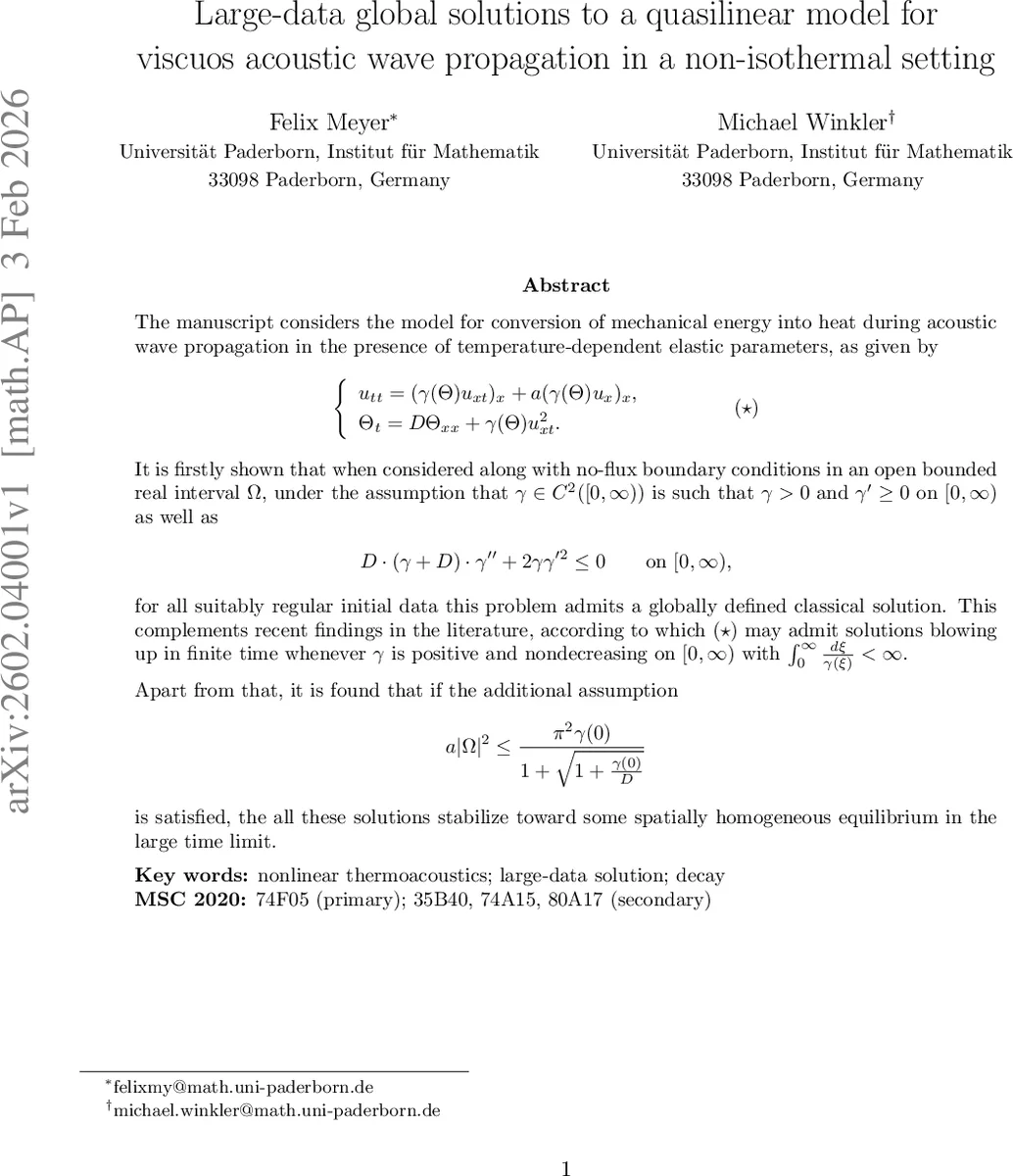
The manuscript considers the model for conversion of mechanical energy into heat during acoustic wave propagation in the presence of temperature-dependent elastic parameters, as given by [ \left{ \begin{array}{l} u_{tt} = (γ(Θ) u_{xt})x + a (γ(Θ) u_x)x, \[1mm] Θ_t = DΘ{xx} + γ(Θ) u{xt}^2. \end{array} \right. \qquad \qquad (\star) ] It is firstly shown that when considered along with no-flux boundary conditions in an open bounded real interval $Ω$, under the assumption that $γ\in C^2([0,\infty))$ is such that $γ>0$ and $γ’\ge 0$ on $[0,\infty)$ as well as [ D\cdot (γ+D) \cdot γ’’ + 2γγ’^2 \le 0 \qquad \mbox{on } [0,\infty), ] for all suitably regular initial data this problem admits a globally defined classical solution. This complements recent findings in the literature, according to which ($\star$) may admit solutions blowing up in finite time whenever $γ$ is positive and nondecreasing on $[0,\infty)$ with $\int_0^\infty \frac{dξ}{γ(ξ)} < \infty$. Apart from that, it is found that if the additional assumption [ a|Ω|^2 \le \frac{π^2 γ(0)}{1+\sqrt{1+\frac{γ(0)}{D}}} ] is satisfied, the all these solutions stabilize toward some spatially homogeneous equilibrium in the large time limit.
💡 Research Summary
The paper investigates a one‑dimensional quasilinear system that models the conversion of mechanical energy into heat during acoustic wave propagation in a medium whose elastic modulus depends on temperature. The governing equations are
\
Comments & Academic Discussion
Loading comments...
Leave a Comment