Matchings: Source, Goal and Faithful Companion
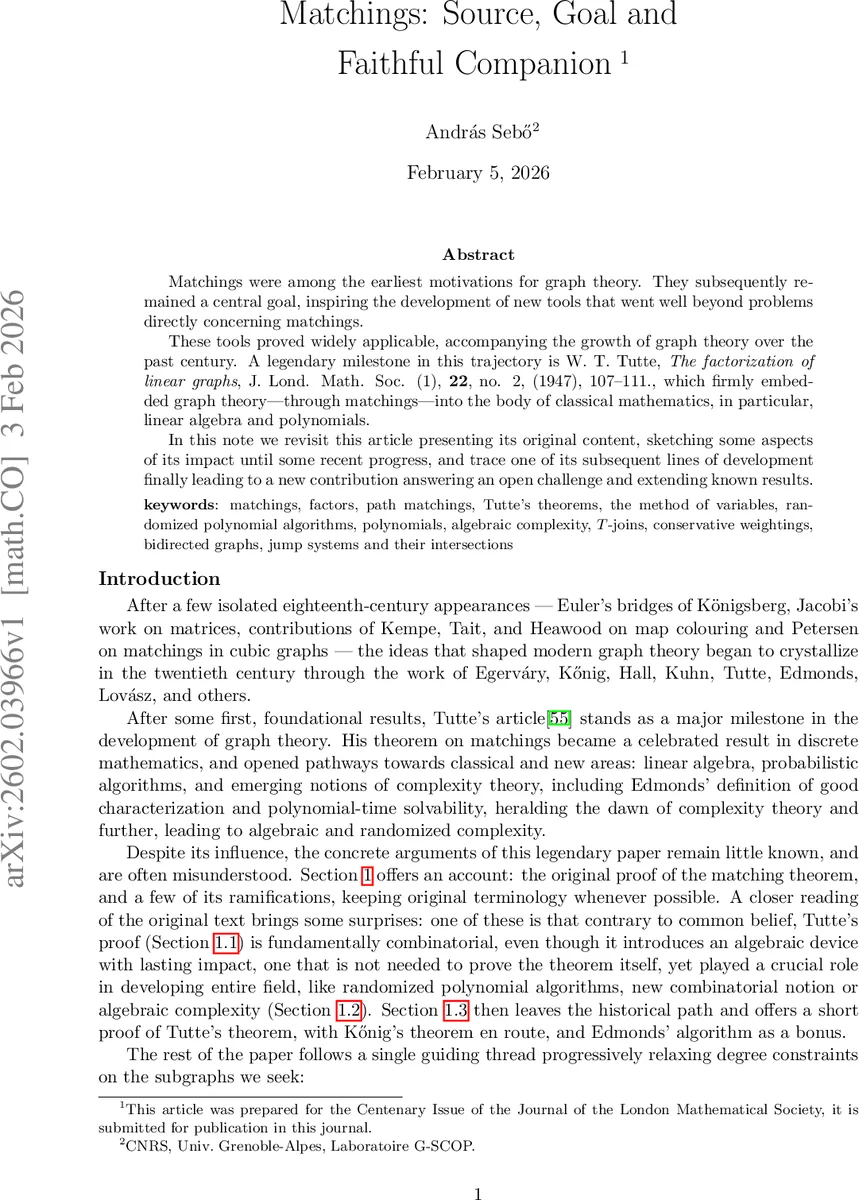
Matchings were among the earliest motivations for graph theory. They subsequently remained a central goal, inspiring the development of new tools that went well beyond problems directly concerning matchings. These tools proved widely applicable, accompanying the growth of graph theory over the past century. A legendary milestone in this trajectory is W. T. Tutte, “The factorization of linear graphs,” J. Lond. Math. Soc. (1), 22, no. 2, (1947), 107-111, which firmly embedded graph theory through matchings into the body of classical mathematics, in particular, linear algebra and polynomials. In this note we revisit this article presenting its original content, sketching some aspects of its impact until some recent progress, and trace one of its subsequent lines of development finally leading to a new contribution answering an open challenge and extending known results.
💡 Research Summary
The paper revisits William T. Tutte’s seminal 1947 article “The factorization of linear graphs,” which introduced the celebrated Tutte‑matching theorem. After a brief historical overview that places Tutte’s work among earlier contributions by Euler, König, Hall, and later pioneers such as Edmonds and Lovász, the authors present a faithful reconstruction of Tutte’s original proof. Tutte’s argument hinges on a skew‑symmetric matrix M_G whose entries are indeterminates associated with the edges of a graph G. The determinant of M_G equals the square of the Pfaffian (Pf_G), a classical identity due to Muir. Lemma 1.1 shows that a graph is “prime” (i.e., has no perfect matching) precisely when det M_G is identically zero. A more intricate Pfaffian identity involving four distinct vertices (equation (1)) is then used to relate the existence of perfect matchings in various vertex‑deleted subgraphs.
The authors demonstrate that the essential combinatorial content of Tutte’s proof can be extracted without any heavy algebra. By interpreting the Pfaffian identity combinatorially, they replace it with a simple argument about the symmetric difference of two perfect matchings in the subgraphs G − {i,k} and G − {j,l}. This symmetric difference decomposes into alternating paths and cycles; the impossibility of certain path configurations forces the remaining vertices to be paired in a way that yields the desired perfect matchings. Thus Lemma 1.2, the key step in Tutte’s original reasoning, admits a purely graph‑theoretic proof, and the whole theorem follows from this streamlined approach.
The paper then surveys the cascade of developments that stemmed from Tutte’s algebraic machinery. The Tutte matrix generalizes the bipartite Edmonds matrix, allowing the determinant (a multivariate polynomial) to be evaluated at random points. By invoking the Schwartz–Zippel lemma, one obtains a Monte‑Carlo algorithm that decides the existence of a perfect matching in RP time. Repeating the test and performing edge deletions yields an actual matching, and the same technique extends to the maximum‑matching problem in bipartite graphs. For general graphs, the Tutte matrix is indispensable; Lovász later leveraged it to devise a randomized algorithm for matroid matching, and Geelen subsequently derandomized the approach for ordinary graphs.
In the later sections the authors turn to two modern research threads: the “general factor problem” and “jump systems.” The general factor problem asks for a subgraph respecting prescribed lower and upper degree bounds together with parity constraints at each vertex. Building on Lovász’s and Cornuéjols’s work, the paper presents a unified algorithmic framework that computes the minimum deficiency of such a factor in polynomial time, even when both parity and bound constraints are present.
Jump systems, introduced by Lovász as an abstract independence structure, are shown to be closely related to graph factors. By mapping jump‑system intersections to factor constraints, the authors obtain a new polynomial‑time algorithm that simultaneously solves a class of jump‑system feasibility problems and the corresponding factor problem. The Tutte‑Pfaffian identity again plays a central role in establishing tractability.
Finally, the authors resolve an open question left by Tutte concerning the structural characterization of graphs that lack a perfect matching yet remain “hyper‑prime” (every pair of vertices removed still yields a prime graph). They prove that in any hyper‑prime graph all non‑singular vertices induce a complete subgraph, thereby strengthening the classic odd‑component bound. This result not only refines the original Tutte theorem but also yields tighter bounds for the general factor and jump‑system settings.
In conclusion, the paper demonstrates that Tutte’s 1947 theorem is far more than a combinatorial curiosity; its algebraic underpinnings sparked a rich interplay between linear algebra, randomized algorithms, matroid theory, and modern combinatorial optimization. The new structural theorem and the unified algorithmic treatment of factors and jump systems constitute fresh contributions that extend Tutte’s legacy into contemporary research frontiers.
Comments & Academic Discussion
Loading comments...
Leave a Comment