On the existence of global cross sections to volume-preserving flows
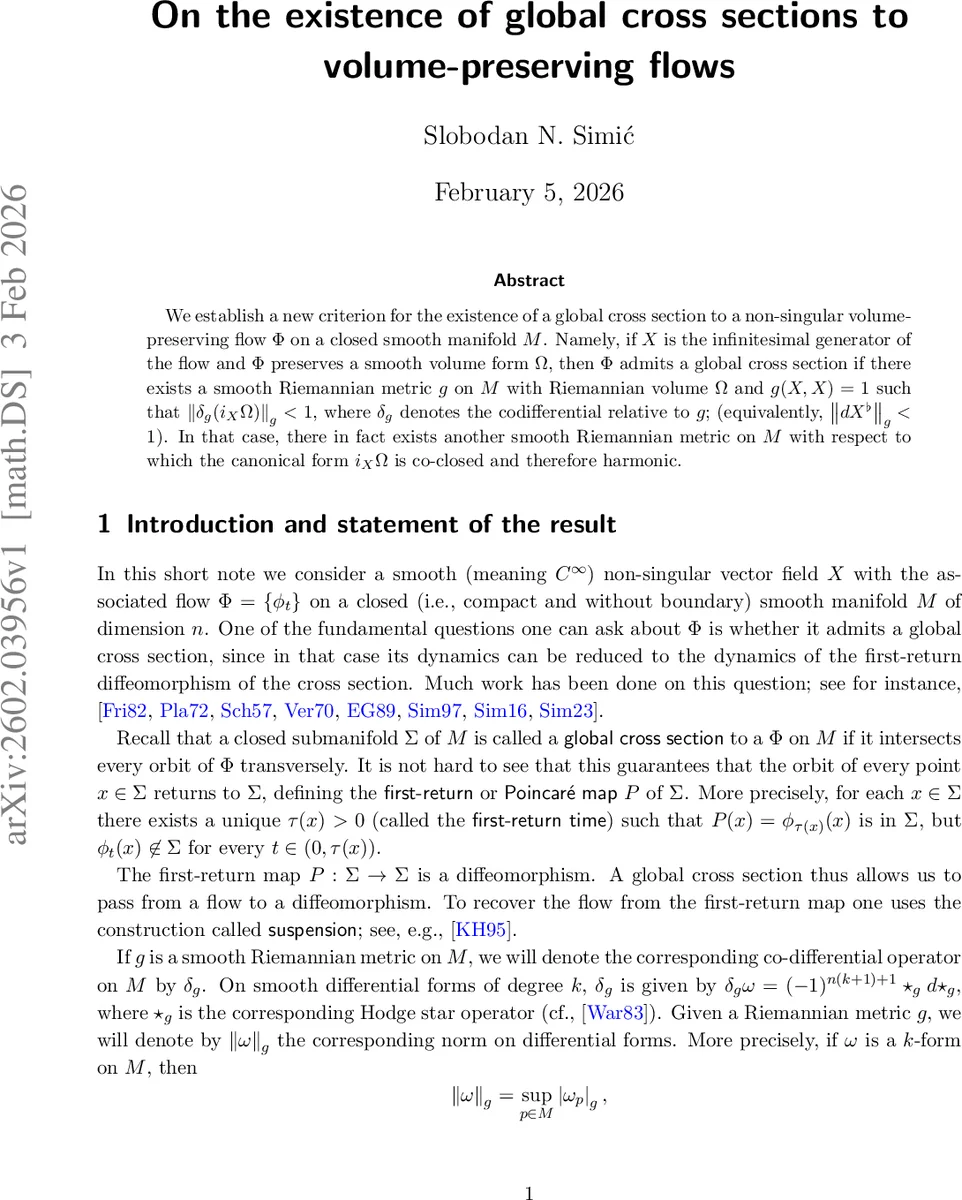
We establish a new criterion for the existence of a global cross section to a non-singular volume-preserving flow $Φ$ on a closed smooth manifold $M$. Namely, if $X$ is the infinitesimal generator of the flow and $Φ$ preserves a smooth volume form $Ω$, then $Φ$ admits a global cross section if there exists a smooth Riemannian metric $g$ on $M$ with Riemannian volume $Ω$ and $g(X,X) = 1$ such that $\lVert δ_g (i_X Ω) \rVert_g < 1$, where $δ_g$ denotes the codifferential relative to $g$; (equivalently, $\lVert dX^\flat \rVert_g < 1$). In that case, there in fact exists another smooth Riemannian metric on $M$ with respect to which the canonical form $i_X Ω$ is co-closed and therefore harmonic.
💡 Research Summary
The paper investigates the long‑standing problem of determining when a smooth, non‑singular, volume‑preserving flow Φ on a closed smooth manifold M admits a global cross‑section. A global cross‑section is a closed codimension‑one submanifold intersecting every orbit transversely, allowing the flow to be reduced to the first‑return (Poincaré) map on that submanifold.
The main result provides a new analytic criterion expressed in terms of the infinitesimal generator X of the flow, the invariant volume form Ω, and a Riemannian metric g whose Riemannian volume coincides with Ω. If one can choose g so that g(X,X)=1 and the codifferential of the (n‑1)‑form i_XΩ satisfies
‖δ_g(i_XΩ)‖_g < m_g(X)^2,
where m_g(X)=inf_{p∈M}‖X(p)‖_g (equivalently ‖dX^♭‖_g < m_g(X)^2), then Φ possesses a global cross‑section. Moreover, under the same hypothesis M is a fiber bundle over S¹.
The proof proceeds as follows. Define the 1‑form θ_X = X^♭. Using the Hodge star, one shows that ‖dθ_X‖_g = ‖δ_g(i_XΩ)‖_g. Proposition 1.5 (proved in the paper) states that for any C^r‑form ξ, the C⁰‑norm of dξ bounds the distance from ξ to the space of closed forms. Applying this to θ_X yields a closed 1‑form ω with ‖θ_X−ω‖_g < m_g(X)^2. Because ω(X) = ω(X)−θ_X(X)+θ_X(X) ≥ −‖ω−θ_X‖_g·‖X‖_g + m_g(X)^2 > 0, ω evaluates positively on X everywhere. Consequently, the kernel distribution Ker ω is a smooth, codimension‑one, integrable plane field transverse to X. Its integral manifolds N_p are (n‑1)‑dimensional submanifolds on which the restriction of i_XΩ is a volume form.
Honda’s 1997 theorem characterizes intrinsically harmonic (n‑1)‑forms as those that restrict to volume forms on a family of (n‑1)‑dimensional submanifolds through every point. Hence i_XΩ is intrinsically harmonic. Simic’s 2023 theorem then asserts that a volume‑preserving flow admits a global cross‑section if and only if i_XΩ is intrinsically harmonic. Therefore the metric condition guarantees the existence of a global cross‑section. By Plante’s result, the existence of such a section forces M to be a bundle over the circle.
The paper also discusses the extremal case δ_g(i_XΩ)=0, where i_XΩ becomes both closed and co‑closed, i.e., harmonic with respect to g, and the flow already has a global cross‑section. As a contrasting example, for the geodesic flow on the unit tangent bundle S N of a compact Riemannian manifold N, any metric g with g(X,X)=1 and volume form equal to the Liouville volume satisfies ‖δ_g(i_XΩ)‖_g ≥ 1, showing that the inequality cannot be satisfied and confirming that geodesic flows lack global cross‑sections.
Overall, the work bridges dynamical systems, differential geometry, and Hodge theory. It supplies a concrete, computable analytic condition—norm of the codifferential of i_XΩ relative to the minimal speed of the flow—that guarantees a global cross‑section, thereby extending and unifying earlier topological criteria (e.g., Anosov, Verjovsky) with a harmonic‑form perspective. The result is both theoretically elegant and potentially useful for verifying cross‑section existence in concrete volume‑preserving flows.
Comments & Academic Discussion
Loading comments...
Leave a Comment