Recent advances in Brill--Noether theory and the geometry of Brill--Noether curves
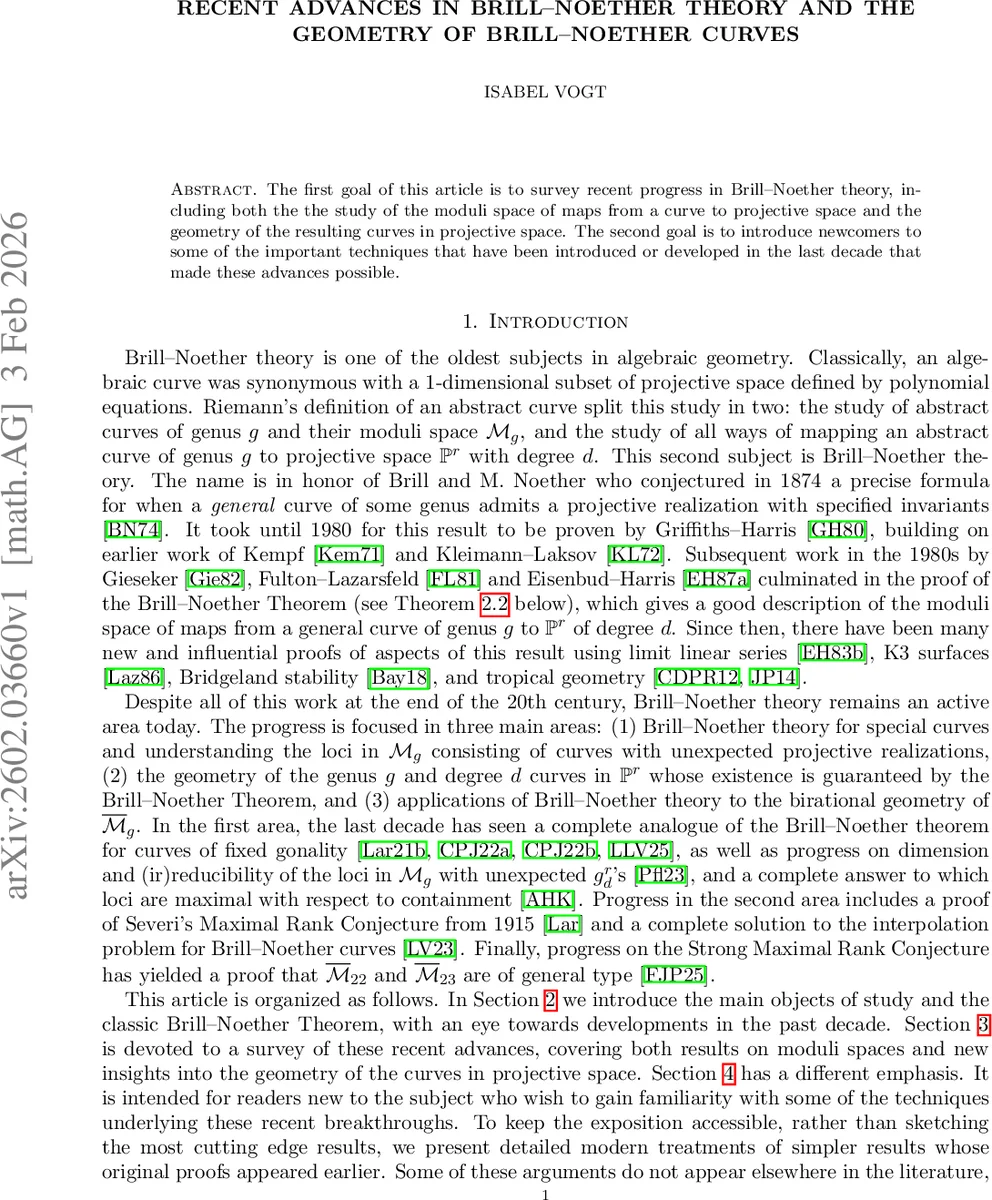
The first goal of this article is to survey recent progress in Brill–Noether theory, including both the study of the moduli space of maps from a curve to projective space and the geometry of the resulting curves in projective space. The second goal is to introduce newcomers to some of the important techniques that have been introduced or developed in the last decade that made these advances possible.
💡 Research Summary
The paper provides a comprehensive survey of recent progress in Brill–Noether theory, focusing on two intertwined themes: the geometry of the moduli space of maps from a smooth curve C of genus g to projective space ℙ^r of degree d, and the intrinsic geometry of the images of such maps, often called Brill–Noether curves. After recalling the classical Brill–Noether theorem—stating that for a general curve the Brill–Noether loci W^r_d(C) are non‑empty precisely when the Brill–Noether number ρ(g,r,d)=g−(r+1)(g−d+r) is non‑negative—the author reviews modern proofs and extensions, emphasizing the role of degeneracy‑locus techniques, Petri map injectivity, and the Gieseker–Petri theorem.
The survey then divides recent advances into three main areas. First, the study of Brill–Noether theory for special curves where the classical theorem fails. Notable results include a full Brill–Noether theorem for curves of fixed gonality (Larson et al.), and a series of dimension and irreducibility statements for the Brill–Noether loci M^r_{g,d} when ρ<0, due to Pflueger, Teixidor i Bigas, and others. These works often fix either the gonality or the negativity of ρ and obtain precise statements about the existence of components of expected dimension.
Second, the geometry of the images of general maps in the Brill–Noether component. The paper discusses the proof of the Maximal Rank Conjecture (MRC) by Larson, the solution of the interpolation problem for Brill–Noether curves (Liu–Vainsencher), and the Strong Maximal Rank Conjecture, which together imply that the moduli spaces M_22 and M_23 are of general type. The Embedding Theorem (Eisenbud–Harris) and its refinements show that for r≥3 a general Brill–Noether map is an embedding, and more generally p‑very ample for r≥2p+1.
Third, the methodological breakthroughs that made these results possible. The author highlights four key tools introduced in the last decade: limit linear series (especially in positive characteristic via chains of elliptic curves), K3 surface techniques (Lazarsfeld’s characteristic‑zero approach), Bridgeland stability conditions (Bay), and tropical geometry (Cools–Draisma–Payne–Robeva, Jensen–Payne). Each tool provides a new perspective on degeneracy loci, dimension counts, and existence arguments, often allowing characteristic‑independent proofs.
Sections 4.1 and 4.2 present streamlined proofs of the Brill–Noether non‑existence and existence theorems, respectively, using the modern language of determinantal loci and limit linear series. These proofs are intended to be accessible to newcomers and illustrate how the aforementioned techniques simplify classical arguments.
Finally, the paper surveys applications to the birational geometry of the moduli space of curves. By analyzing the Brill–Noether divisors M^r_{g,d} (especially when ρ=−1) and higher‑codimension loci (ρ=−2,−3), the author recounts how Eisenbud–Harris used these divisors to prove that M_g is of general type for g≥24, and how recent work computes their classes in the tautological ring.
Overall, the article serves both as a state‑of‑the‑art review for experts and as an introductory guide for graduate students, summarizing the key results, the powerful new techniques, and the open problems that continue to drive research in Brill–Noether theory.
Comments & Academic Discussion
Loading comments...
Leave a Comment