Collectivity Signatures in High-Multiplicity pp Collisions from Hybrid Hydro+Tsallis Modeling of Pion Spectra
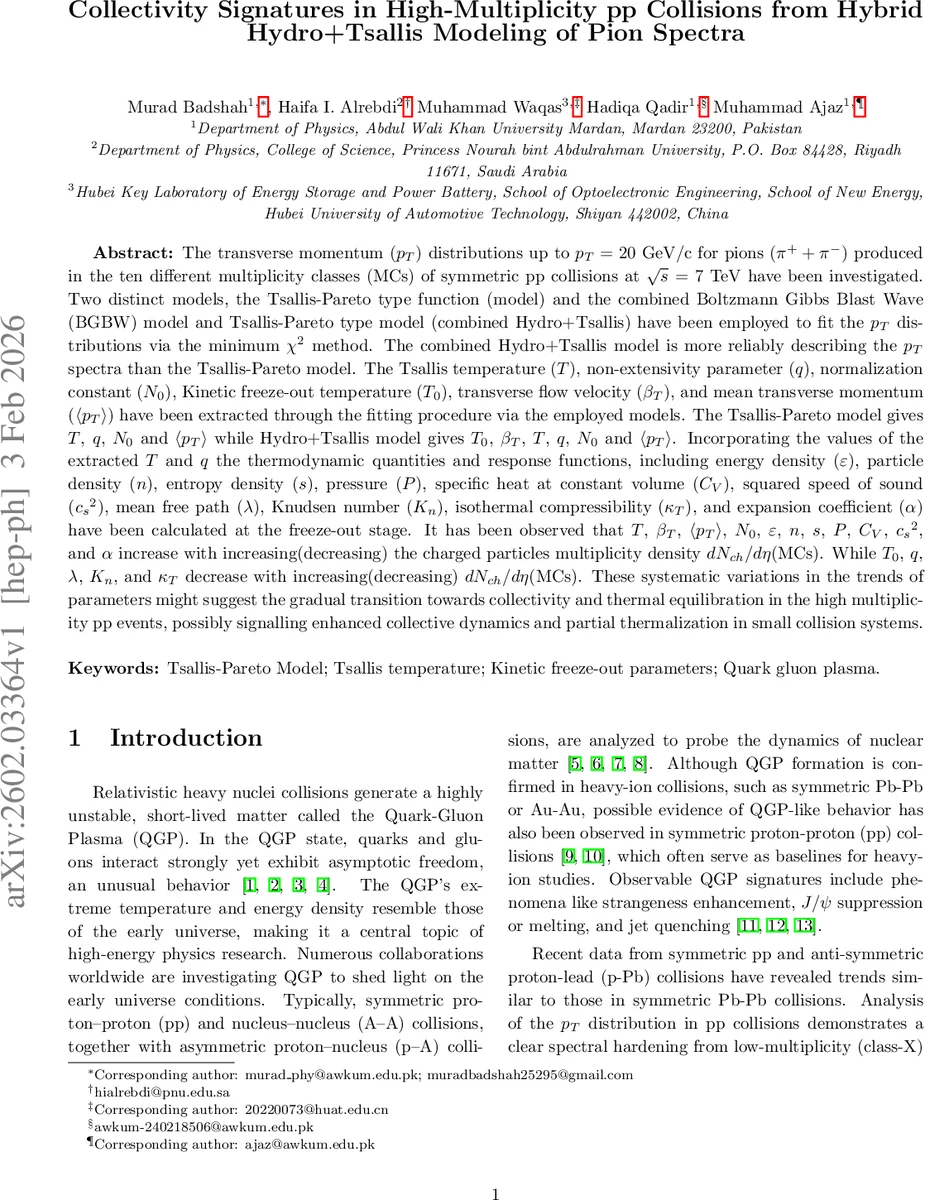
The transverse momentum (pT) distributions up to pT = 20 GeV/c for pions produced in the ten different multiplicity classes (MCs) of symmetric pp collisions at sqrt(s) = 7 TeV have been investigated. Two distinct models, the Tsallis-Pareto type function (model) and the combined BGBW model and Tsallis-Pareto type model have been employed to fit the pT distributions via the minimum chi-square method. The combined Hydro+Tsallis model is more reliably describing the pT spectra than the Tsallis-Pareto model. The Tsallis temperature (T), non-extensivity parameter (q), normalization constant (N0), Kinetic freeze-out temperature (T0), transverse flow velocity (betaT), and (mean pT) have been extracted through the fitting procedure via the employed models. The Tsallis-Pareto model gives T, q, N0 and mean pT while Hydro+Tsallis model gives T0, betaT, T, q, N0 and mean pT. Incorporating the values of the extracted T and q the thermodynamic quantities and response functions, including energy density (epsilon), particle density (n), entropy density (s), pressure (P), specific heat at constant volume (CV), squared speed of sound (cs2), mean free path (lambda), Knudsen number (Kn), isothermal compressibility (kappaT), and expansion coefficient (alpha) have been calculated at the freeze-out stage. It has been observed that T, betaT, mean pT, N0, epsilon, n, s, P, CV, cs2, and alpha increase with increasing(decreasing) the charged particles multiplicity density dNch/deta(MCs). While T0, q, lambda, Kn, and kappaT decrease with increasing(decreasing) dNch/deta(MCs). These systematic variations in the trends of parameters might suggest the gradual transition towards collectivity and thermal equilibration in the high multiplicity pp events, possibly signalling enhanced collective dynamics and partial thermalization in small collision systems.
💡 Research Summary
The paper investigates the transverse momentum (p_T) spectra of charged pions (π⁺ + π⁻) produced in proton–proton (pp) collisions at √s = 7 TeV, focusing on ten multiplicity classes (MC I to MC X) defined by the charged‑particle density dN_ch/dη. The authors employ two distinct fitting strategies: (i) a pure Tsallis‑Pareto distribution, which captures the power‑law tail at high p_T with three free parameters (Tsallis temperature T, non‑extensivity parameter q, and normalization N₀), and (ii) a hybrid “Hydro+Tsallis” model that superposes a Boltzmann‑Gibbs Blast‑Wave (BGBW) component (characterized by kinetic freeze‑out temperature T₀ and average transverse flow ⟨β_T⟩) with the Tsallis‑Pareto function, introducing six free parameters (T₀, ⟨β_T⟩, T, q, N₀, and the mixing fraction k).
Fitting is performed using a minimum χ² method, and model comparison incorporates both χ² per degree of freedom and the Akaike Information Criterion (AIC) to penalize extra parameters. The hybrid model yields a substantially lower χ²/ndf in nine out of ten multiplicity classes, with the most dramatic improvement observed for the highest‑multiplicity class (MC X), where χ²/ndf drops from ~630/45 (Tsallis alone) to ~198/42 (Hybrid). This demonstrates that incorporating collective flow via the BGBW component markedly enhances the description of the low‑p_T region while preserving the high‑p_T power‑law behavior.
Using the extracted Tsallis parameters (T and q), the authors compute a suite of thermodynamic quantities at freeze‑out within the framework of non‑extensive statistical mechanics: energy density ε, particle density n, entropy density s, pressure P, specific heat at constant volume C_V, squared speed of sound c_s², mean free path λ, Knudsen number Kn, isothermal compressibility κ_T, and thermal expansion coefficient α. These are derived from integrals over the Tsallis distribution (Eqs. 10‑14) and standard kinetic theory relations (Eqs. 16‑21).
Systematic trends emerge when the multiplicity density increases: the Tsallis temperature T, average transverse flow ⟨β_T⟩, mean p_T, normalization N₀, and all derived bulk thermodynamic quantities (ε, n, s, P, C_V, c_s², α) rise monotonically. Conversely, the kinetic freeze‑out temperature T₀, non‑extensivity q, mean free path λ, Knudsen number Kn, and compressibility κ_T decrease with increasing dN_ch/dη. The rise of ⟨β_T⟩ to values around 0.3–0.5 c and the reduction of Kn below unity indicate that the system increasingly behaves like a near‑perfect fluid. The approach of c_s² toward the conformal limit 1/3 further suggests an equation of state reminiscent of a deconfined quark‑gluon plasma (QGP).
These observations collectively point to a gradual emergence of collective dynamics and partial thermal equilibration in high‑multiplicity pp events, despite the small system size. The decreasing q values imply that the system moves closer to Boltzmann‑Gibbs equilibrium as multiplicity grows, while the simultaneous increase of flow velocity and thermodynamic densities signals the development of pressure‑driven expansion.
In conclusion, the hybrid Hydro+Tsallis model provides a superior phenomenological tool for describing the full p_T spectrum of pions in pp collisions and enables the extraction of meaningful thermodynamic and transport properties. The systematic parameter evolution with multiplicity supports the hypothesis that even in the smallest collision systems, signatures traditionally associated with QGP formation—such as collective flow, reduced Knudsen number, and near‑conformal sound speed—can manifest. The study paves the way for similar analyses of other hadron species and for direct comparisons with hydrodynamic simulations, thereby deepening our understanding of the onset of collectivity in high‑energy hadronic collisions.
Comments & Academic Discussion
Loading comments...
Leave a Comment