Omnidirectional Solid-State mmWave Radar Perception for UAV Power Line Collision Avoidance
Detecting and estimating distances to power lines is a challenge for both human UAV pilots and autonomous systems, which increases the risk of unintended collisions. We present a mmWave radar-based perception system that provides spherical sensing coverage around a small UAV for robust power line detection and avoidance. The system integrates multiple compact solid-state mmWave radar modules to synthesize an omnidirectional field of view while remaining lightweight. We characterize the sensing behavior of this omnidirectional radar arrangement in power line environments and develop a robust detection-and-avoidance algorithm tailored to that behavior. Field experiments on real power lines demonstrate reliable detection at ranges up to 10 m, successful avoidance maneuvers at flight speeds upwards of 10 m/s, and detection of wires as thin as 1.2 mm in diameter. These results indicate the approach’s suitability as an additional safety layer for both autonomous and manual UAV flight.
💡 Research Summary
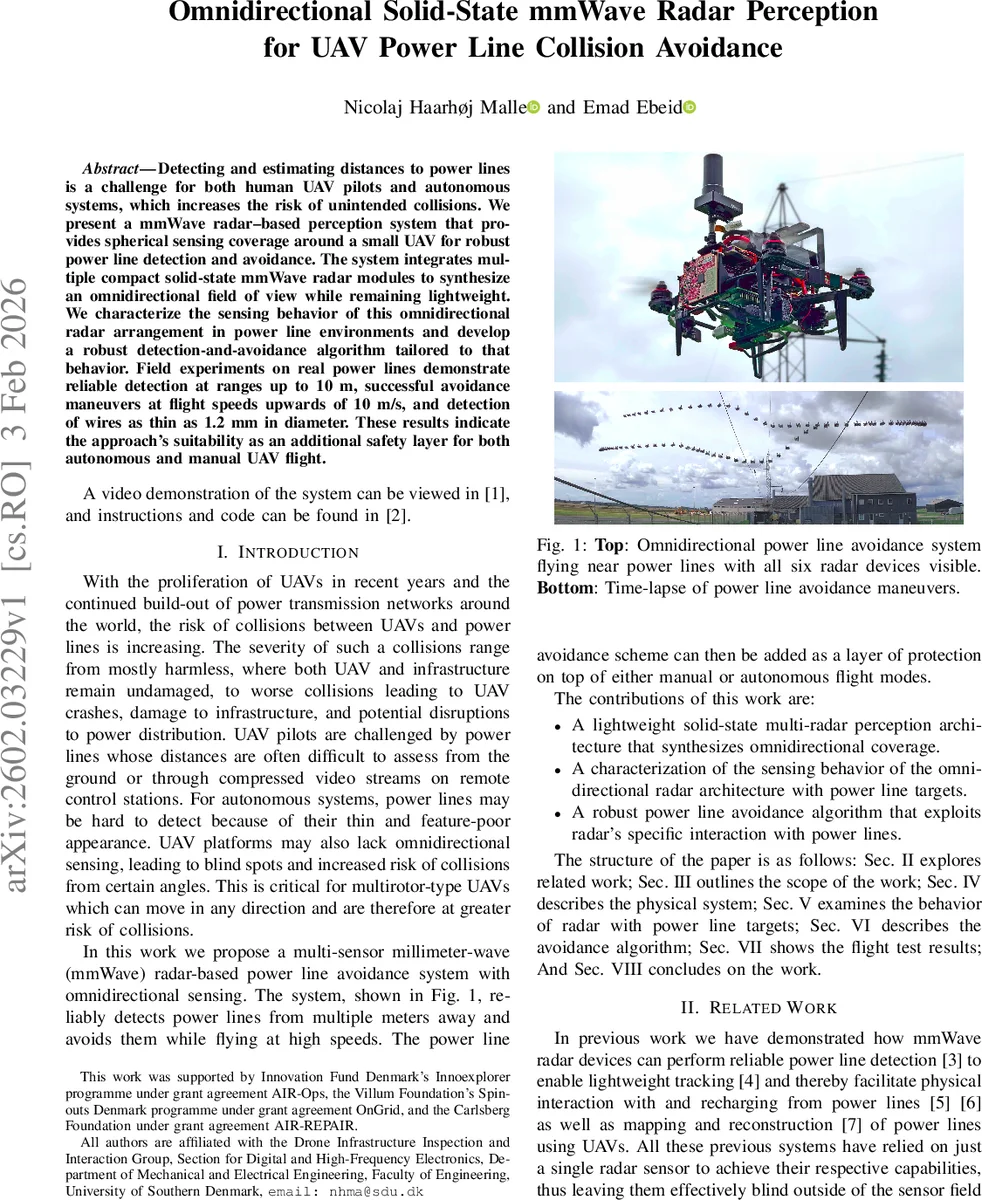
The paper presents a novel perception and avoidance system for unmanned aerial vehicles (UAVs) that relies solely on millimeter‑wave (mmWave) radar to detect and avoid power lines. Recognizing that power lines are thin, feature‑poor, and often invisible to cameras, the authors designed a lightweight, omnidirectional radar architecture that surrounds a small quadcopter with six solid‑state Texas Instruments mmWave modules. The front‑facing sensor is a long‑range IWR6843ISK (60‑64 GHz) providing a 120° azimuth and 30° elevation field of view (FoV); the remaining five are IWR6843A‑OP‑EVM antenna‑on‑package units, each offering a 120° × 120° FoV. The left and right sensors are angled 15° inward to close gaps, while top, bottom, rear, and front sensors are aligned with the UAV axes, achieving near‑spherical coverage while keeping total mass and power consumption compatible with a 250 mm‑wheelbase quadcopter.
Calibration experiments using a metallic corner reflector on a turntable measured distance errors across the X‑Z, Y‑Z, and X‑Y planes. The overall mean error was ~6 cm (σ≈2.8 cm), with individual sensor errors ranging from –0.4 cm to +11 cm, which the authors deem acceptable for obstacle avoidance. Measured FoVs were slightly narrower than datasheet specifications, especially in azimuth, but real‑world power‑line tests showed the discrepancy to be minor.
A key insight, termed the “Pₐ phenomenon,” emerged from yaw‑rotation tests in front of an actual power line. When the radar boresight is within roughly ±30° of being perpendicular to the line, the point returned by the radar coincides with the geometrically closest point on the line. As the boresight deviates further, the detected point drifts toward the intersection of the boresight with the line. This behavior allows the system to obtain the minimum distance to a line without complex signal processing, simplifying downstream avoidance logic.
The avoidance algorithm operates in three hierarchical modes:
-
Tangential avoidance (medium speed): For detections inside an “avoidance sphere” of radius rₐ, the algorithm computes a tangent vector orthogonal to the line‑to‑UAV vector using cross‑products with gravity. The tangent direction is chosen based on the dot product with the UAV’s current velocity, scaled by the alignment between the velocity and the line vector. This tangent is summed with the pilot‑desired velocity, and the result is clamped to the desired speed magnitude.
-
E‑brake (high speed): If a detection enters the avoidance sphere while the UAV is traveling faster than a predefined threshold, the system reduces speed to the medium‑speed regime before applying the tangential correction, ensuring sufficient reaction time.
-
Retreat (very close): When a detection lies within a tighter inner radius, the controller issues an immediate reverse thrust command to pull the UAV away from the line.
Both the UAV’s instantaneous velocity (from the autopilot state) and the pilot‑specified target velocity are processed, allowing the system to respect operator intent while guaranteeing safety.
Field trials were conducted on real high‑voltage transmission lines with conductors as thin as 1.2 mm. The omnidirectional radar reliably detected lines up to 10 m away, and the UAV successfully performed avoidance maneuvers at flight speeds exceeding 10 m/s. The system also handled multiple parallel conductors, demonstrating its ability to generate composite avoidance vectors in cluttered environments. Ground‑truth positions were obtained using a GNSS RTK receiver (±2 cm accuracy), though the authors note that the system functions without RTK as well.
Limitations identified include reduced reflectivity for insulated or non‑metallic conductors, potential degradation of the Pₐ phenomenon during aggressive attitude changes, and the 10 Hz radar update rate, which may introduce latency at very high speeds. Future work is suggested to explore higher‑rate radar firmware, multi‑target separation algorithms, and adaptive FoV tuning to further improve robustness in complex power‑line networks.
In summary, the paper delivers a practical, radar‑only solution that provides spherical sensing, characterizes mmWave interaction with thin conductors, and implements a lightweight, real‑time avoidance strategy. The approach adds a valuable safety layer for both autonomous and manually piloted UAV operations, addressing a critical gap in current aerial inspection and infrastructure‑interaction technologies.
Comments & Academic Discussion
Loading comments...
Leave a Comment