BinaryDemoire: Moiré-Aware Binarization for Image Demoiréing
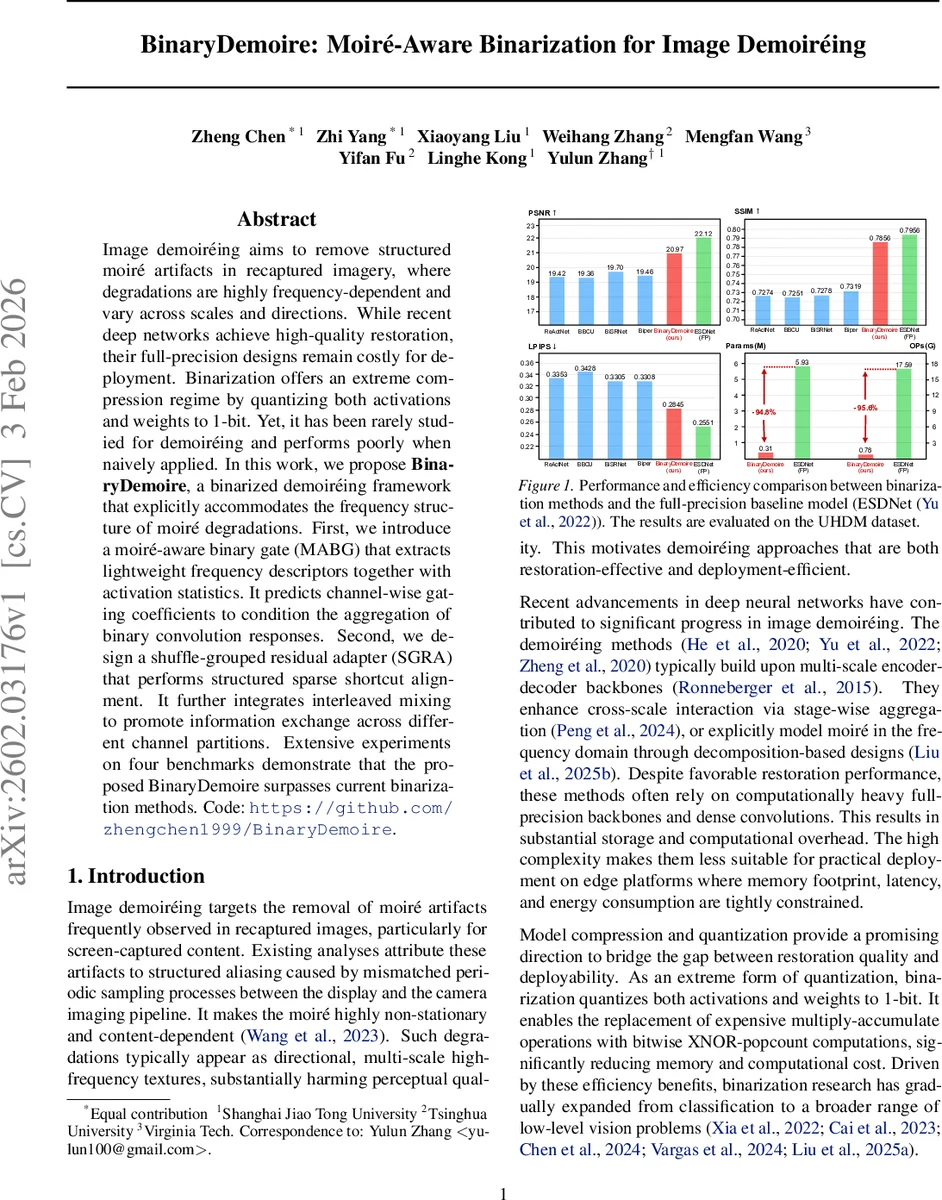
Image demoiréing aims to remove structured moiré artifacts in recaptured imagery, where degradations are highly frequency-dependent and vary across scales and directions. While recent deep networks achieve high-quality restoration, their full-precision designs remain costly for deployment. Binarization offers an extreme compression regime by quantizing both activations and weights to 1-bit. Yet, it has been rarely studied for demoiréing and performs poorly when naively applied. In this work, we propose BinaryDemoire, a binarized demoiréing framework that explicitly accommodates the frequency structure of moiré degradations. First, we introduce a moiré-aware binary gate (MABG) that extracts lightweight frequency descriptors together with activation statistics. It predicts channel-wise gating coefficients to condition the aggregation of binary convolution responses. Second, we design a shuffle-grouped residual adapter (SGRA) that performs structured sparse shortcut alignment. It further integrates interleaved mixing to promote information exchange across different channel partitions. Extensive experiments on four benchmarks demonstrate that the proposed BinaryDemoire surpasses current binarization methods. Code: https://github.com/zhengchen1999/BinaryDemoire.
💡 Research Summary
BinaryDemoire introduces a novel binarized framework for image demoiréing, tackling the challenge of removing structured moiré patterns while drastically reducing model size and computational cost. The authors observe that moiré artifacts are highly frequency‑dependent, directional, and multi‑scale, which makes naïve binarization—typically designed for classification tasks—ineffective due to uniform quantization errors that erase crucial high‑frequency information. To bridge this gap, the paper proposes two key modules that adapt binary networks to the specific characteristics of moiré degradations.
The first module, the Moiré‑Aware Binary Gate (MABG), extracts lightweight frequency descriptors from a single‑level discrete wavelet transform (DWT) of the full‑precision feature map. By computing the mean absolute response of the four sub‑bands (HH, HL, LH, LL), it derives a high‑frequency ratio (r_hf) and an orientation score (s) that quantify how much a channel responds to high‑frequency content and whether the response is horizontally or vertically dominant. In parallel, a statistics descriptor (channel‑wise mean, standard deviation, and mean absolute value) is computed. All descriptors are concatenated and fed through a shared fully‑connected layer followed by a sigmoid to produce channel‑wise gating coefficients β ∈
Comments & Academic Discussion
Loading comments...
Leave a Comment