Une remarque sur l'arborification de Matula
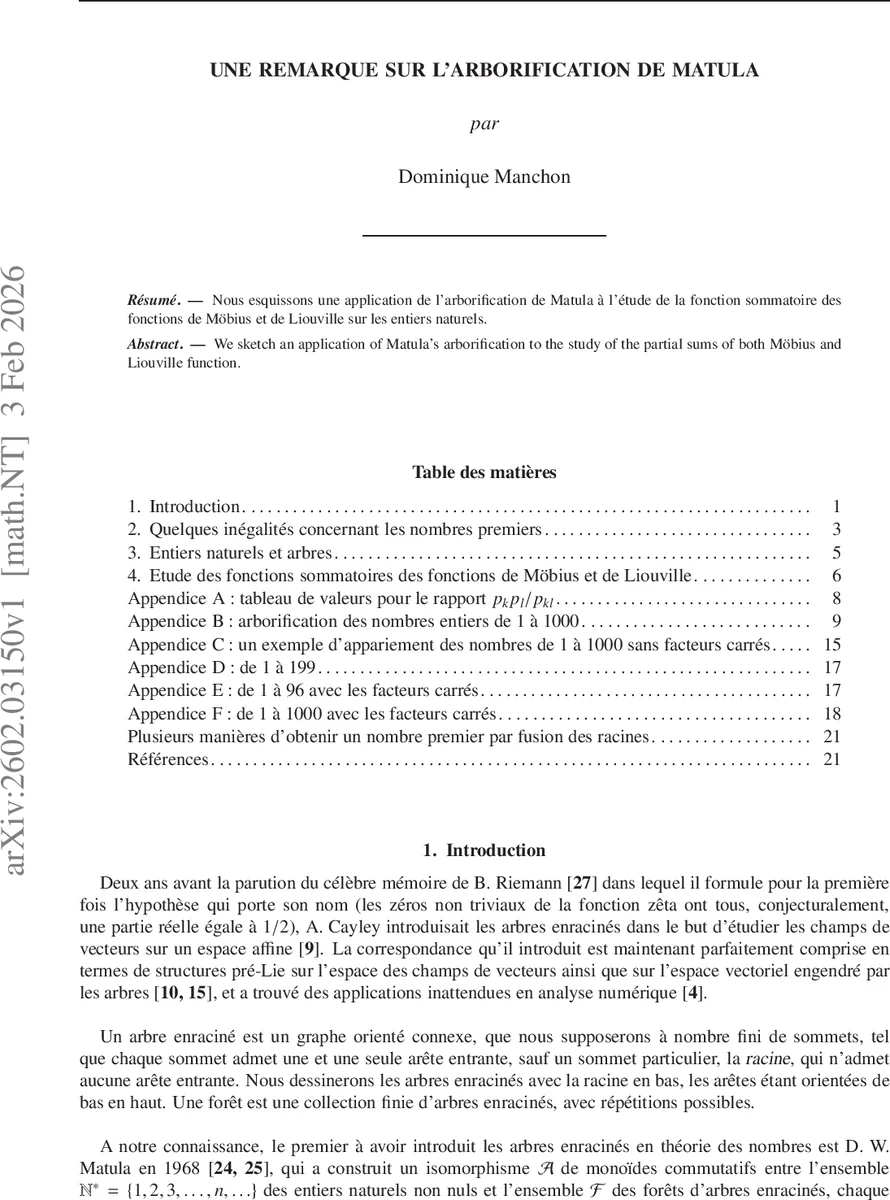
Nous esquissons une application de l’arborification de Matula à l’étude de la fonction sommatoire des fonctions de M" obius et de Liouville sur les entiers naturels - We sketch an application of Matula’s arborification to the study of the partial sums of both M" obius and Liouville function.
💡 Research Summary
The paper revisits the classic Matula correspondence, a bijection between the positive integers and rooted trees (often called “Matula numbers”), and explores how this combinatorial encoding can be used to study the partial sums of the Möbius function μ(k) and the Liouville function λ(k).
After a brief historical introduction that places the work in the context of the Riemann hypothesis and recent applications of Matula numbers (e.g., chemical graph coding), the author defines the arborification map A : ℕ⁺ → F (the set of rooted trees) recursively by A(1)=∅ and A(pₙ)=B⁺(A(n)), where pₙ denotes the n‑th prime and B⁺ adds a new common root to a forest. The paper emphasizes that, rather than associating a single tree to each integer, it is more natural to consider the whole forest obtained by gathering all branches at the root.
The next section gathers sharp inequalities for primes, notably the Dusart–Massias–Robin bounds
n(log n+log log n−1) ≤ pₙ ≤ n log n+log log n−1+1,
and uses them to prove a product inequality pₖ p_ℓ ≥ p_{kℓ} for k,ℓ ≥ 14. This inequality is interpreted in the language of trees: the Butcher product (the operation that merges the roots of two trees) dominates ordinary multiplication of the corresponding Matula numbers.
A key algebraic structure introduced is the NAP (non‑associative permutative) magma (T, ⊙), where ⊙ is the “root‑fusion” operation on trees. The NAP identity x⊙(y⊙z)=y⊙(x⊙z) reflects the fact that the order in which branches are grafted onto a root is irrelevant. The set of prime numbers P becomes a free NAP‑monoid under ⊙, because every prime can be obtained by iterated Butcher products starting from p₁=2. The paper shows explicitly that pₘ⊙pₙ = p_{pₘ n}, illustrating how the tree viewpoint encodes prime multiplication in a richer way.
Turning to the arithmetic functions, μ(k) equals 0 when k contains a squared factor and otherwise (−1)^{ω(k)} where ω(k) counts distinct prime factors; λ(k) = (−1)^{Ω(k)} where Ω(k) counts all prime factors with multiplicity. Both functions are completely multiplicative (μ is not, but its absolute value is). The author proposes a pairing strategy: arrange the integers 1,…,n into pairs {a,b} such that μ(a)+μ(b)=0 (or λ(a)+λ(b)=0). The pairing is guided by the tree representation: numbers whose trees share a common branch or leaf can be placed together, guaranteeing opposite signs because the parity of the number of prime factors flips when a branch is moved.
Using this pairing, the paper derives simple upper bounds for the partial sums
M(n)=∑{k≤n} μ(k), L(n)=∑{k≤n} λ(k).
Specifically, it shows that |M(n)| and |L(n)| are bounded by a constant times √n (or a slightly larger polynomial bound, depending on the exact pairing). Numerical experiments up to a few hundred confirm that the absolute values drop to modest numbers, illustrating the effectiveness of the tree‑based cancellation. However, the author candidly notes that these bounds do not improve on classical results such as the Mertens estimate nor do they shed new light on the zeros of ζ(s).
The paper includes extensive appendices: tables of Matula numbers for 1–1000, forests with and without square‑free constraints, examples of “appairement” (pairing) without square factors, and a detailed list of ratios pₖ p_ℓ / p_{kℓ} for small k,ℓ. It also discusses the ordinal perspective, contrasting the natural order ω on ℕ with the order ε₀ induced by the Cantor normal form on forests, thereby situating the combinatorial hierarchy within set‑theoretic foundations.
In conclusion, the work demonstrates that Matula’s arborification, when combined with modern prime‑inequality estimates and the algebraic framework of NAP magmas, provides a fresh, combinatorial lens on classical arithmetic functions. While the current bounds are modest, the methodology suggests several promising directions: assigning weights to tree edges, incorporating probabilistic tree models, or exploring higher‑order Butcher products could potentially yield sharper estimates for M(n) and L(n) and perhaps even connect more directly to the analytic behavior of the Riemann zeta function. The paper thus opens a novel interdisciplinary bridge between number theory, combinatorial algebra, and the theory of rooted trees.
Comments & Academic Discussion
Loading comments...
Leave a Comment