Maintaining the Heterogeneity in the Organization of Software Engineering Research
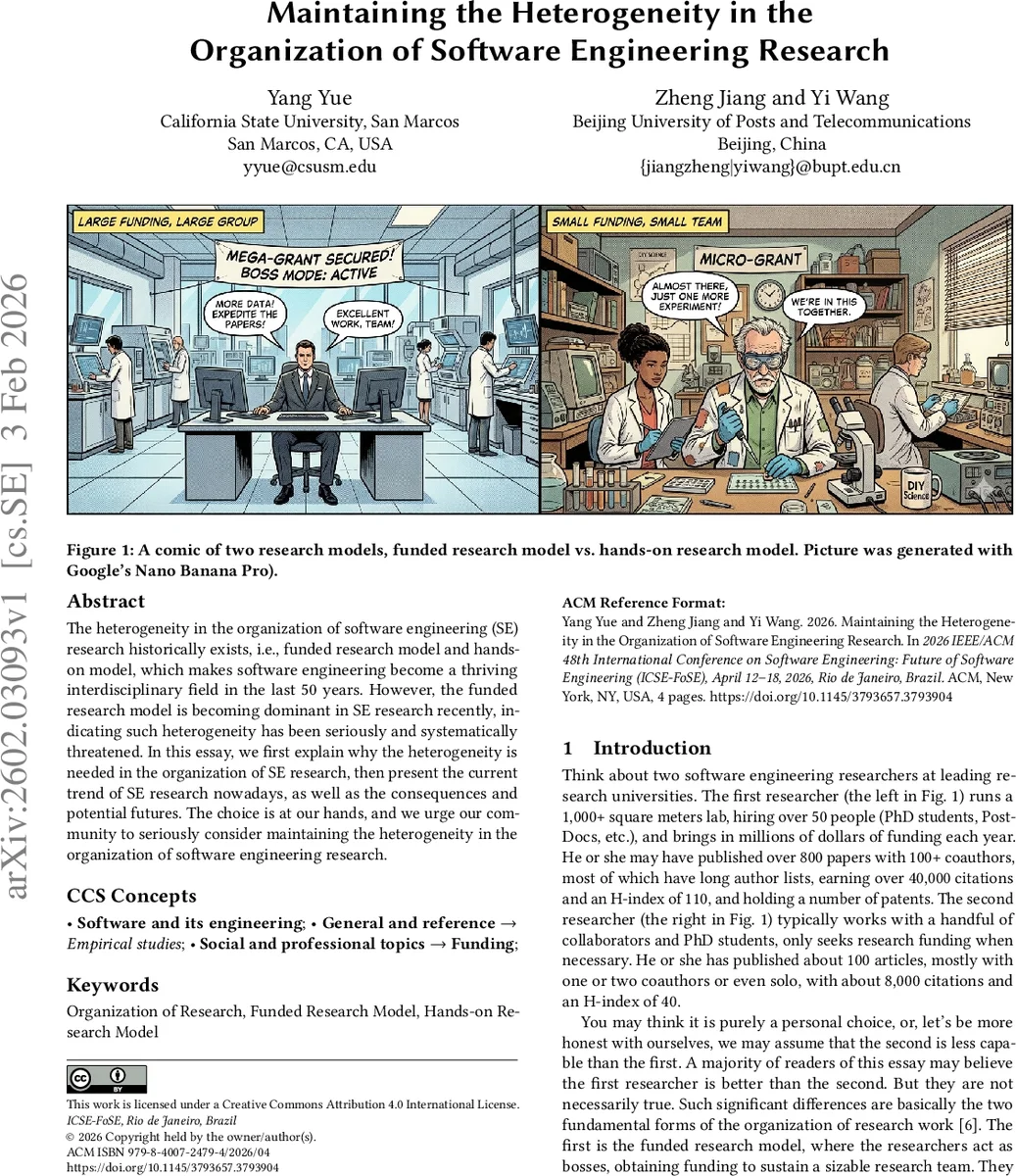
The heterogeneity in the organization of software engineering (SE) research historically exists, i.e., funded research model and hands-on model, which makes software engineering become a thriving interdisciplinary field in the last 50 years. However, the funded research model is becoming dominant in SE research recently, indicating such heterogeneity has been seriously and systematically threatened. In this essay, we first explain why the heterogeneity is needed in the organization of SE research, then present the current trend of SE research nowadays, as well as the consequences and potential futures. The choice is at our hands, and we urge our community to seriously consider maintaining the heterogeneity in the organization of software engineering research.
💡 Research Summary
The paper argues that software engineering (SE) research has historically been organized around two complementary models: a funded research model, characterized by large, well‑financed labs, many graduate students and post‑docs, and a hands‑on research model, where a small group of researchers directly conducts experiments and builds systems. The authors trace the origins of this heterogeneity to the interdisciplinary nature of SE, which inherits both the engineering focus of large‑scale system building and the mathematical, formal‑methods tradition of hands‑on inquiry.
They contend that the intrinsic properties of software—complexity, changeability, invisibility—preclude universal solutions, making a diversity of research approaches essential. Large teams excel at scaling and developing existing ideas, while small teams are more likely to generate disruptive innovations, as illustrated by the development of REST by a two‑person team that later became a cornerstone of web architecture.
Recent trends, however, show a systematic shift toward the funded model. Funding success has become a primary metric for hiring, promotion, and tenure, compelling researchers—especially early‑career faculty—to align their topics with agency priorities. This emphasis on quantifiable outputs (grant dollars, paper counts, citation metrics) encourages low‑risk, incremental work that fits tight conference deadlines. Consequently, methodological diversity erodes, and hands‑on approaches such as action research, which require long‑term industry collaboration and tolerate failure, have virtually disappeared from flagship SE venues (ICSE, FSE, ASE).
The authors identify three major consequences: (1) junior researchers receive project‑oriented training rather than apprenticeship in independent inquiry, limiting their ability to formulate original research questions; (2) a narrowing of methods leads to a “safe incrementalism” where large teams produce high‑volume, benchmark‑driven papers but fail to address fundamental, unsolved problems (e.g., software cost estimation); and (3) a widening gap between academia and industry, as PIs become detached from real‑world practice, producing solutions that look elegant on benchmarks but lack practical relevance.
Two possible futures are outlined. In the “reluctant” future, the funded model dominates completely, turning SE research into an assembly‑line process that yields many incremental papers but few paradigm‑shifting breakthroughs, and graduates become “specialized cogs” lacking broad engineering insight. In the “alternative” future, shrinking funding pools and the Matthew effect force many researchers to adopt the hands‑on model, preserving small, agile teams that can pursue high‑risk, high‑reward ideas.
The paper concludes with a call to action: the SE community must consciously preserve heterogeneity by revising evaluation criteria, diversifying funding mechanisms, and valuing quality and innovation over sheer quantity. Researchers themselves should reflect on their career choices, balancing the allure of large labs with the intellectual freedom and impact that hands‑on, small‑team research can provide.
Comments & Academic Discussion
Loading comments...
Leave a Comment