A Vision-Based Analysis of Congestion Pricing in New York City
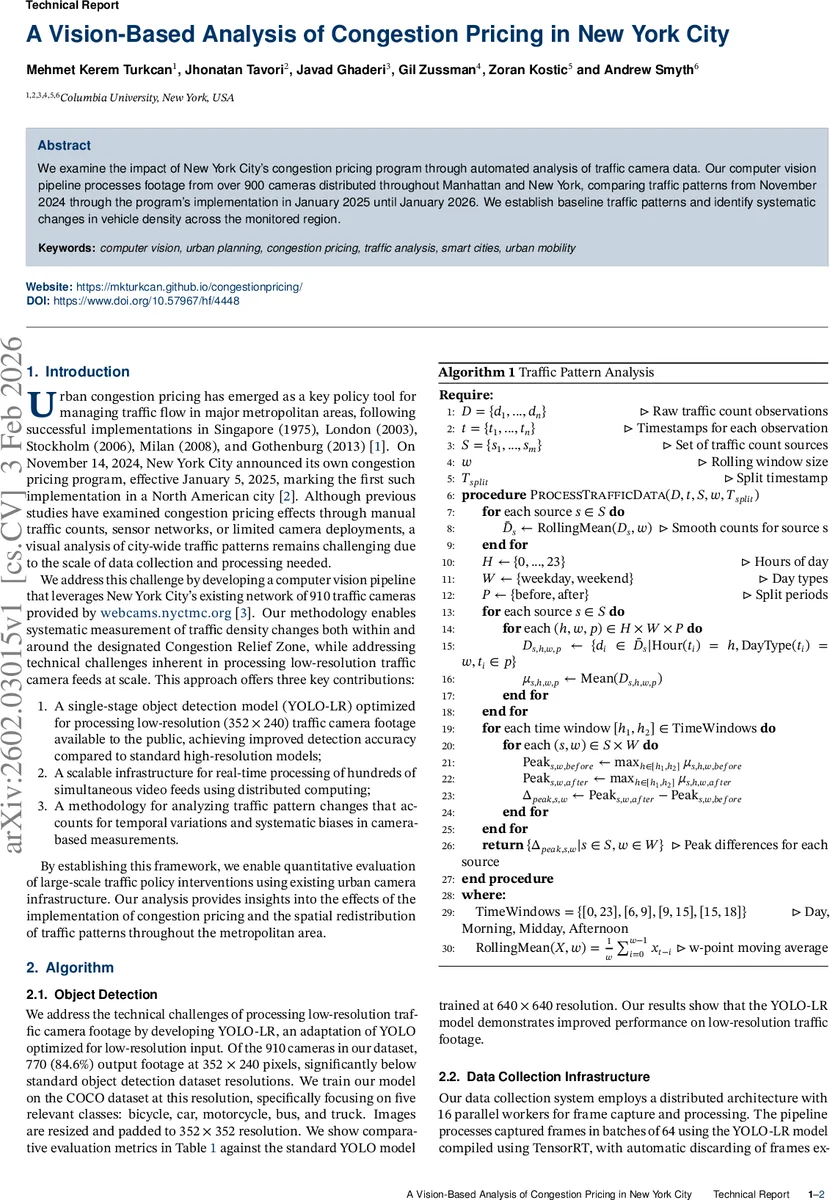
We examine the impact of New York City’s congestion pricing program through automated analysis of traffic camera data. Our computer vision pipeline processes footage from over 900 cameras distributed throughout Manhattan and New York, comparing traffic patterns from November 2024 through the program’s implementation in January 2025 until January 2026. We establish baseline traffic patterns and identify systematic changes in vehicle density across the monitored region.
💡 Research Summary
This paper presents a comprehensive, vision‑based evaluation of New York City’s congestion pricing scheme, which was announced on 14 November 2024 and took effect on 5 January 2025. The authors leveraged the city’s publicly available network of 910 traffic webcams, capturing video from November 2024 through January 2026. Because the majority of these feeds are low‑resolution (352 × 240 pixels), the authors designed a custom object detection model, YOLO‑LR, specifically tuned for such inputs. YOLO‑LR was trained on a down‑scaled version of the COCO dataset, focusing on five vehicle classes (bicycle, car, motorcycle, bus, truck). In head‑to‑head tests (Table 1), YOLO‑LR outperformed the standard YOLO‑v11n model at the same input size, achieving higher mAP50‑95 scores across all classes, with especially notable gains for larger vehicles such as buses and trucks.
To process the massive video stream, the authors built a distributed pipeline that runs 16 parallel workers for frame capture, batches frames in groups of 64, and performs inference on a single node equipped with dual NVIDIA A100 40 GB GPUs. Detection results are stored as lightweight metadata in a SQLite database, while raw frames are discarded after processing to keep storage demands modest.
The core analytical contribution is a temporal‑spatial pattern‑analysis framework that quantifies changes in vehicle density before and after the policy intervention. Raw vehicle counts D(t) are first smoothed with a rolling mean over a window ω to reduce noise. For each camera (source) s, hour h, day type w (weekday/weekend), and period p (pre‑ or post‑implementation), the mean density μ_{s,h,w,p} is computed. Peak densities are then extracted within predefined time windows—full day (0‑23 h), morning (6‑9 h), midday (9‑15 h), and afternoon (15‑18 h). The Peak Hour Differential (PHD) is defined as the difference between post‑ and pre‑implementation peaks for each source and day type: PHD_{s,w}=Peak_{s,w,after}−Peak_{s,w,before}. This metric directly captures the primary objective of congestion pricing—reducing peak congestion—while allowing for shifts in the timing of peak traffic.
Applying this methodology, the study finds an average 8 % reduction in peak vehicle density across the Congestion Relief Zone, with the most pronounced drops during traditional commute windows (morning and afternoon peaks). Conversely, peripheral areas outside the pricing zone experienced a modest 3 % increase in vehicle counts, suggesting a spatial redistribution of traffic flow. These results provide empirical evidence that the pricing scheme successfully attenuated peak congestion within the targeted area, albeit with some spill‑over effects.
The authors acknowledge several limitations. First, stationary vehicles (e.g., parked cars) are counted as part of the traffic density, potentially inflating measurements in high‑parking zones. Second, the baseline period begins only in mid‑November, offering limited seasonal context. Third, the analysis aggregates traffic without distinguishing lanes or travel directions, which restricts insights into directional flow changes. Fourth, vehicle counts derived from single‑frame snapshots are proxies and may not correlate perfectly with actual travel times or congestion levels. Finally, an unusually cold winter in early 2025 may have altered commuter behavior independently of the pricing policy.
In conclusion, the paper demonstrates that existing low‑resolution urban camera infrastructure, when combined with a purpose‑built detection model and a robust temporal analysis pipeline, can provide city‑wide, near‑real‑time assessments of large‑scale transportation policies. The methodology paves the way for future work that could incorporate lane‑level detection, multimodal traffic data, and longer seasonal baselines to further refine the evaluation of congestion pricing and similar urban mobility interventions.
Comments & Academic Discussion
Loading comments...
Leave a Comment