Understanding Bug-Reproducing Tests: A First Empirical Study
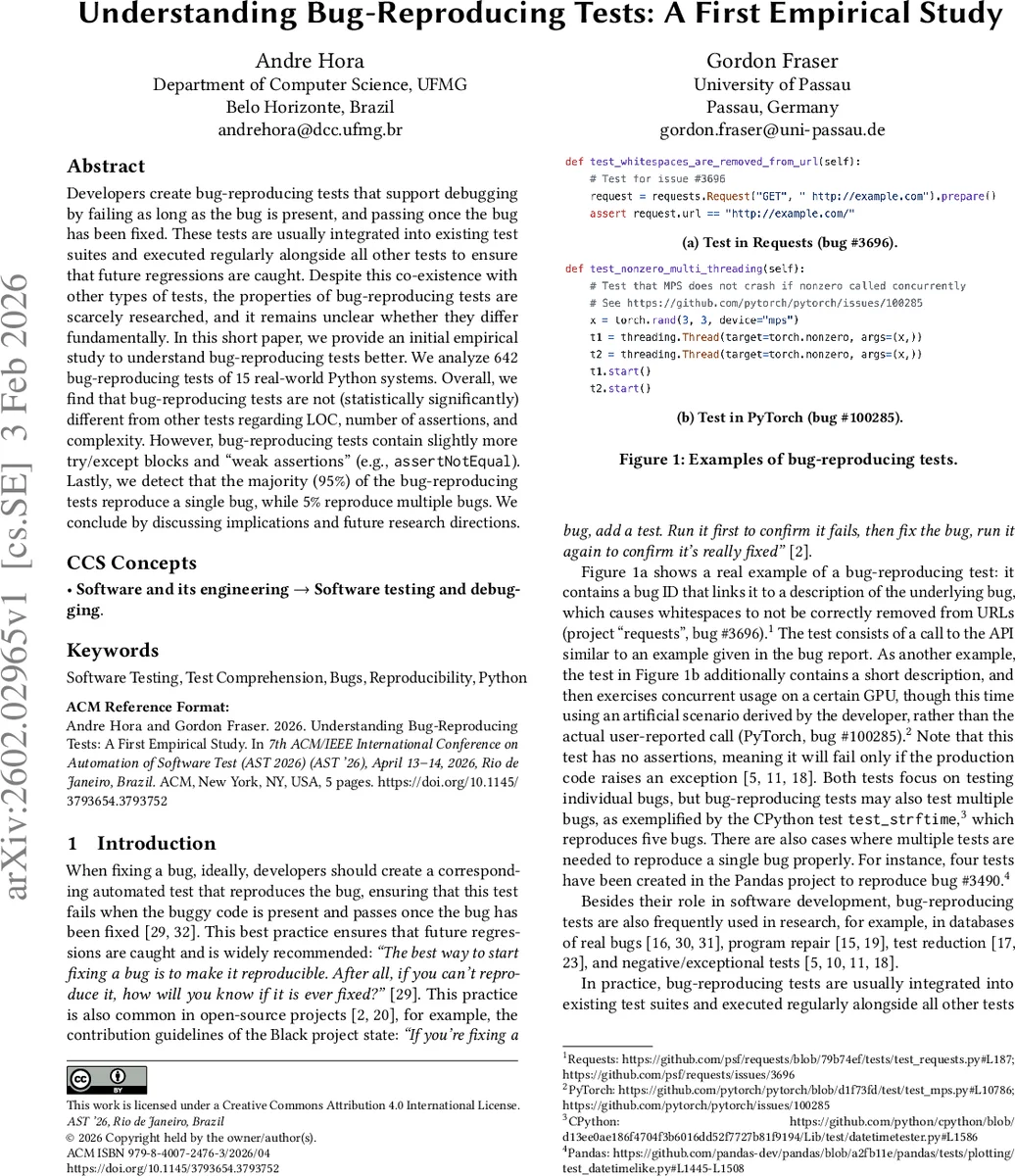
Developers create bug-reproducing tests that support debugging by failing as long as the bug is present, and passing once the bug has been fixed. These tests are usually integrated into existing test suites and executed regularly alongside all other tests to ensure that future regressions are caught. Despite this co-existence with other types of tests, the properties of bug-reproducing tests are scarcely researched, and it remains unclear whether they differ fundamentally. In this short paper, we provide an initial empirical study to understand bug-reproducing tests better. We analyze 642 bug-reproducing tests of 15 real-world Python systems. Overall, we find that bug-reproducing tests are not (statistically significantly) different from other tests regarding LOC, number of assertions, and complexity. However, bug-reproducing tests contain slightly more try/except blocks and ``weak assertions’’ (e.g.,~\texttt{assertNotEqual}). Lastly, we detect that the majority (95%) of the bug-reproducing tests reproduce a single bug, while 5% reproduce multiple bugs. We conclude by discussing implications and future research directions.
💡 Research Summary
This paper presents the first empirical investigation of bug‑reproducing tests (BRTs), a class of tests that are written to fail while a bug is present and pass once the bug is fixed. The authors collected 642 BRTs from the top‑15 most‑starred Python projects on GitHub (e.g., Transformers, Django, PyTorch) by mining test methods that contain the words “bug” or “regression” together with an issue identifier in comments or test names. This conservative, precision‑oriented approach yields a high‑confidence set of BRTs, albeit with limited recall.
Two research questions guide the study: (RQ1) What are the code characteristics of BRTs compared with ordinary tests? (RQ2) How are bugs mapped to BRTs? For RQ1 the authors measured four quantitative metrics on each test: lines of code (LOC), number of assertions, control‑flow complexity (count of if/for/while/try structures), and the number of try/except blocks. They computed the same metrics for all 121,447 test methods across the 15 projects, then applied Mann‑Whitney U tests and Cohen’s d effect sizes to assess statistical significance and practical relevance. For RQ2 they classified the relationship between bugs and tests into three scenarios: (a) one bug per test, (b) multiple bugs per test, and (c) one bug covered by multiple tests (shared bugs).
Findings for RQ1
- LOC: BRTs have a median of 5–20 lines (median 5, Q2 10, Q3 20) versus 6–19 lines for all tests. The difference is statistically significant (p < 0.01) but the effect size is negligible (d ≈ 0.06), indicating no practical size difference.
- Assertions: Both groups have a median of 2 assertions and similar means (≈3). However, the distribution of assertion types differs. BRTs use a higher proportion of “weak assertions” such as
assertNotEqual,assertContains, andassertAlmostEqual. In the top‑25 most frequent assertions, 11 of them appear in BRTs, of which 4 are exclusive weak assertions, compared with 8 weak assertions (2 exclusive) in the overall test set. - Complexity: The average number of control‑flow constructs is virtually identical (≈0.39 for BRTs vs 0.38 for all tests), with a negligible effect size.
- Try/except blocks: 6 % of BRTs contain at least one try/except block, versus only 2 % of ordinary tests. This difference is statistically significant (p < 0.01) and has a small effect size (d ≈ 0.26). The authors interpret this as developers frequently using explicit exception handling to verify that a bug manifests via an exception, rather than employing the more idiomatic
assertRaises.
Findings for RQ2
- Bug‑to‑test mapping: 95 % of BRTs follow scenario (a) – each test reproduces a single bug. Only 5 % fall under scenario (b) – a test reproduces multiple bugs (e.g., a Django test that covers six distinct bug IDs).
- Shared vs exclusive bugs: 80 % of BRTs target exclusive bugs (the bug is exercised by a single test), while 20 % target shared bugs (multiple tests cover the same bug). This indicates that, for some complex or multi‑faceted bugs, developers write several focused tests rather than a monolithic one.
Implications and Recommendations
- Strengthen assertions: The higher prevalence of weak assertions and try/except blocks suggests limited observability in bug‑reproducing scenarios. The authors recommend replacing try/except with
assertRaisesand favoring strong assertions (assertEqual,assertTrue, etc.) to improve test reliability and diagnostic clarity. - Refactor multi‑bug tests: Tests that cover multiple bugs hinder pinpointing the failing cause. Automated refactoring tools could suggest splitting such tests into single‑bug units, which would align with best practices for test granularity and maintainability.
- Apply test reduction: Many BRTs are derived directly from issue‑tracker bug reports, often reproducing the entire user‑reported scenario. The paper advocates employing test‑reduction techniques to trim unnecessary setup code, thereby reducing test suite size and execution time while preserving the essential failure‑inducing behavior.
- Future work: Extending the analysis to other languages (e.g., Java, JavaScript) would test the generality of the observed patterns. Moreover, longitudinal studies could examine whether the presence of BRTs accelerates bug‑fix turnaround or improves post‑release defect rates. Investigating the root causes of weak assertions (e.g., ambiguous bug reports, lack of observable outputs) could also inform tooling that assists developers in writing more robust BRTs.
Conclusion
The study demonstrates that bug‑reproducing tests are largely similar to ordinary tests in size, assertion count, and structural complexity, but they exhibit modestly higher usage of try/except blocks and weak assertions. Most BRTs are dedicated to a single bug, though a non‑trivial minority handle multiple bugs or share bugs across tests. These insights lay a foundation for improving the quality of BRTs, guiding automated support tools, and informing future research on test design practices in the context of bug fixing.
Comments & Academic Discussion
Loading comments...
Leave a Comment