Nonstandard free groups
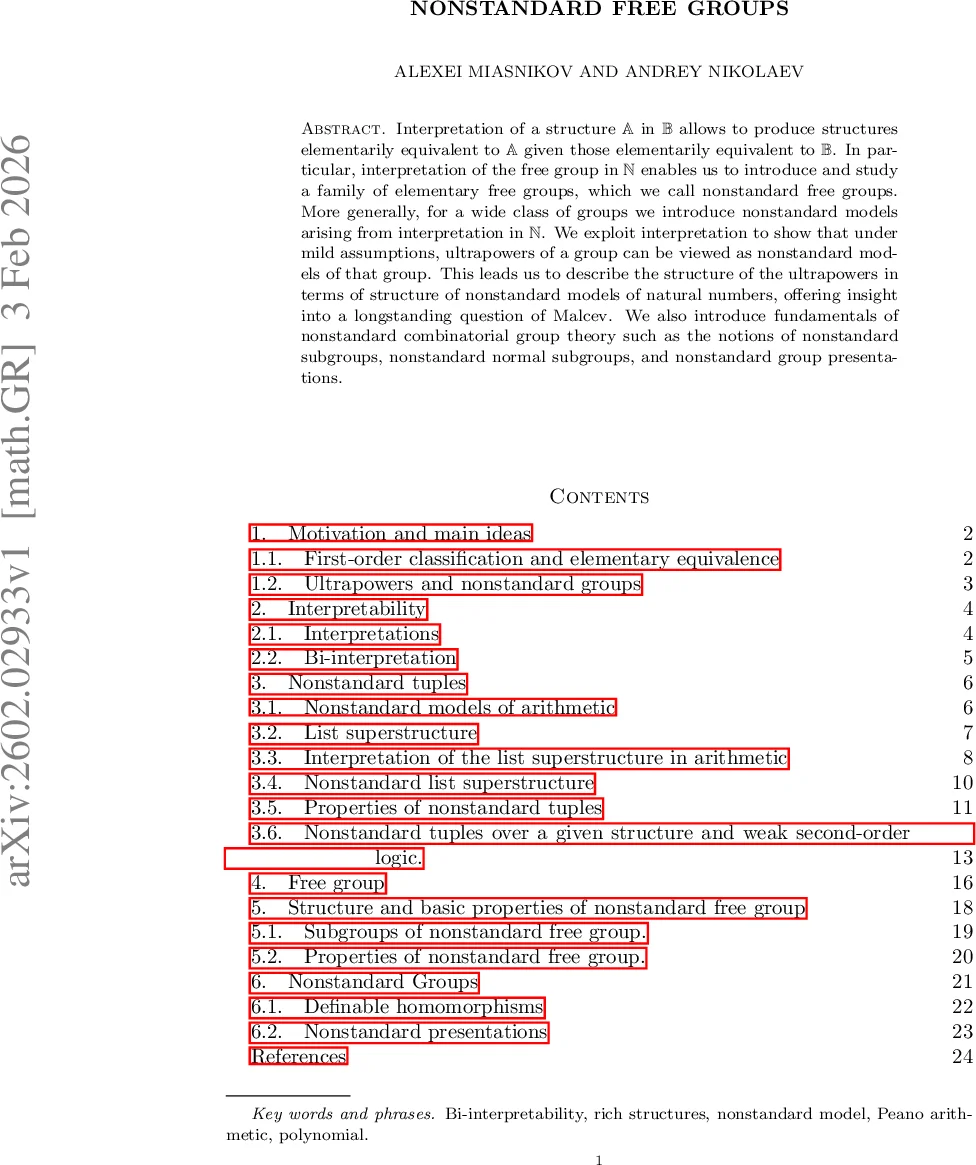
Interpretation of a structure $\mathbb A$ in $\mathbb B$ allows to produce structures elementarily equivalent to $\mathbb A$ given those elementarily equivalent to $\mathbb B$. In particular, interpretation of the free group in $\mathbb N$ enables us to introduce and study a family of elementary free groups, which we call nonstandard free groups. More generally, for a wide class of groups we introduce nonstandard models arising from interpretation in $\mathbb N$. We exploit interpretation to show that under mild assumptions, ultrapowers of a group can be viewed as nonstandard models of that group. This leads us to describe the structure of the ultrapowers in terms of structure of nonstandard models of natural numbers, offering insight into a longstanding question of Malcev. We also introduce fundamentals of nonstandard combinatorial group theory such as the notions of nonstandard subgroups, nonstandard normal subgroups, and nonstandard group presentations.
💡 Research Summary
The paper introduces and develops the theory of “nonstandard free groups,” a new class of elementary extensions of free groups obtained by interpreting the free group inside the arithmetic structure of the natural numbers (or the integers). The authors begin by recalling the general framework of interpretability: a structure A is 0‑definably interpretable in a structure B if there exists a definable domain, a definable equivalence relation, and definable interpretations of the symbols of A on the quotient. The key model‑theoretic fact (Theorem 2.1) is that if A is absolutely interpretable in B, then for any elementary extension eB≡B, the interpreted structure Γ(eB) is elementarily equivalent to A. Moreover, when A is finitely generated, any two absolute interpretations of A in ℤ yield isomorphic nonstandard models (Theorem 2.2).
Applying this to a free group F, the authors exhibit a concrete interpretation Γ of F in ℤ. For any nonstandard model eℤ of arithmetic (i.e., any elementary extension of ℤ that is not isomorphic to ℤ), the group F(eℤ)=Γ(eℤ) is defined and called a nonstandard free group, denoted eF. The construction is independent of the particular interpretation when F is finitely generated, so eF is determined solely by F and the chosen nonstandard arithmetic model.
The paper then analyses the algebraic structure of eF. Unlike a classical free group, whose centralizers are cyclic, every centralizer in eF is isomorphic to the additive group of the underlying nonstandard integers eℤ⁺. This yields a family of groups elementarily equivalent to F but with non‑cyclic centralizers, providing new examples beyond previously known constructions such as ℤ∗(ℤ⊕ℚ⁺). The authors also develop a “nonstandard list superstructure” which serves as the ambient setting for defining nonstandard subgroups, nonstandard normal subgroups, and nonstandard presentations. In this setting the usual group‑theoretic results (e.g., the first isomorphism theorem) have natural analogues.
A major motivation is Malcev’s longstanding problem: describe the algebraic structure of the ultrapower F^I/D for a free non‑abelian group F. The authors show that if a group G is absolutely interpretable in ℤ, then for any index set I and non‑principal ultrafilter D, the ultrapower G^I/D is isomorphic to G(eℤ) where eℤ=ℤ^I/D. Consequently, F^I/D ≅ eF, providing a concrete description of the ultrapower as a nonstandard free group. This method extends to any group that can be interpreted in arithmetic, yielding a uniform approach to ultrapowers of “infinitely dimensional’’ groups, a situation where classical algebraic schemes fail.
The authors further explore the model‑theoretic landscape of groups elementarily equivalent to a given group G. They prove that every model of Th(G) embeds elementarily into some nonstandard model G(eℤ) of the same cardinality (Theorem 6.3), and under the generalized continuum hypothesis every saturated model of Th(G) is itself a nonstandard model arising from a saturated arithmetic model (Theorem 6.4). This positions nonstandard groups as canonical, highly homogeneous representatives of the elementary class of G.
In addition to the structural results, the paper introduces the notions of definable homomorphisms between nonstandard groups, nonstandard presentations (generators together with a possibly infinite set of nonstandard relations), and a weak second‑order logic that captures the richer expressive power of nonstandard models. The authors argue that nonstandard free groups are elementary equivalent to ordinary free groups not only in first‑order group language but also in stronger logics, opening avenues for further logical analysis.
Overall, the work blends interpretability theory, nonstandard model theory, and ultrapower techniques to construct and analyze nonstandard free groups. It provides a new perspective on classical problems such as Malcev’s ultrapower question, enriches the toolbox of combinatorial group theory with nonstandard concepts, and establishes nonstandard groups as central objects in the model‑theoretic study of groups. The paper’s methods are likely to influence future research on elementary equivalence, saturation, and the algebraic structure of ultrapowers across a broad spectrum of algebraic systems.
Comments & Academic Discussion
Loading comments...
Leave a Comment