MapDream: Task-Driven Map Learning for Vision-Language Navigation
Vision-Language Navigation (VLN) requires agents to follow natural language instructions in partially observed 3D environments, motivating map representations that aggregate spatial context beyond local perception. However, most existing approaches rely on hand-crafted maps constructed independently of the navigation policy. We argue that maps should instead be learned representations shaped directly by navigation objectives rather than exhaustive reconstructions. Based on this insight, we propose MapDream, a map-in-the-loop framework that formulates map construction as autoregressive bird’s-eye-view (BEV) image synthesis. The framework jointly learns map generation and action prediction, distilling environmental context into a compact three-channel BEV map that preserves only navigation-critical affordances. Supervised pre-training bootstraps a reliable mapping-to-control interface, while the autoregressive design enables end-to-end joint optimization through reinforcement fine-tuning. Experiments on R2R-CE and RxR-CE achieve state-of-the-art monocular performance, validating task-driven generative map learning.
💡 Research Summary
Vision‑Language Navigation (VLN) requires an embodied agent to follow natural‑language instructions while exploring a partially observed 3D environment. Existing VLN systems typically augment the visual‑language policy with hand‑crafted spatial representations—topological graphs, occupancy grids, or semantic maps—that are built independently of the navigation policy. Because these maps are not shaped by the downstream task, they often contain information irrelevant to the current instruction and cannot be refined through learning, leading to a mismatch between the spatial context supplied to the policy and the actual decision‑making needs.
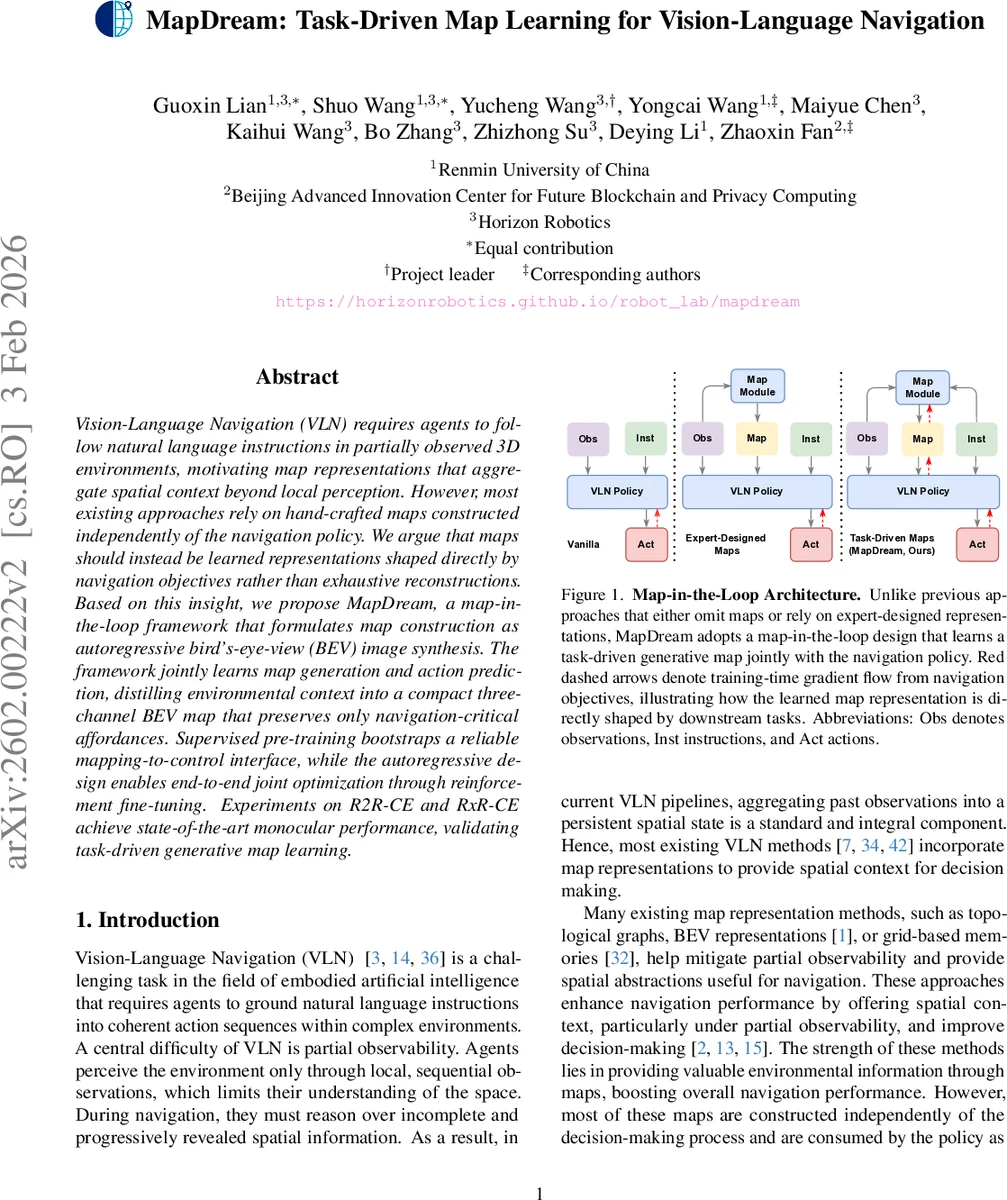
MapDream introduces a fundamentally different paradigm: the map is treated as a task‑driven latent representation that is learned jointly with the navigation policy. The core idea is that a map need not be a complete reconstruction of the environment; it only has to encode the spatial cues that are essential for the current navigation objective. To this end, the authors formulate map construction as an autoregressive bird’s‑eye‑view (BEV) image synthesis problem. Given a history of egocentric RGB observations (O_t), the current frame (o_t), and the instruction (I), a lightweight generative module (G) predicts a three‑channel BEV map (M_t). The three channels are (1) Occupancy (impassable, unobserved, traversable), (2) Distance (geodesic distance to the goal, normalized), and (3) Landmark (binary mask of objects explicitly mentioned in the instruction). This compact representation captures geometry, goal direction, and semantic anchors while remaining small enough for efficient processing.
The training pipeline consists of two stages.
Stage 1 – Supervised pre‑training: The map module is trained with a reconstruction loss that maximizes the likelihood of the ground‑truth BEV tokens, while the VLN policy is trained with a cross‑entropy loss to predict a multi‑step action sequence conditioned on the predicted map and the language‑vision context. This stage establishes a stable “mapping‑to‑control” interface and fixes the resolution and token budget of the BEV maps.
Stage 2 – Reinforcement fine‑tuning: Both modules are jointly optimized under a unified navigation reward. The reward combines (a) an action reward that only credits the longest correct prefix of the predicted action sequence, encouraging precise step‑wise credit assignment, and (b) a format reward that checks whether the generated action sequence respects the required syntactic constraints (e.g., presence of a STOP token). The total reward (r_{\text{total}} = r_{\text{act}} + r_{\text{fmt}}) is used in a Group Relative Policy Optimization (GRPO) framework, where multiple rollouts are sampled, relative advantages are computed within each group, and gradients are back‑propagated through both the policy and the map generator. Because the map is directly exposed to the navigation reward, it gradually learns to retain only navigation‑critical information and discard irrelevant visual details.
Empirical evaluation on the standard VLN benchmarks R2R‑CE and RxR‑CE (Val‑Unseen split) demonstrates that MapDream, using only a single monocular RGB camera, outperforms or matches state‑of‑the‑art methods that rely on additional sensors (depth, panoramic views) or external semantic maps. For example, on R2R‑CE Val‑Unseen, MapDream achieves a Navigation Error (NE) of 4.59 m, Success Rate (SR) of 64.4 %, and SPL of 59.8 %, surpassing BEVBert‑FSTTA (NE 4.39 m, SR 65 %, SPL 60 %) and other recent baselines. Moreover, the method shows strong generalization to unseen environments, indicating that the learned BEV maps capture abstract, instruction‑aligned spatial priors rather than overfitting to specific scenes.
Technical contributions of the paper include:
- Task‑driven map perspective – reframing maps as representations shaped by downstream navigation objectives.
- Autoregressive cross‑modal BEV synthesis – extending image‑generation techniques to the cross‑view, cross‑domain setting required for VLN (multiple egocentric frames → top‑down map).
- Two‑stage training with reinforcement‑driven joint optimization – stabilizing learning with supervised pre‑training and then directly aligning map generation with navigation performance.
- Compact three‑channel BEV design – balancing expressive power (geometry, goal direction, semantic anchors) with computational efficiency.
The paper also discusses limitations: the current BEV is a 2‑D planar abstraction, which may struggle with multi‑level structures (e.g., stairs, elevators). Ground‑truth BEV supervision requires some labeling effort, suggesting future work on self‑supervised or unsupervised map learning. Extending the framework to multi‑agent scenarios or human‑robot interaction contexts is an open direction.
In summary, MapDream demonstrates that integrating map generation into the learning loop, and shaping it with reinforcement signals, yields a more efficient and effective spatial representation for VLN. This paradigm shift—from expert‑crafted, task‑agnostic maps to learned, navigation‑oriented BEV maps—opens new avenues for embodied AI systems that must reason over partial observations while following complex language instructions.
Comments & Academic Discussion
Loading comments...
Leave a Comment