ESG Risk: Lessons Learned from Utility Theory
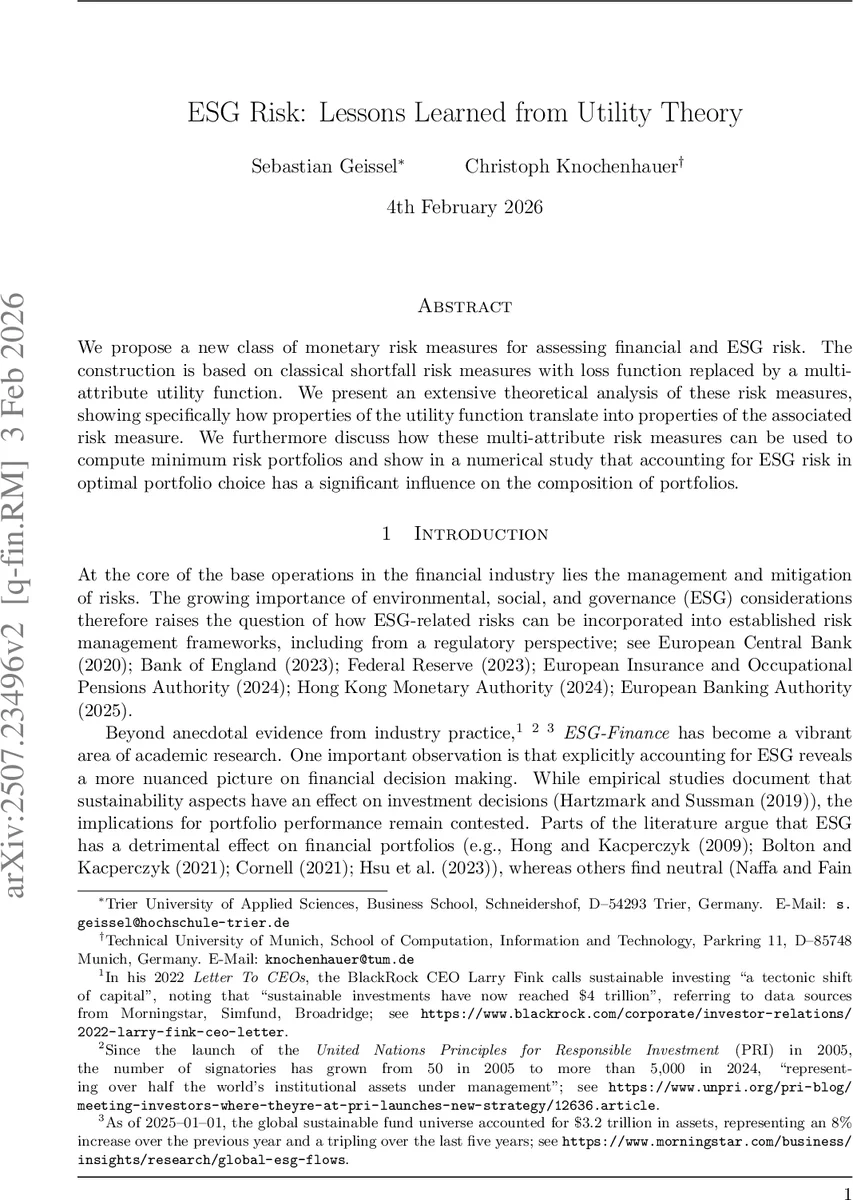
We propose a new class of monetary risk measures for assessing financial and ESG risk. The construction is based on classical shortfall risk measures with loss function replaced by a multi-attribute utility function. We present an extensive theoretical analysis of these risk measures, showing specifically how properties of the utility function translate into properties of the associated risk measure. We furthermore discuss how these multi-attribute risk measures can be used to compute minimum risk portfolios and show in a numerical study that accounting for ESG risk in optimal portfolio choice has a significant influence on the composition of portfolios.
💡 Research Summary
The paper introduces a novel class of monetary risk measures that simultaneously capture financial and ESG (environmental, social, governance) risk by extending the classical shortfall risk framework with a multi‑attribute utility function. Starting from the well‑known shortfall risk ρ̂
Comments & Academic Discussion
Loading comments...
Leave a Comment