How weak are weak factors? Uniform inference for signal strength in signal plus noise models
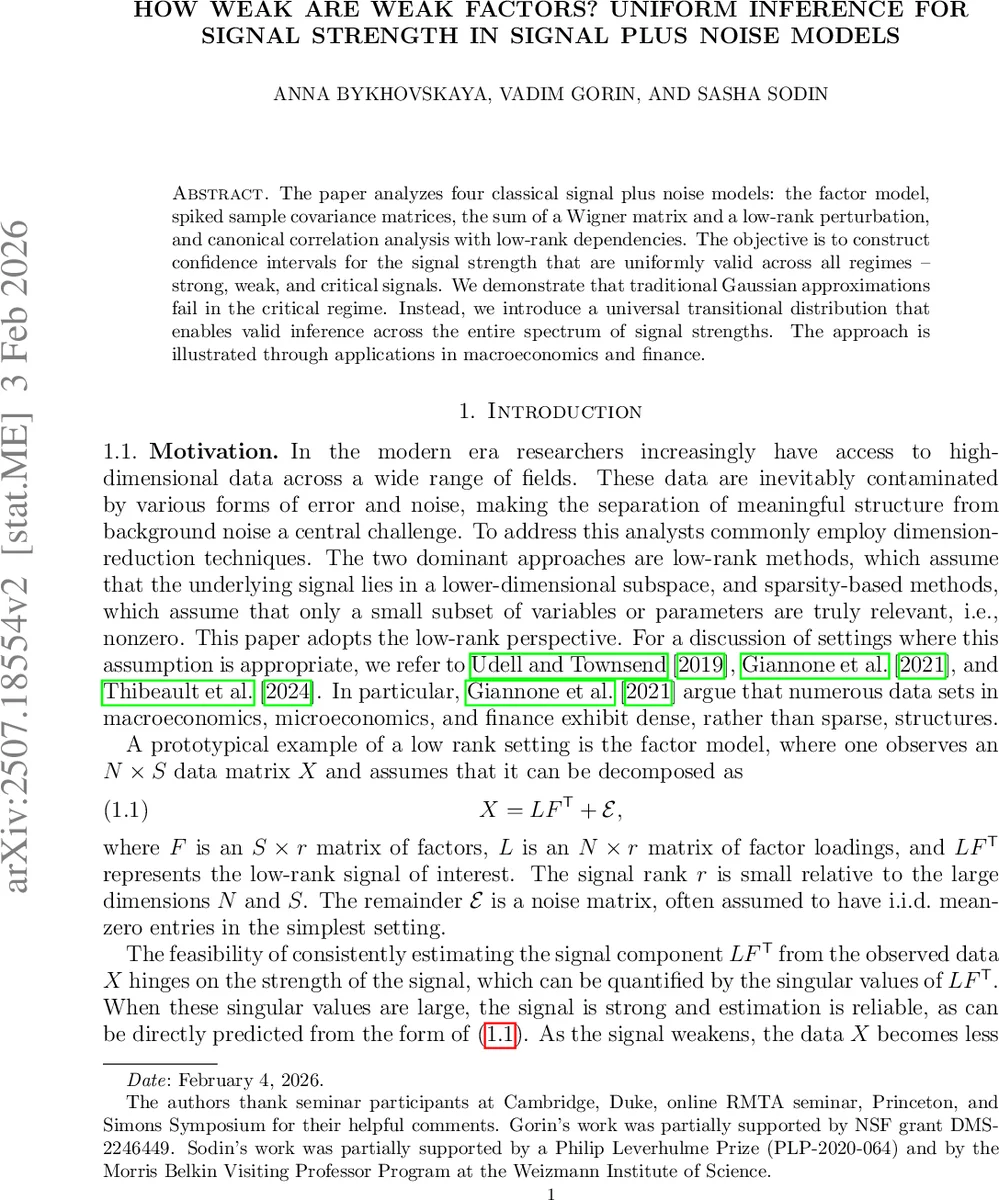
The paper analyzes four classical signal-plus-noise models: the factor model, spiked sample covariance matrices, the sum of a Wigner matrix and a low-rank perturbation, and canonical correlation analysis with low-rank dependencies. The objective is to construct confidence intervals for the signal strength that are uniformly valid across all regimes - strong, weak, and critical signals. We demonstrate that traditional Gaussian approximations fail in the critical regime. Instead, we introduce a universal transitional distribution that enables valid inference across the entire spectrum of signal strengths. The approach is illustrated through applications in macroeconomics and finance.
💡 Research Summary
This paper tackles a fundamental problem in high‑dimensional statistics: constructing confidence intervals for the strength of low‑rank signals embedded in noisy data, often called “spiked” models. The authors focus on four canonical settings that cover most applications in econometrics and finance: (i) the spiked Wigner model, (ii) spiked sample covariance matrices (equivalently, PCA‑based factor models), (iii) the spiked Wigner model with a low‑rank perturbation, and (iv) canonical correlation analysis (CCA) with low‑rank dependencies. All four can be expressed as a low‑rank signal matrix Θ =∑_{k=1}^r θ_k u_k v_k^T (or its symmetric version) added to a high‑dimensional noise matrix drawn from a classical random‑matrix ensemble (GOE, Wishart, or Jacobi).
In the classical asymptotic regime where dimensions grow proportionally, the largest eigenvalues λ_k of the observed matrix are the primary statistics used to estimate the signal strengths θ_k. When a signal is “super‑critical” (θ_k exceeds a known threshold θ_c), λ_k separates from the bulk and its fluctuations are asymptotically Gaussian. This leads to the familiar plug‑in estimator θ̂_k = f^{-1}(λ_k) together with a Gaussian confidence interval. However, when θ_k is close to the threshold (the “critical” regime) or below it, the eigenvalue distribution undergoes a phase transition: the fluctuations are no longer Gaussian but are governed by the Airy‑1 point process and related non‑standard limits. Existing methods that rely on Gaussian approximations therefore produce severely under‑covered intervals in the critical region.
The central contribution of the paper is the introduction of a universal transitional distribution, denoted G(w) and called the Airy–Green function. G(w) captures the joint limit of the appropriately scaled edge eigenvalues for all four models. The authors prove that, after model‑specific centering and scaling (constants c_N and d_N that depend only on the noise ensemble), the transformed statistic
T(Θ) = c_N (λ_k – λ_+) + d_N
converges in distribution to G(w). The proof rests on two relatively mild assumptions about the unspiked noise matrix: (i) the largest eigenvalue converges to the Airy‑1 process, and (ii) a local law holds for the Stieltjes transform near the spectral edge. Both are known for GOE, Wishart, and Jacobi ensembles, making the result broadly applicable.
Using this limit, the paper derives explicit (1–α) confidence intervals for each θ_k that are valid uniformly over strong, weak, and critical regimes. The interval endpoints are obtained by inverting the deterministic mapping f(θ) that links signal strength to the population edge λ(θ) and then adjusting by the quantiles of G(w). In symbols:
θ_k^{−} = f^{-1}(λ_k – c_N G_{α/2}), θ_k^{+} = f^{-1}(λ_k – c_N G_{1–α/2}),
where G_{q} denotes the q‑th quantile of the Airy–Green distribution. When θ_k≫θ_c the quantiles of G(w) collapse to the Gaussian quantiles, recovering the classical intervals; when θ_k≈θ_c the full non‑Gaussian shape of G(w) is essential.
The authors also propose a formula‑free bootstrap scheme that estimates the scaling constants directly from the data, allowing practitioners to implement the method without deep knowledge of random‑matrix theory.
Empirical illustrations cover three domains: (1) macro‑economic factor analysis, where many factors are weak and traditional methods would mistakenly deem them insignificant; (2) a large‑scale equity‑return factor model, showing that several “weak” factors actually have statistically significant strength once the transitional distribution is used; and (3) a financial network CCA, where the method correctly captures the uncertainty of inter‑market dependencies near the detection threshold. In all cases, Gaussian‑based intervals either under‑cover or become overly narrow near the critical point, while the proposed intervals achieve the nominal coverage.
In summary, the paper delivers a unified, theoretically rigorous, and practically implementable framework for inference on signal strength in a wide class of signal‑plus‑noise models. By identifying a single universal transitional law that governs the edge eigenvalue fluctuations across disparate ensembles, it bridges a gap between random‑matrix universality results and econometric inference, enabling reliable detection and quantification of weak factors that were previously inaccessible. Future work may extend the approach to non‑Gaussian noise, dependent observations, and multiple interacting spikes.
Comments & Academic Discussion
Loading comments...
Leave a Comment