LSD of the Commutator of two data Matrices
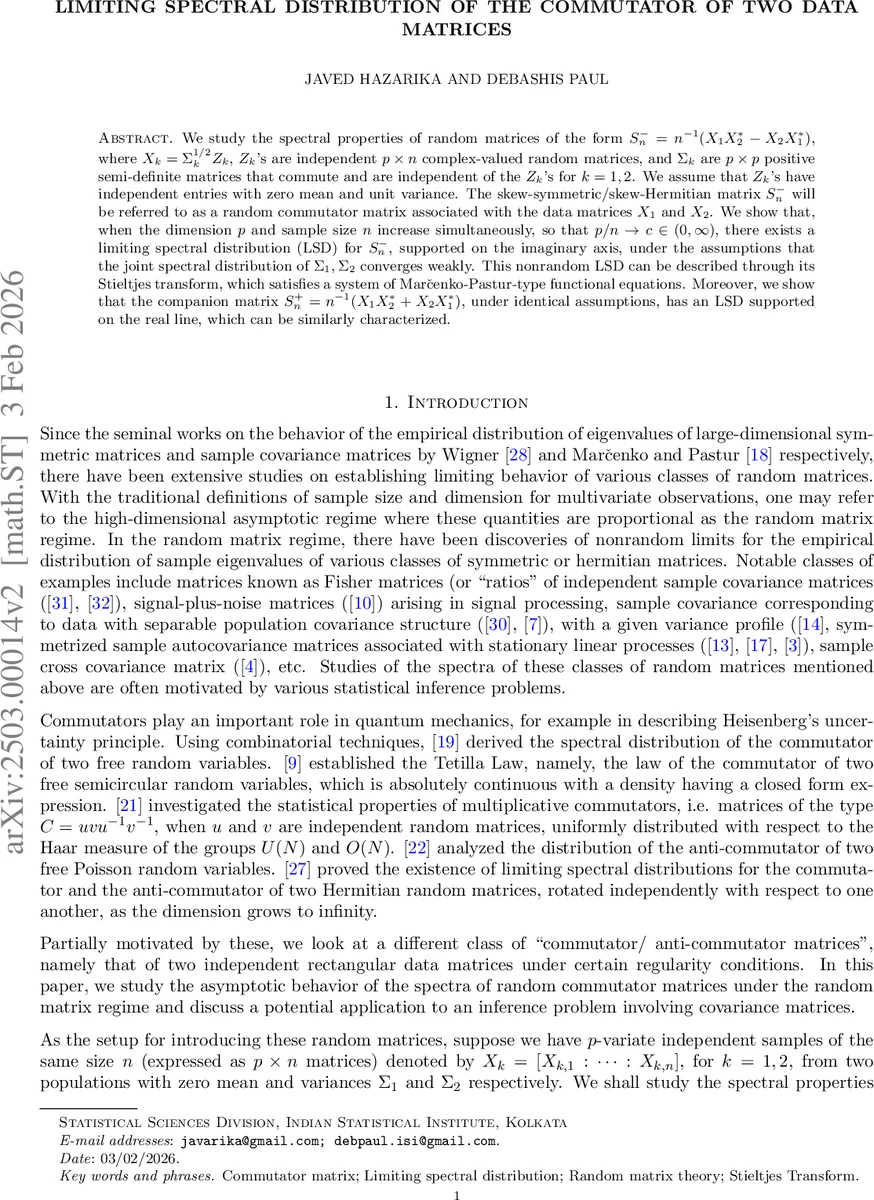
We study the spectral properties of a class of random matrices of the form $S_n^{-} = n^{-1}(X_1 X_2^* - X_2 X_1^)$ where $X_k = Σ_k^{1/2}Z_k$, $Z_k$’s are independent $p\times n$ complex-valued random matrices, and $Σ_k$ are $p\times p$ positive semi-definite matrices that commute and are independent of the $Z_k$’s for $k=1,2$. We assume that $Z_k$’s have independent entries with zero mean and unit variance. The skew-symmetric/skew-Hermitian matrix $S_n^{-}$ will be referred to as a random commutator matrix associated with the samples $X_1$ and $X_2$. We show that, when the dimension $p$ and sample size $n$ increase simultaneously, so that $p/n \to c \in (0,\infty)$, there exists a limiting spectral distribution (LSD) for $S_n^{-}$, supported on the imaginary axis, under the assumptions that the joint spectral distribution of $Σ_1, Σ_2$ converges weakly and the entries of $Z_k$’s have moments of sufficiently high order. This nonrandom LSD can be described through its Stieltjes transform, which satisfies a system of Marčenko-Pastur-type functional equations. Moreover, we show that the companion matrix $S_n^{+} = n^{-1}(X_1X_2^ + X_2X_1^*)$, under identical assumptions, has an LSD supported on the real line, which can be similarly characterized.
💡 Research Summary
The paper investigates the asymptotic spectral behavior of a novel class of random matrices that arise as commutators of two independent data matrices. Specifically, given two (p\times n) data matrices (X_{1}) and (X_{2}) defined by (X_{k}= \Sigma_{k}^{1/2} Z_{k}) for (k=1,2), where the (Z_{k}) have i.i.d. zero‑mean, unit‑variance entries with sufficiently high moments, and where the population covariance matrices (\Sigma_{1}) and (\Sigma_{2}) are positive semi‑definite, commute with each other, and are independent of the (Z_{k}), the authors consider the skew‑Hermitian “sample commutator”
\
Comments & Academic Discussion
Loading comments...
Leave a Comment