Advancing the phenomenology of GeV-scale axion-like particles
Searches for axion-like particles (ALPs) with masses in the GeV range are a central objective of present and future Intensity Frontier experiments. Interpreting these searches demands a reliable description of ALP production in hadronic collisions and decay. The prescription currently adopted by the community (i) depends on parameters of unphysical chiral rotation used to match gluonic ALP interactions with the interactions in terms of hadronic bound states, (ii) misdescribes the mass scaling of the ALP flux, and neglects mixing with heavy pseudoscalar resonances. We introduce a framework that treats GeV-scale ALP interactions in a chiral-rotation-invariant manner, includes their mixing with heavier excitations $π(1300)$, $η(1295)$, and $η(1440)$, and properly describes their production channels. When applying our description to proton beam experiments, we find that existing bounds and projected sensitivities shift by up to an order of magnitude relative to earlier estimates. We further delineate the dominant theoretical uncertainties, which originate from the still-incomplete experimental knowledge of the spectrum of pseudoscalar excitations.
💡 Research Summary
This paper addresses a long‑standing inconsistency in the phenomenology of GeV‑scale axion‑like particles (ALPs) that are primarily coupled to gluons (c G ≠ 0). The standard approach used by the community relies on a chiral rotation of the quark fields to eliminate the gluonic operator, introducing an unphysical matrix (\hat\kappa_q). Physical observables, however, should not depend on this arbitrary choice. The authors construct a fully (\hat\kappa_q)‑independent framework by (i) performing the chiral rotation, (ii) diagonalising the quadratic ALP–meson Lagrangian, and (iii) including all cubic and quartic ALP‑meson operators that arise at order (\epsilon = f_\pi/f_a). The cancellation between the (\hat\kappa_q)‑dependent pieces from the quadratic mixing and from higher‑order operators is demonstrated explicitly (Fig. 2), guaranteeing that production rates and decay widths are truly physical.
Beyond the low‑mass regime where pure chiral perturbation theory (ChPT) suffices, the authors recognise that for (m_a\sim 1)–2 GeV additional resonances contribute significantly. They adopt the Extended Linear Sigma Model (ELSM) to incorporate the heavy pseudoscalar excitations (\pi^0(1300)), (\eta(1295)) and (\eta(1440)), as well as axial‑vector states (a_1), (f_1(1285)) and (f_1(1415)). Mixing angles (\theta_{P_h a}) are derived by diagonalising the full quadratic Lagrangian; they become resonantly enhanced when the ALP mass approaches the resonance masses, a feature absent in earlier treatments.
The production of ALPs in proton‑beam experiments is re‑evaluated with a comprehensive set of mechanisms: (1) proton bremsstrahlung (initial‑state radiation) using the quasi‑real approximation and an ALP‑nucleon form factor, (2) final‑state radiation in quark fragmentation, (3) Drell–Yan gluon‑fusion (gg\to a) with scale variations to assess QCD uncertainties, (4) two‑ and three‑body decays of light mesons ((\pi^0,\eta,\eta’,K_S,K^+,\rho^0,\omega)), the latter two included for the first time, and (5) rare B‑meson decays (B\to X_{s/d} a). Each channel’s contribution to the ALP yield per proton‑on‑target is computed for a 400 GeV proton beam on a molybdenum target, mimicking the SHiP configuration. The authors provide theoretical uncertainty bands for each channel, reflecting variations in factorisation/renormalisation scales, fragmentation models, and the poorly known widths of the heavy resonances.
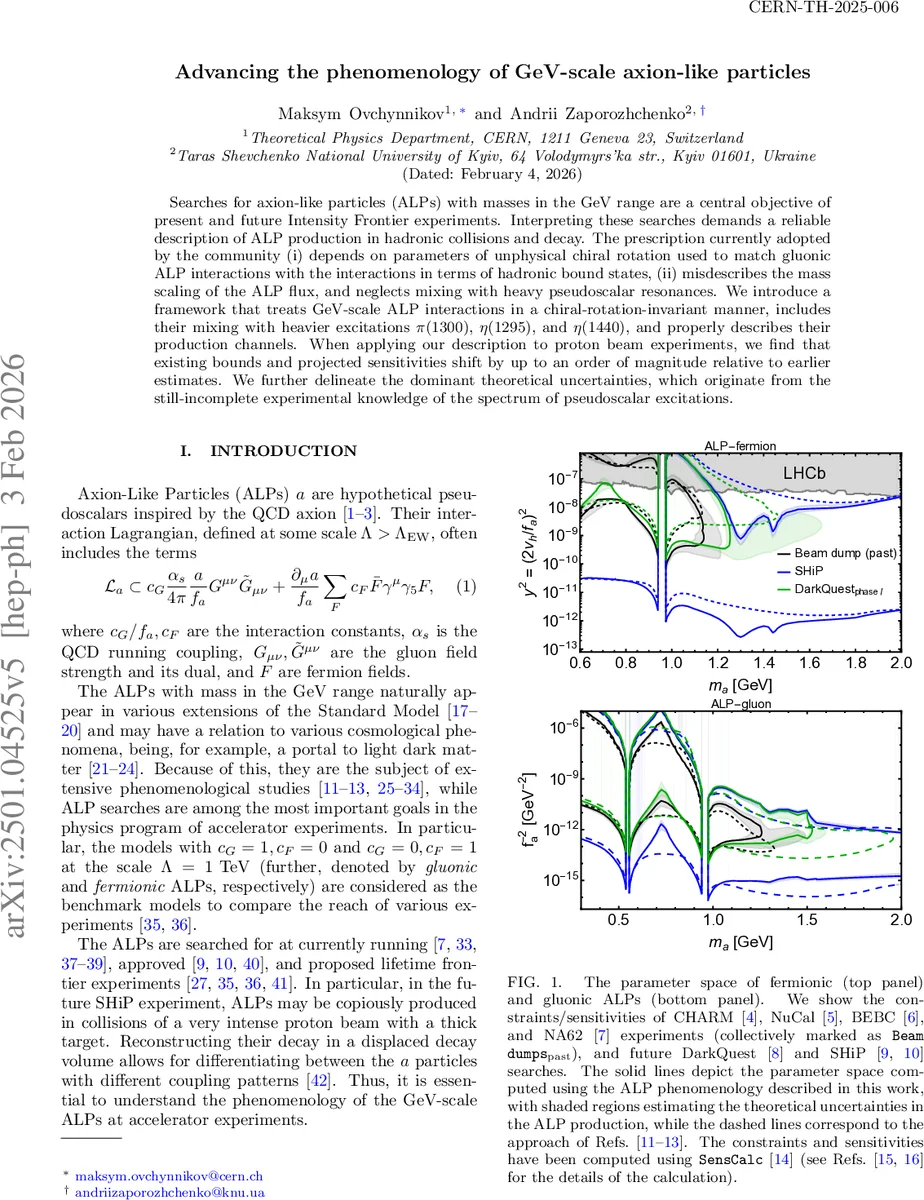
When the new framework is applied to existing beam‑dump limits (CHARM, NuCal, BEBC, NA62) and projected sensitivities of future experiments (SHiP, DarkQuest), the exclusion and discovery contours shift by up to an order of magnitude relative to the conventional approach of Refs.
Comments & Academic Discussion
Loading comments...
Leave a Comment