Fractal Topology of Majorana Bound States in Superconducting Quasicrystals
Quasicrystalline order induces a fractal energy spectrum, yet its impact on topological protection remains an open fundamental question. Here, we demonstrate that the topological phase transitions characterised by the appearance of Majorana Bound States themselves have a fractal character. By extending this analysis to the full family of Sturmian words, we uncover Kitaev’s Butterfly $-$ a spectral fractal analogous to Hofstadter’s butterfly, but fundamentally distinguished by a central superconducting gap. Within this framework, we identify Majorana’s Butterfly as a fractal topological phase diagram governed by the competition between quasicrystallinity and superconducting pairing. We show that this competition dictates a hierarchy of Majorana stability, where the survival of the topological phase against fractal fragmentation is determined by the relative strength of these competing energy scales.
💡 Research Summary
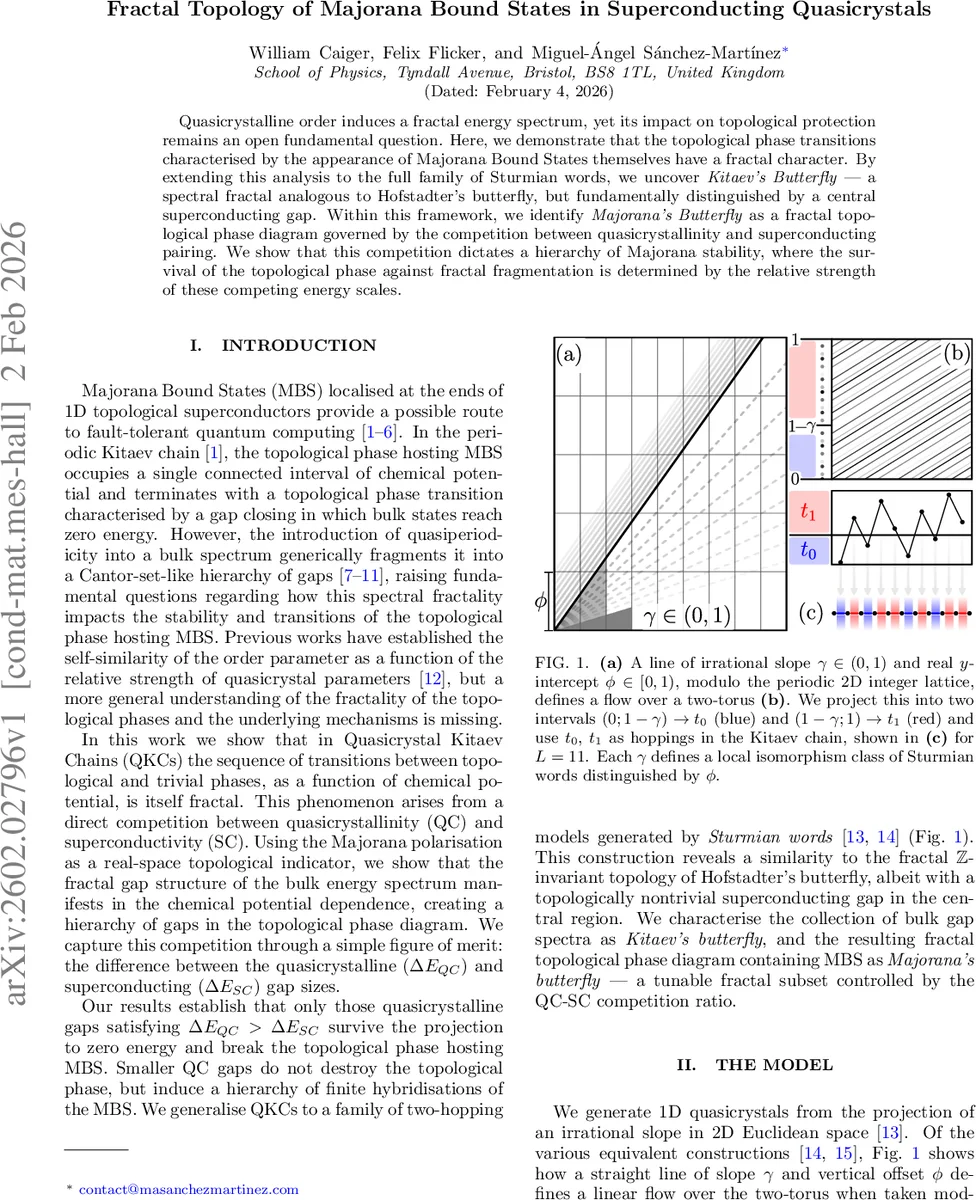
This paper investigates how quasicrystalline order influences the topological protection of Majorana bound states (MBS) in one‑dimensional superconducting Kitaev chains. By constructing quasicrystals from the projection of an irrational line onto a two‑torus, the authors generate binary hopping sequences (Sturmian words) that encode two distinct hopping amplitudes, t₀ and t₁. The resulting “quasicrystal Kitaev chain” (QKC) inherits a fractal energy spectrum reminiscent of a Cantor set, with an infinite hierarchy of gaps.
The authors first review the standard periodic Kitaev model, where a uniform hopping t and pairing Δ produce a Z₂ topological phase for |μ|<2t. In the QKC, the hopping becomes site‑dependent according to the Sturmian word, leading to an effective bandwidth Wγ≈4 \bar{t}_γ with \bar{t}_γ=(1−γ)+γρ (ρ=t₁/t₀). Consequently, the critical chemical potential shifts to μ′_c≈2 \bar{t}_γ.
A central result is that not every quasicrystalline gap translates into a topological transition. Using the gap‑labeling theorem N(E)=p+γq, each bulk gap is assigned an integer pair (p,q), where q counts the winding of mid‑gap states as the phason ϕ is varied. The central superconducting gap carries q=0 but possesses a Z₂ invariant that hosts MBS, distinguishing it from the Hofstadter butterfly’s Chern‑number‑labeled gaps.
To quantify the competition between quasicrystallinity (QC) and superconductivity (SC), the authors introduce two energy scales: the size of a QC‑induced bulk gap ΔE_QC and the size of the superconducting gap ΔE_SC that would appear at the same chemical potential after projection. They propose a simple criterion: a QC gap survives as a “MBS‑phase gap” (i.e., it breaks the topological phase) only if ΔE_QC > ΔE_SC. Otherwise the SC gap overwhelms the QC gap, preserving the MBS.
The real‑space diagnostic for this competition is the Majorana Polarisation (MP), defined as
M = P_L·P_R* = P_R·P_L* ,
where P_{L,R} are normalized particle‑hole expectation values on the left and right halves of the chain. For an ideal, isolated MBS pair M = −1; deviations indicate hybridisation or trivial zero‑energy states. Because MP varies continuously with μ, a tolerance ε must be set (M < −1 + ε) to decide whether the system is in a topological phase. By lowering ε more gaps are detected, revealing a hierarchy of increasingly small QC gaps that only weakly perturb the MBS.
Numerical simulations on the Fibonacci chain (γ = φ−1) with L = 200 sites illustrate the concept. The full fractal spectrum is plotted, and the regions where ΔE_QC > ΔE_SC are highlighted; these correspond precisely to the five “MBS‑phase gaps” where MP drops below the chosen threshold. The authors show that as the ratio ρ/Δ′ (QC strength over pairing strength) is increased, more QC gaps satisfy the criterion, and the MP landscape develops a series of “domes” whose heights encode the order in which gaps become topological as the ratio diverges. In the limit ρ/Δ′ → ∞ every QC gap dominates, producing an infinitely fine fractal topological phase diagram.
Extending beyond the Fibonacci case, the authors demonstrate that all irrational γ∈(0,1) (the full Sturmian family) generate identical fractal structures. By scanning γ and the energy axis they construct “Kitaev’s Butterfly” (KB), a spectral fractal that mirrors the Hofstadter butterfly (HB) in symmetry and q‑labeling, but with a central superconducting gap (q = 0) absent in HB. The subset of KB where the QC‑SC competition criterion holds is dubbed “Majorana’s Butterfly,” a tunable fractal region that directly maps to the presence of robust MBS.
The paper concludes that the interplay between quasiperiodic modulation and superconducting pairing fragments the topological phase diagram into a self‑similar hierarchy. This fractal topological protection suggests new routes for engineering robust Majorana platforms: by designing the hopping modulation (γ, ρ) one can control the number and size of topological gaps, potentially enabling multi‑scale manipulation of Majorana modes. Moreover, the combined use of gap‑labeling and Majorana polarisation provides a powerful framework for diagnosing topology in non‑periodic superconductors, where conventional momentum‑space invariants fail. The work opens avenues for exploring fractal topological phases, disorder‑resilient quantum computation schemes, and the broader classification of superconducting quasicrystals.
Comments & Academic Discussion
Loading comments...
Leave a Comment