Comment on ''The space-time line element for static ellipsoidal objects''
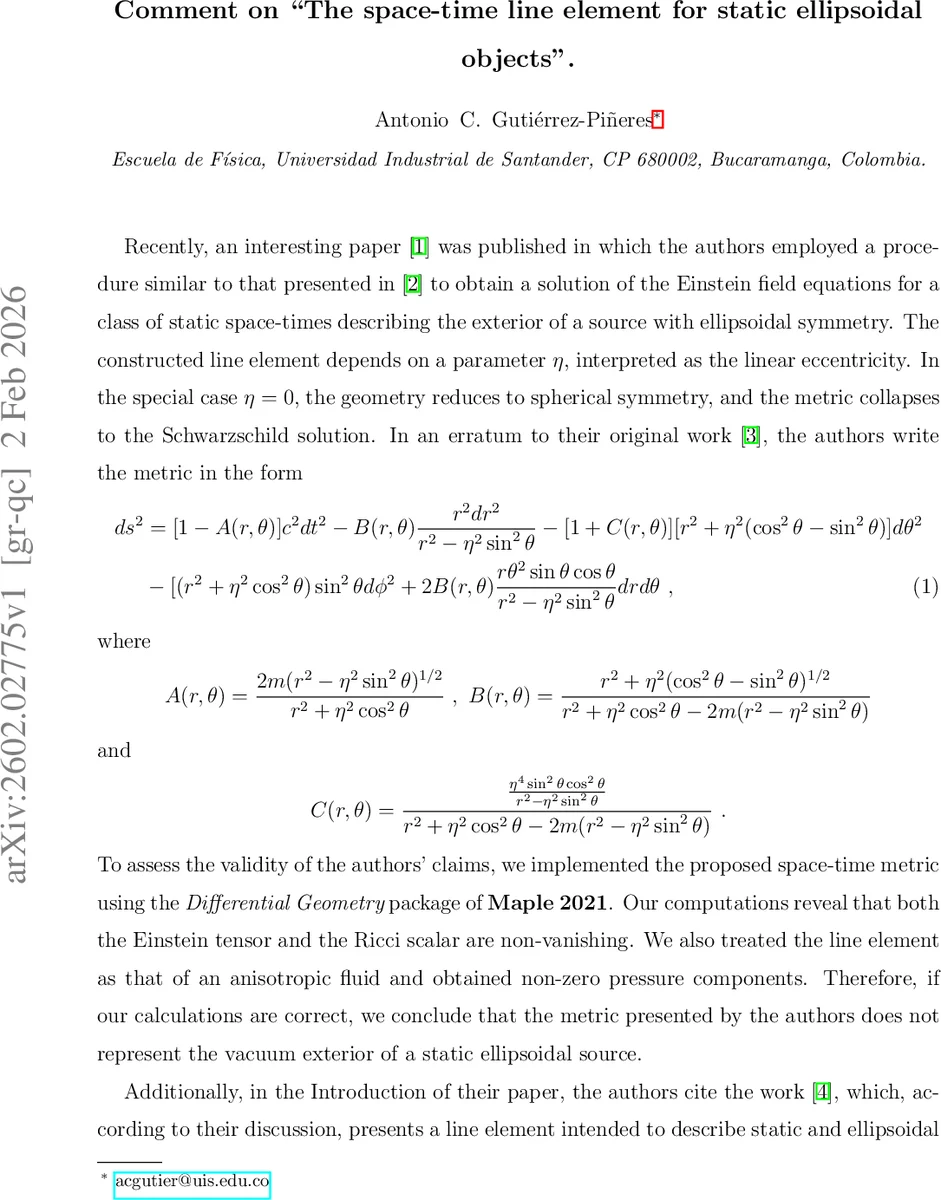
A recent paper proposes a static ellipsoidal space-time metric that reduces to Schwarzschild. After examining the corrected line element using Maple’s Differential geometry package, we find that the Einstein tendor and Ricci scalar are non-zero, and the metric yields non-zero pressures when interpreted as an anisotropic fluid. Thus, it does not represent a vacuum solution. We also checked a cited ellipsoidal metric from the literature and found it likewise fails to satisfy the vacuum Einstein equations.
💡 Research Summary
The paper under review critically examines a recently proposed static ellipsoidal space‑time metric that allegedly reduces to the Schwarzschild solution when the eccentricity parameter η vanishes. The authors of the original work claim that the line element, constructed via a procedure reminiscent of Chandrasekhar’s method, describes the vacuum exterior of a source with ellipsoidal symmetry. In an erratum the metric was rewritten in terms of three functions A(r,θ), B(r,θ) and C(r,θ), and the claim of vacuum character was retained.
To test these assertions, the present authors implemented the full metric in Maple 2021 using its Differential Geometry package. They first defined the metric tensor g_{μν} and computed its inverse, then derived the Christoffel symbols, Ricci tensor R_{μν}, Ricci scalar R, and finally the Einstein tensor G_{μν}=R_{μν}−½g_{μν}R. The symbolic computation revealed that none of the Einstein tensor components vanish for generic (r,θ) when η≠0. Explicitly, G_{tt}, G_{rr}, G_{θθ} and G_{φφ} are non‑zero functions of η, the mass parameter m, and the coordinates. Consequently the metric does not satisfy the vacuum Einstein equations R_{μν}=0.
The authors then interpreted the same line element as describing an anisotropic fluid, i.e. they set T_{μν}=diag(ρ,−p_r,−p_θ,−p_φ) and used the Einstein equations G_{μν}=8πT_{μν} to read off effective energy density and pressures. The resulting pressures p_r, p_θ, p_φ are non‑zero and depend on both r and θ, exhibiting angular anisotropy that is absent in a true vacuum solution. In particular, for η≠0 the pressures can change sign, indicating an unphysical matter distribution if one insists on a fluid interpretation.
In addition to the primary metric, the paper also scrutinizes a second ellipsoidal line element cited in the original work (Nikouravan 2011). Applying the same Maple‑based procedure, the authors find that this second metric likewise yields a non‑vanishing Einstein tensor and Ricci scalar, confirming that it too fails to be a vacuum solution.
The overall conclusion is that while the proposed metric correctly reproduces the Schwarzschild geometry in the limit η→0, it does not represent a vacuum exterior for any non‑zero eccentricity. Instead it encodes a non‑trivial stress‑energy content, contradicting the original claim of a vacuum solution. The authors therefore advise that the metric should not be used to model the exterior of a static ellipsoidal body unless an explicit matter source is introduced. Future work should either search for a genuine vacuum solution with ellipsoidal symmetry or develop a consistent matter model that accounts for the anisotropic stresses revealed by the calculations.
Comments & Academic Discussion
Loading comments...
Leave a Comment