Marvelous slices of orthogonal matrices
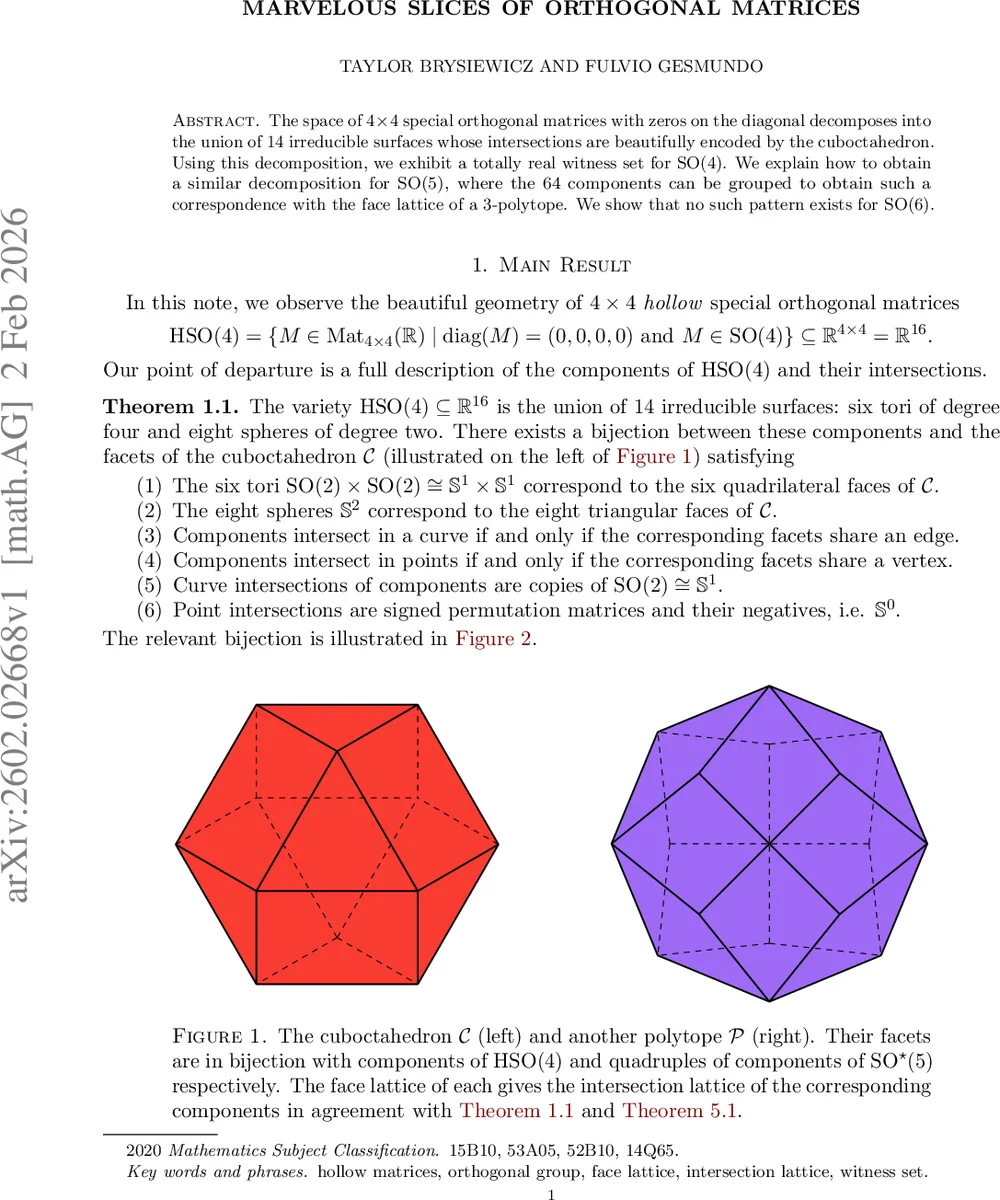
The space of $4 \times 4$ special orthogonal matrices with zeros on the diagonal decomposes into the union of $14$ irreducible surfaces whose intersections are beautifully encoded by the cuboctahedron. Using this decomposition, we exhibit a totally real witness set for $SO(4)$. We explain how to obtain a similar decomposition for $SO(5)$, where the $64$ components can be grouped to obtain such a correspondence with the face lattice of a $3$-polytope. We show that no such pattern exists for $SO(6)$.
💡 Research Summary
The paper investigates special orthogonal matrices whose diagonal entries are forced to be zero, a condition the authors refer to as “hollow”. For the 4 × 4 case they define the set HSO(4) ⊂ SO(4) and prove that it decomposes into exactly fourteen irreducible algebraic surfaces: six 2‑dimensional tori (each isomorphic to S¹ × S¹) of degree four and eight 2‑spheres (each isomorphic to S²) of degree two. The key observation is that these fourteen components are in bijection with the fourteen faces of a cuboctahedron. The six tori correspond to the six quadrilateral faces, while the eight spheres correspond to the eight triangular faces.
Intersection patterns mirror the face lattice of the cuboctahedron: two components intersect along a one‑dimensional curve (a copy of S¹) precisely when the corresponding faces share an edge, and they intersect at isolated points (signed permutation matrices with determinant ±1) precisely when the faces meet at a vertex. The authors tabulate these incidences (Table 3.1) and illustrate them in Figures 2 and 3.
Using this combinatorial decomposition, the authors construct a totally real witness set for SO(4). Since deg SO(4)=40, they exhibit two linear hyperplanes H₁ and H₂ whose intersection with SO(4) consists of exactly forty real points. These points are explicitly listed; each has entries involving a = ±1/√3 and arises as an intersection of the previously described spheres and tori. This resolves the conjecture from
Comments & Academic Discussion
Loading comments...
Leave a Comment