Discovering Data Manifold Geometry via Non-Contracting Flows
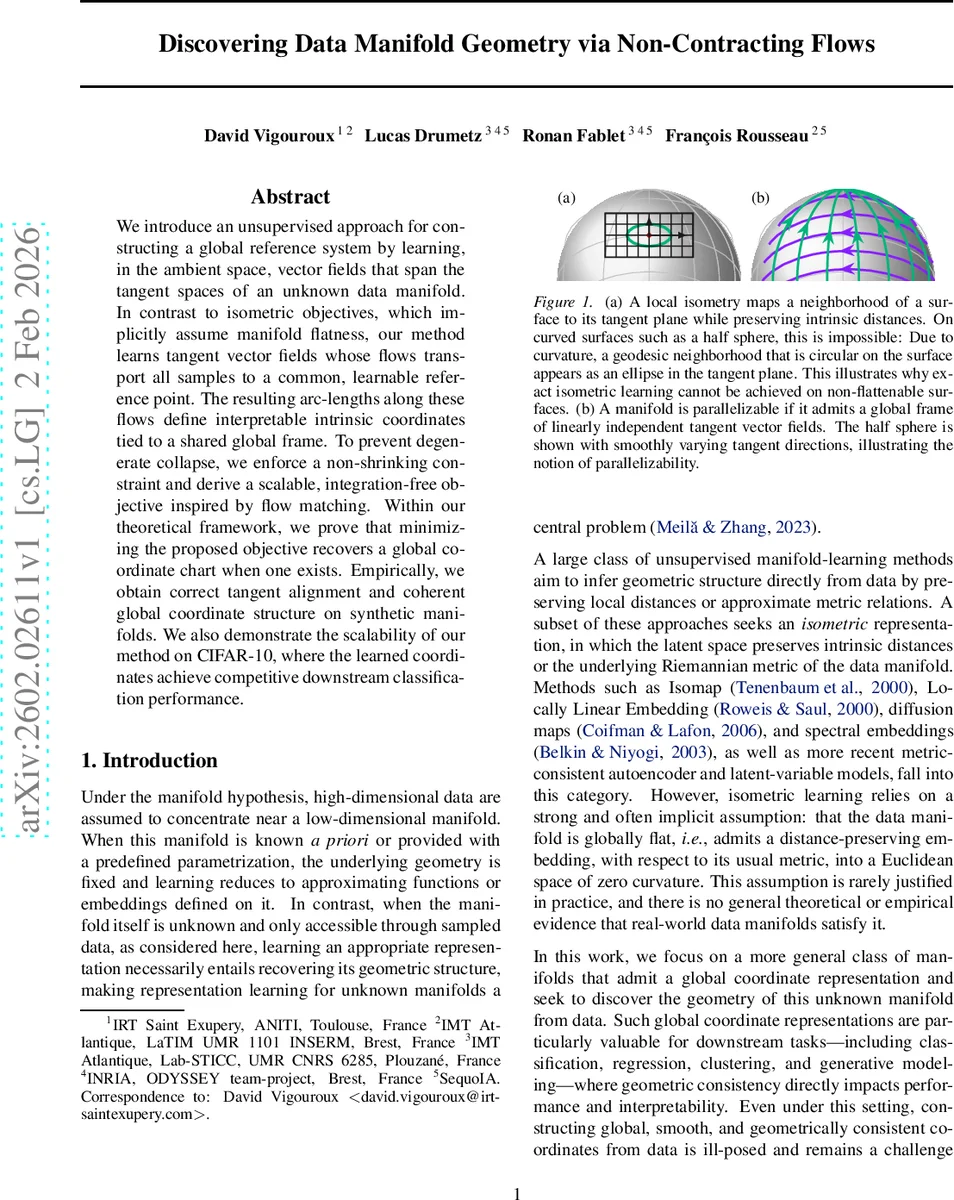
We introduce an unsupervised approach for constructing a global reference system by learning, in the ambient space, vector fields that span the tangent spaces of an unknown data manifold. In contrast to isometric objectives, which implicitly assume manifold flatness, our method learns tangent vector fields whose flows transport all samples to a common, learnable reference point. The resulting arc-lengths along these flows define interpretable intrinsic coordinates tied to a shared global frame. To prevent degenerate collapse, we enforce a non-shrinking constraint and derive a scalable, integration-free objective inspired by flow matching. Within our theoretical framework, we prove that minimizing the proposed objective recovers a global coordinate chart when one exists. Empirically, we obtain correct tangent alignment and coherent global coordinate structure on synthetic manifolds. We also demonstrate the scalability of our method on CIFAR-10, where the learned coordinates achieve competitive downstream classification performance.
💡 Research Summary
In this paper the authors address a fundamental limitation of most unsupervised manifold‑learning methods: the implicit assumption that the underlying data manifold is globally flat and can be embedded isometrically into Euclidean space. Instead of preserving pairwise distances, they propose to learn a set of vector fields defined directly in the ambient space that span the tangent spaces of the unknown manifold. By treating each vector field as the generator of a flow, they construct a sequence of m flows (where m is the intrinsic dimension) that progressively transports every data point toward a common reference point C. The arc‑length travelled along the i‑th flow, ℓ_i(x), becomes the i‑th coordinate of x in a global chart.
A central technical challenge is to avoid the degenerate solution where all flows simply collapse the data onto C, discarding any geometric information. To prevent this, the authors impose a non‑shrinking constraint: the Lie derivative of the Euclidean metric along each vector field must be positive semi‑definite. Intuitively, nearby trajectories are not allowed to contract distances locally, which forces each learned field to remain tangent to the manifold and to align with a distinct intrinsic direction.
Training such a system would normally require numerical integration of the flows, which is computationally prohibitive for high‑dimensional data. The authors exploit the commutativity of the learned vector fields – flowing along F_i then F_j yields the same result as the opposite order – and replace the integration‑based loss with a flow‑matching‑inspired, integration‑free objective:
\
Comments & Academic Discussion
Loading comments...
Leave a Comment