Nonlinear light cone spreading of correlations in a triangular quantum magnet: a hard quantum simulation target
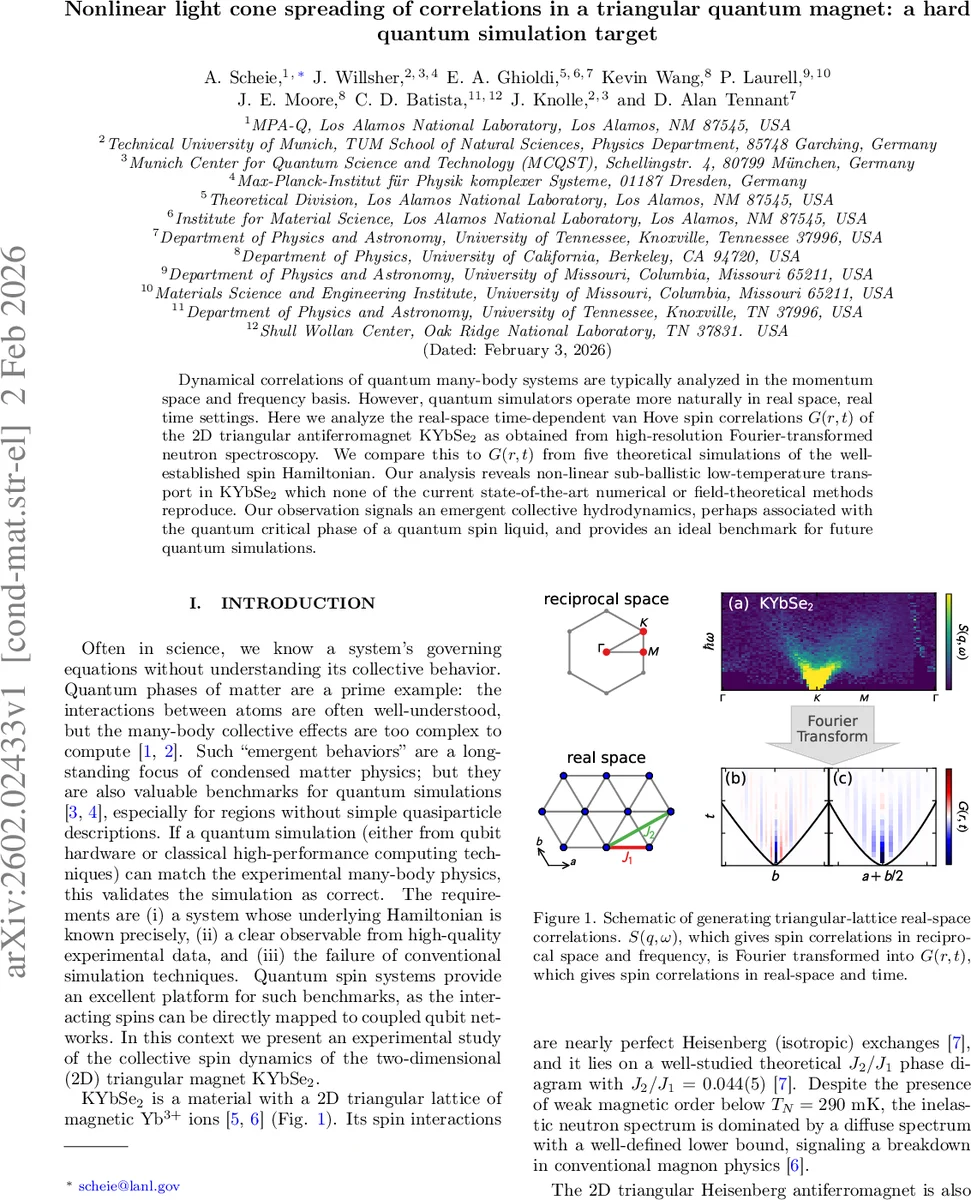
Dynamical correlations of quantum many-body systems are typically analyzed in the momentum space and frequency basis. However, quantum simulators operate more naturally in real space, real time settings. Here we analyze the real-space time-dependent van Hove spin correlations $G(r,t)$ of the 2D triangular antiferromagnet KYbSe$_2$ as obtained from high-resolution Fourier-transformed neutron spectroscopy. We compare this to $G(r,t)$ from five theoretical simulations of the well-established spin Hamiltonian. Our analysis reveals non-linear sub-ballistic low-temperature transport in KYbSe$_2$ which none of the current state-of-the-art numerical or field-theoretical methods reproduce. Our observation signals an emergent collective hydrodynamics, perhaps associated with the quantum critical phase of a quantum spin liquid, and provides an ideal benchmark for future quantum simulations.
💡 Research Summary
The authors present a comprehensive study of real‑space, real‑time spin correlations in the two‑dimensional triangular antiferromagnet KYbSe₂, using high‑resolution Fourier‑transformed inelastic neutron scattering to obtain the van Hove correlation function G(r,t) at a base temperature of 0.3 K. The material is a near‑ideal realization of a J₁‑J₂ Heisenberg model on a triangular lattice with a precisely known exchange ratio J₂/J₁≈0.044, placing it close to the boundary of the quantum spin‑liquid (QSL) regime. Despite weak magnetic order below T_N≈0.29 K, the neutron spectrum is dominated by a broad continuum, indicating that conventional magnon descriptions fail.
To benchmark quantum‑simulation capabilities, the authors compare the experimental G(r,t) with five state‑of‑the‑art theoretical approaches applied to the same Hamiltonian: (i) zero‑temperature linear spin‑wave theory (LSWT), (ii) Schwinger‑boson mean‑field theory, (iii) finite‑temperature classical Landau‑Lifshitz (LL) dynamics, (iv) a U(1) random‑phase approximation (RPA) designed for a Dirac spin‑liquid near the 120° ordered phase, and (v) matrix‑product‑state (MPS) calculations on a six‑site circumference cylinder. Each method reproduces certain qualitative aspects of the data (e.g., overall shape of the light cone), but none captures the key quantitative feature: a non‑linear, sub‑ballistic light‑cone propagation.
Experimentally, the onset of non‑zero imaginary G(r,t) defines a “light cone” that deviates from a straight line in the (r, t) plane. By fitting the onset time t_onset to a power law t_onset = A r^z, the authors extract a dynamical exponent z ≈ 1.4–1.5. This lies between the ballistic limit (z = 1) and diffusive limit (z = 2), indicating super‑diffusive but sub‑ballistic transport of spin correlations. All five theoretical models yield z≈1 (or, for MPS, an artificial cutoff due to finite size), failing to reproduce the observed exponent.
The paper discusses three possible origins of the anomalous exponent. First, integrable one‑dimensional spin chains exhibit similar super‑diffusive exponents (z≈1.5) at high temperatures, but the triangular lattice is non‑integrable and the effect appears at the lowest temperatures, making this explanation unlikely. Second, confinement of spinons could slow down propagation, yet the relevant energy scale (set by T_N) would imply dynamics on a timescale an order of magnitude longer than observed. Third, the authors favor an emergent quantum‑critical hydrodynamics scenario: near a quantum critical point, quasiparticles dissolve and collective hydrodynamic modes dominate, leading to non‑linear spreading of correlations. This interpretation aligns with recent theoretical proposals linking KYbSe₂’s low‑energy response to Gross‑Neveu‑QED₃ universality and with the notion of quantum‑critical transport in two dimensions.
Beyond the fundamental physics, the authors argue that the observed non‑linear light cone satisfies the three criteria for an ideal quantum‑simulation benchmark: (i) the microscopic Hamiltonian is known with high precision, (ii) the experimental observable (the exponent z in G(r,t)) is cleanly extracted from high‑quality data, and (iii) all leading classical and tensor‑network methods fail to reproduce it. Consequently, reproducing this feature constitutes a realistic near‑term target for both digital quantum computers (e.g., gate‑based simulators) and analog quantum simulators (e.g., Rydberg atom arrays). Successful replication would validate quantum hardware while simultaneously shedding light on the unresolved question of how strong quantum interactions reshape correlation spreading in frustrated magnets.
In conclusion, the work uncovers a previously unanticipated sub‑ballistic magnetic transport in a well‑characterized triangular antiferromagnet, highlights a clear deficiency in current many‑body simulation techniques, and establishes a concrete, experimentally accessible metric for future quantum‑simulation efforts. The study also demonstrates the power of real‑space, real‑time correlation functions as a diagnostic tool for complex quantum materials, revealing subtle collective dynamics that are obscured in conventional momentum‑frequency analyses.
Comments & Academic Discussion
Loading comments...
Leave a Comment