A formula for any real number, maybe
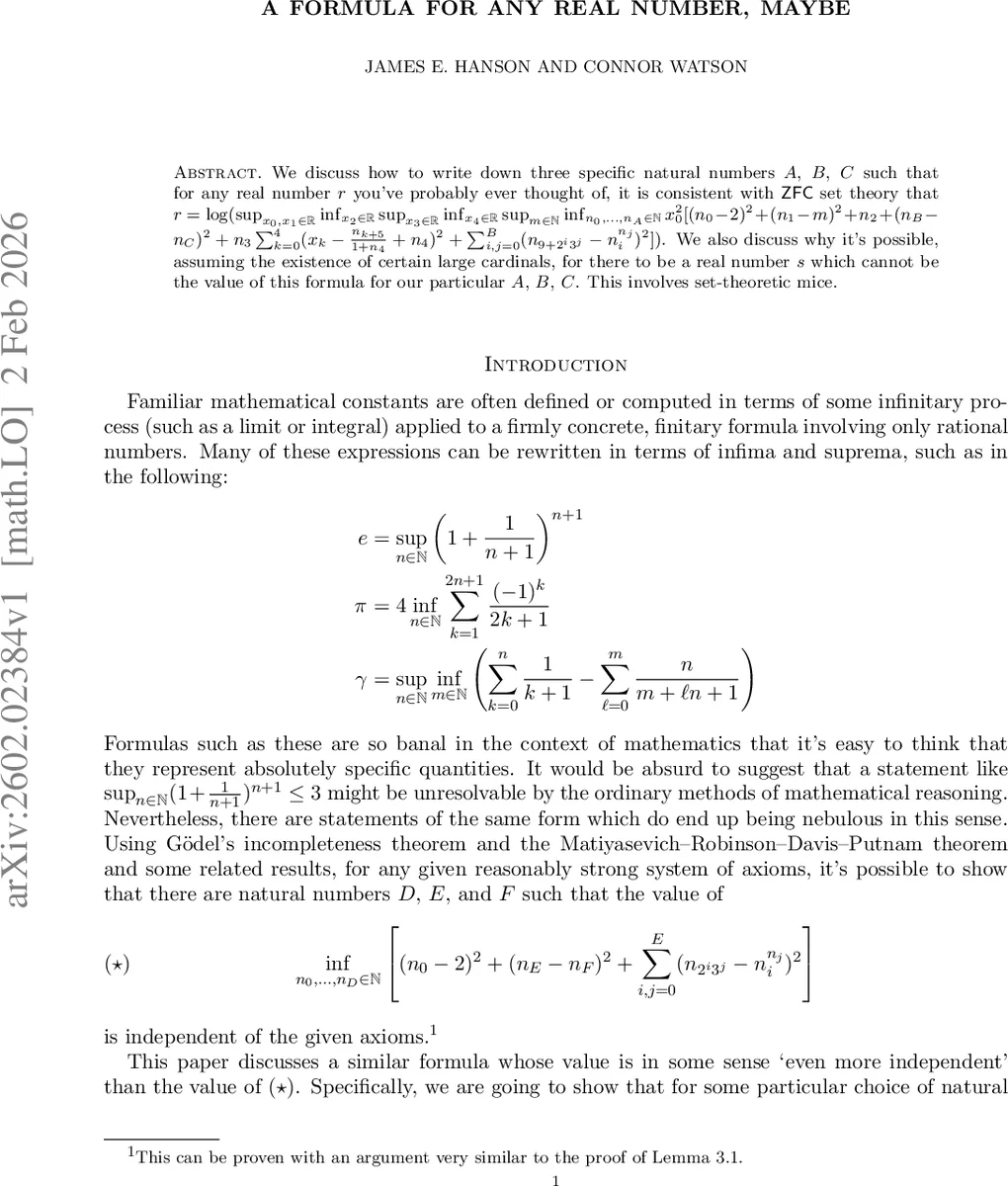
We discuss how to write down three specific natural numbers $A$, $B$, $C$ such that for any real number $r$ you’ve probably ever thought of, it is consistent with $\mathsf{ZFC}$ set theory that $$\def\Rb{\mathbb{R}}\def\Nb{\mathbb{N}}r = \log\left(\sup_{x_0,x_1 \in \Rb} \inf_{x_2 \in \Rb} \sup_{x_3 \in \Rb}\inf_{x_4 \in \Rb}\sup_{m \in \Nb}\inf_{n_0,\dots,n_{A} \in \Nb} x^2_0 \begin{bmatrix} \phantom{+}(n_0 - 2)^2 + (n_1-m)^2 \ + n_2 + (n_B - n_C)^2 \ + n_3 \sum_{k=0}^4 ( x_k - \frac{n_{k+5}}{1+n_4} +n_4)^2 \ + \sum_{i,j = 0}^B (n_{9+2^i3^j} - n_i^{n_j})^2 \end{bmatrix} \right).$$ We also discuss why it’s possible, assuming the existence of certain large cardinals, for there to be a real number $s$ which cannot be the value of this formula for our particular $A$, $B$, $C$. This involves set-theoretic mice.
💡 Research Summary
The paper by Hanson and Watson presents a striking claim: there exist three specific natural numbers A, B, C such that for any real number r a fixed, highly nested formula (denoted (†) in the text) can be made to equal r, and moreover the set of possible values of this formula is so flexible that, assuming the existence of certain large cardinals, there is also a real number s that cannot be obtained as the value of the same formula. The authors frame their work as a continuation of a line of research that shows how many familiar constants (e, π, γ, etc.) can be expressed via infinite processes (limits, integrals, suprema/infima) and then rewritten as finite arithmetic expressions involving only rational data.
The technical core proceeds in three stages. First, the authors recall the hierarchy of effective descriptive‑set‑theoretic classes Σ¹ₙ and Π¹ₙ, emphasizing that any “explicitly defined” subset of ℝ can be coded as a computably open (or Gδ) set, and that the same coding works for Cantor space 2^ω via a computable bijection. This machinery lets them translate set‑theoretic constructions into concrete finite formulas.
Second, they embed this machinery into the concrete expression (†): a long alternating sequence of suprema and infima over real variables x₀,…,x₄, a natural‑number variable m, and a finite block of natural‑number variables n₀,…,n_A. The inner bracket contains a sum of squares built from simple polynomial pieces such as (n₀−2)², (n₁−m)², (n_B−n_C)², a quadratic term involving the x_k’s and the n_i’s, and a highly indexed term Σ_{i,j≤B}(n_{9+2^i3^j}−n_i^{n_j})². By a careful choice of A, B, C the authors argue that the whole expression evaluates, after taking the outer logarithm, to any prescribed non‑negative real number r. In other words, the formula is universal for reals.
Third, the paper addresses independence. Using the “multiverse perspective” (originally due to Hamkins), they note that for a simpler formula (⋆) the only way to change its value between models is to alter the natural numbers themselves. By contrast, (†) can be altered merely by changing the set of reals available in a model. To make this precise they work inside the constructible universe L and its extensions L
Comments & Academic Discussion
Loading comments...
Leave a Comment