Unlocking the Duality between Flow and Field Matching
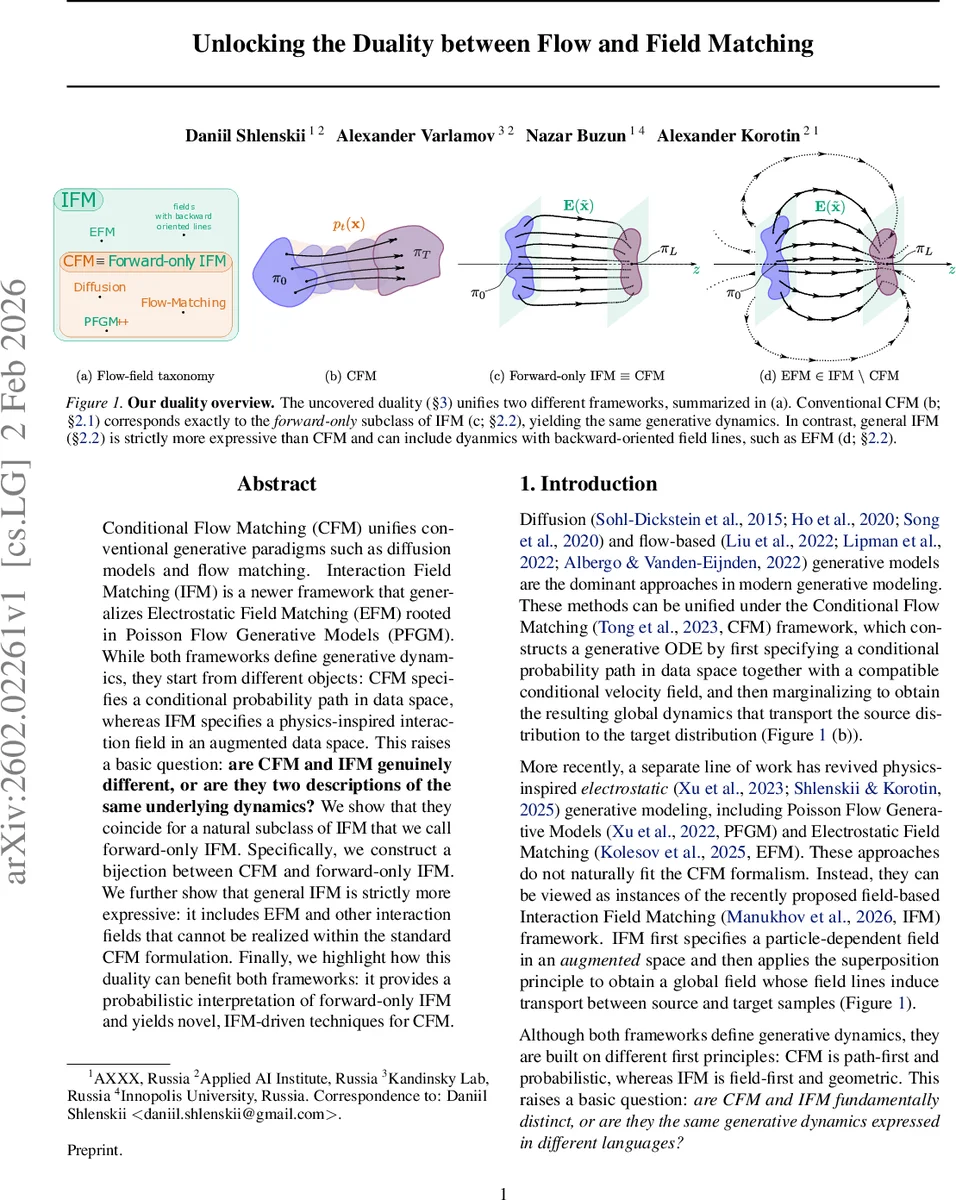
Conditional Flow Matching (CFM) unifies conventional generative paradigms such as diffusion models and flow matching. Interaction Field Matching (IFM) is a newer framework that generalizes Electrostatic Field Matching (EFM) rooted in Poisson Flow Generative Models (PFGM). While both frameworks define generative dynamics, they start from different objects: CFM specifies a conditional probability path in data space, whereas IFM specifies a physics-inspired interaction field in an augmented data space. This raises a basic question: are CFM and IFM genuinely different, or are they two descriptions of the same underlying dynamics? We show that they coincide for a natural subclass of IFM that we call forward-only IFM. Specifically, we construct a bijection between CFM and forward-only IFM. We further show that general IFM is strictly more expressive: it includes EFM and other interaction fields that cannot be realized within the standard CFM formulation. Finally, we highlight how this duality can benefit both frameworks: it provides a probabilistic interpretation of forward-only IFM and yields novel, IFM-driven techniques for CFM.
💡 Research Summary
The paper investigates the relationship between two recently proposed generative modeling frameworks: Conditional Flow Matching (CFM) and Interaction Field Matching (IFM). CFM, introduced by Tong et al. (2023), builds a generative ODE by first defining a conditional probability path (p_{x_0,x_T}(x,t)) and an associated conditional velocity field (v_{x_0,x_T}(x,t)) in the data space (\mathbb{R}^D). By marginalizing over a joint data coupling (\pi_{0,T}), one obtains a global velocity (v_t(x)=\mathbb{E}_{p_t(x_0,x_T|x)}
Comments & Academic Discussion
Loading comments...
Leave a Comment