Strong Correlations in the Dynamical Evolution of Lowest Landau Level Bosons
Recent experiments with rotating Bose gases have demonstrated the interaction-driven hydrodynamic instability of an initial extended strip-like state in the lowest Landau level. We investigate this phenomenon in the low density limit, where the mean-field Gross–Pitaevskii theory becomes inadequate, using exact diagonalisation studies and analytic arguments. We show that the behaviour can be understood in terms of weakly-interacting repulsively-bound few-body clusters. Signatures of cluster behaviour are observed in the expectation values of observables which oscillate at frequencies characterised by the energies of few-body boundstates. Using a semiclassical theory for interacting clusters, we predict the long-time growth of the cloud width to be a power law in the logarithm of time. This slow thermalisation of bound clusters represents a form of quantum many-body scars.
💡 Research Summary
The authors investigate the dynamical instability observed in rotating Bose‑Einstein condensates that are prepared in an extended strip‑like configuration and confined to the lowest Landau level (LLL). While previous works explained the instability using mean‑field Gross–Pitaevskii (GP) theory or Bogoliubov approximations, those approaches become unreliable in the low‑density regime where quantum fluctuations dominate. To address this, the paper combines exact diagonalisation (ED) of the projected LLL Hamiltonian with analytic, semiclassical arguments.
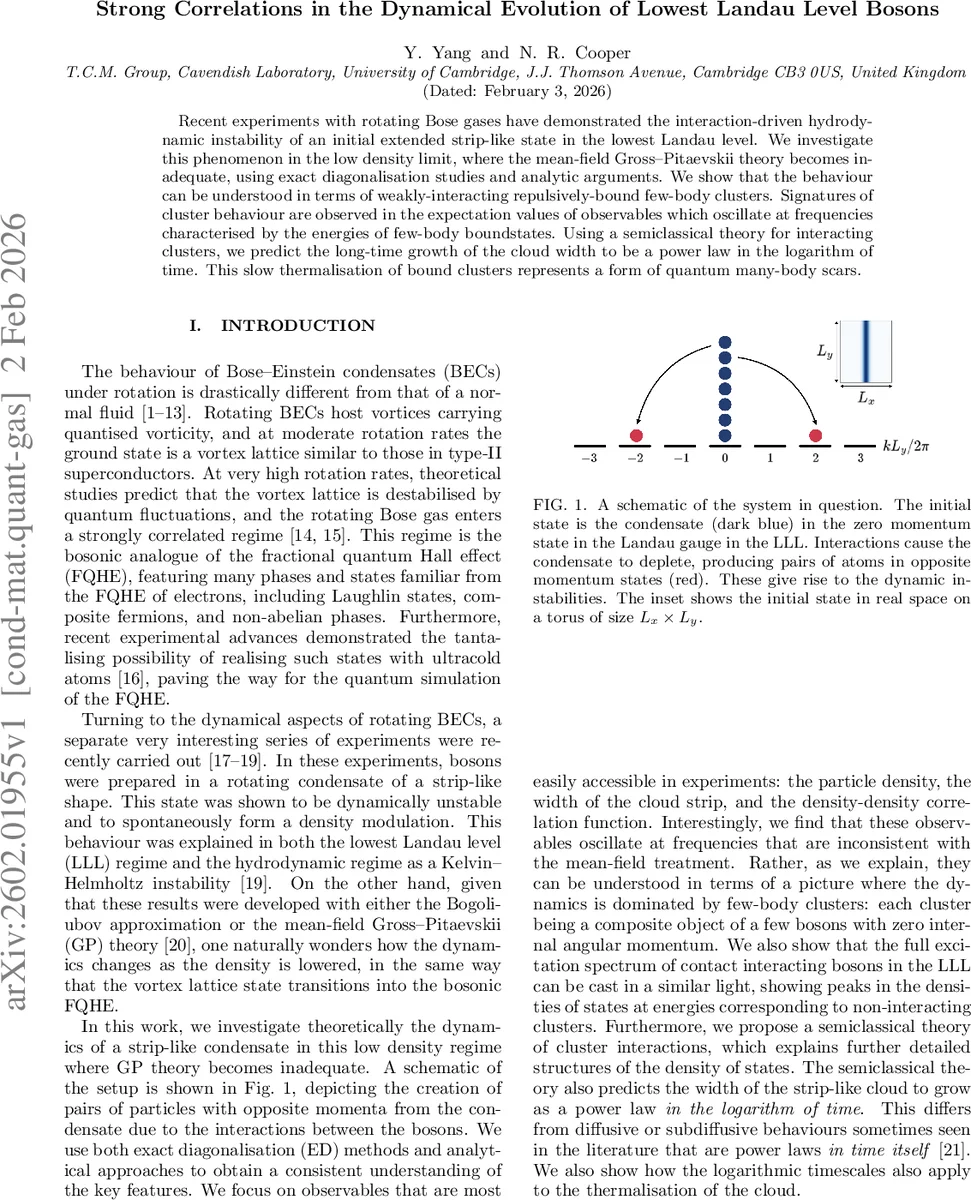
The key physical picture that emerges is that of “repulsively‑bound few‑body clusters.” In the LLL, contact interactions admit exact eigenstates in which c bosons completely overlap (zero internal angular momentum). Such a c‑particle cluster has a fixed interaction energy V₀ c(c‑1)/2, where V₀ = g/(4πℓ_B²) is the Haldane pseudopotential for two particles. The many‑body state can be decomposed into a set of non‑interacting clusters of various sizes {n_c}, with total particle number N = Σ_c c n_c and total energy E = Σ_c n_c c(c‑1)V₀/2. The initial strip state (all particles in the k = 0 momentum mode) is a superposition of many such cluster configurations.
ED results reveal that observables such as the momentum‑space density ⟨ρ̂₀⟩ and its square ⟨ρ̂₀²⟩ display sharp peaks in their Fourier spectra at frequencies equal to integer multiples of V₀. These peaks correspond precisely to energy differences between distinct cluster configurations (e.g., a pair‑cluster versus a singlet‑pair mixture). Selection rules dictated by the operator structure explain why some transitions appear only in ⟨ρ̂₀²⟩ (which can move two particles) but not in ⟨ρ̂₀⟩. The density of states obtained from ED shows pronounced spikes at energies V₀, 3V₀, 6V₀, etc., which match the predicted cluster energies. Moreover, the expectation value of the zero‑separation energy‑density operator C_E(0) in each eigenstate scales with the cluster composition (pair → V(2)_0, triplet → 7 V(2)_0, quadruplet → 25 V(2)_0), confirming the cluster interpretation.
While the fast oscillations of the cloud width ⟨x̂²⟩ are fully accounted for by the superposition of cluster energies, the long‑time growth of the width cannot be explained by non‑interacting clusters alone. The authors therefore introduce weak inter‑cluster repulsion. Treating each cluster as a point particle with an effective Gaussian interaction U(r) ≈ V₀ exp(−r²/2ℓ_B²), they develop a semiclassical kinetic equation for the relative motion of clusters. Solving this equation yields a logarithmic time dependence: the averaged width grows as ⟨x̂²⟩(t) ∝ (ln t)^{3/2}. Numerical time‑averaged data from ED for N = 3 and N = 4 particles fit this prediction remarkably well, displaying periodic modulations superimposed on the slow logarithmic increase.
The combination of (i) a spectrum dominated by discrete cluster energies, (ii) selection‑rule‑controlled observable peaks, and (iii) a logarithmically slow thermalisation of the cloud width, leads the authors to identify the phenomenon as a form of quantum many‑body scar. The clusters constitute a set of non‑ergodic, weakly interacting subspaces that impede full thermalisation, analogous to scarred eigenstates in other many‑body systems.
Experimentally, the signatures predicted here—oscillations at V₀‑multiples in density‑density correlations, a cloud‑width growth that follows a (ln t)^{3/2} law, and a saturation due to finite system size—are directly accessible with current imaging techniques in rotating ultracold gases. The work thus provides a concrete roadmap for observing strong correlation effects beyond mean‑field theory in the LLL and for exploring scar physics in a bosonic quantum Hall setting.
Comments & Academic Discussion
Loading comments...
Leave a Comment