Exceptional phase transition in a single Kerr-cat qubit
Exceptional points in non-Hermitian quantum systems give rise to novel genuine quantum phenomena. Recent explorations of exceptional-point-induced quantum phase transitions have extended from discrete-variable to continuous-variable-encoded quantum systems. However, quantum phase transitions driven by Liouvillian exceptional points (LEPs) in continuous-variable platforms remain largely unexplored. Here, we construct and investigate a Liouvillian exceptional structure based on a driven-dissipative Kerr-cat qubit. Through numerical simulations, we reveal a quantum phase transition occurring at the LEP characterized by a sudden change in dynamical behavior from underdamped oscillations to overdamped relaxations as visualized via Wigner functions and Bloch sphere trajectories. Notably the negativity of the Wigner function serves as a direct signature of genuine quantum coherence unattainable in conventional single-qubit non-Hermitian systems. Furthermore, we introduce the phase difference between the off-diagonal elements of the Liouvillian eigenmatrices as a novel parameter to quantify the transition. Our results establish the Kerr-cat qubit as a novel continuous-variable setting for exploring dissipative quantum criticality and intrinsic non-Hermitian physics.
💡 Research Summary
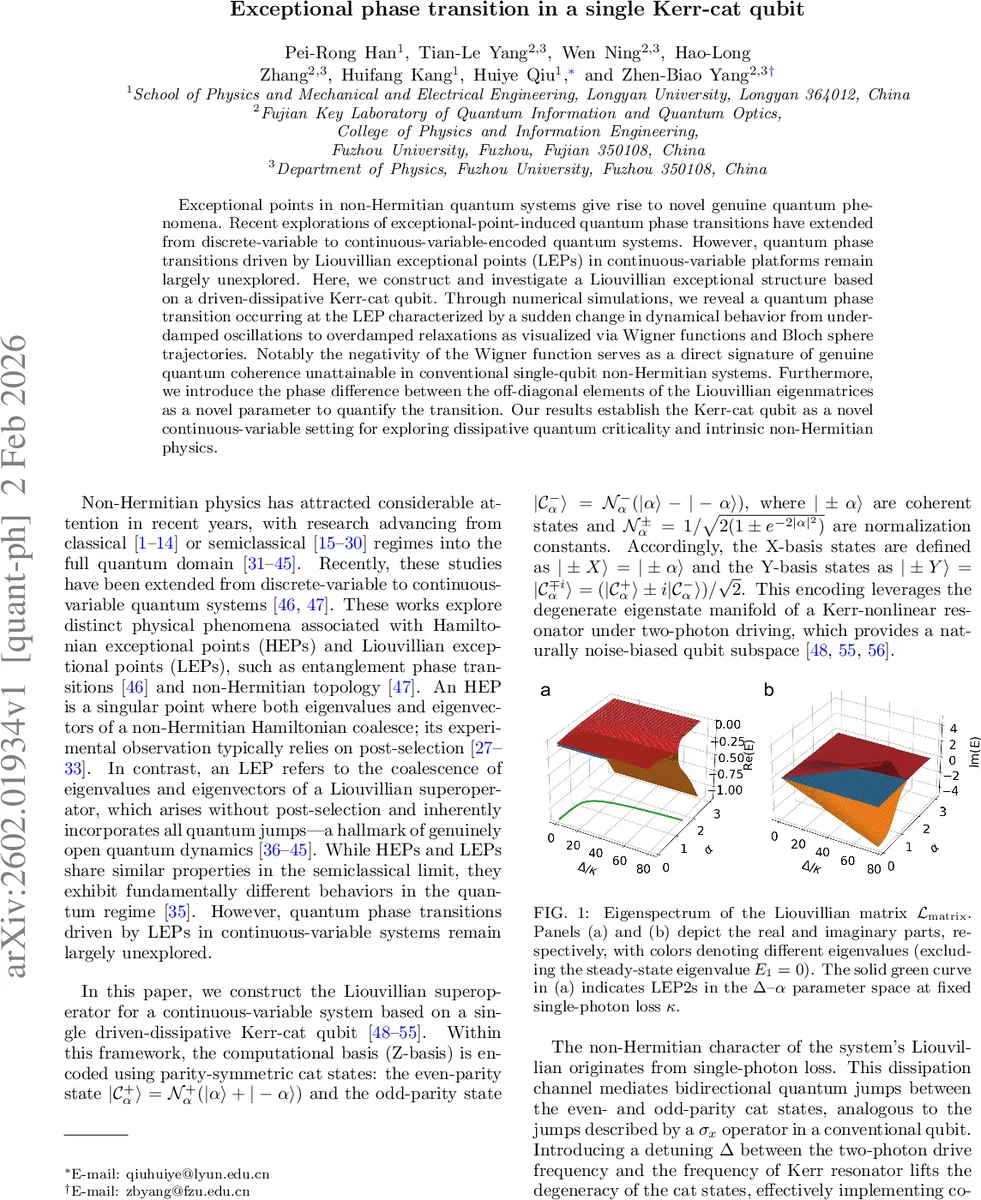
The paper presents a comprehensive study of a Liouvillian exceptional point (LEP) and the associated quantum phase transition in a driven‑dissipative Kerr‑cat qubit, a continuous‑variable platform that naturally hosts non‑Hermitian dynamics through single‑photon loss. Starting from the Hamiltonian H = Δ a†a + K a†²a² + P(a†² + a²) in the rotating frame, the authors define the logical basis using even‑ and odd‑parity cat states |C±α⟩, with α = √(P/K). The system is open because of two dissipative channels: single‑photon loss (rate κ) and pure dephasing (rate κφ). By vectorizing the density matrix in the {|C+α⟩,|C−α⟩} subspace, they obtain a 4 × 4 Liouvillian matrix Lmatrix whose eigenvalues are analytically derived. One eigenvalue is zero (steady state), a second is strictly real, and the remaining two form a complex‑conjugate pair E₃, E₄.
A second‑order exceptional point (LEP2) appears when the detuning Δ reaches the critical value Δ_LEP₂ = κ/(p − 2), where p = N₊α/N₋α quantifies the overlap of the coherent components. At this point E₃ and E₄ coalesce into a single eigenvalue E₂/2, and their eigenvectors merge into a single defective vector (0,i,1,0)ᵀ. This coalescence signals a non‑analytic change in the Liouvillian spectrum and underlies the observed phase transition.
The authors explore the dynamics by initializing the resonator in the coherent state |α⟩ and varying Δ. For |Δ| > Δ_LEP₂ the complex eigenvalues give rise to under‑damped oscillations: the expectation values ⟨X⟩ and ⟨Y⟩ display exponentially damped sinusoidal behavior, and the Bloch‑sphere trajectory spirals inward. In phase space, the Wigner function exhibits alternating interference fringes between |α⟩ and |−α⟩, producing pronounced negativity—a hallmark of genuine quantum coherence that cannot be reproduced in a two‑level non‑Hermitian qubit. Conversely, for |Δ| < Δ_LEP₂ all eigenvalues are real, leading to over‑damped dynamics: ⟨X⟩ and ⟨Y⟩ decay monotonically, the Bloch trajectory follows a straight line to the origin, and the Wigner function relaxes directly to the mixed steady state without visible fringes. At the critical detuning the system is critically damped, achieving the fastest convergence to the steady state.
A novel diagnostic is introduced: the phase difference φ = |arg(ρ₀₁) − arg(ρ₁₀)| between the off‑diagonal elements of the Liouvillian eigenmatrices ρ₃ and ρ₄. φ varies sharply across the LEP, providing a direct, experimentally accessible signature of the exceptional transition that reflects the rotation of the defective eigenvectors in the complex plane. This approach extends previous work on phase differences of non‑Hermitian Hamiltonian eigenstates to the Liouvillian superoperator, highlighting a fundamentally dissipative aspect of non‑Hermitian physics.
To validate the reduced Liouvillian description, the authors compare the full Lindblad master‑equation evolution with the analytical expansion ρ(t)=∑c_i e^{E_i t} ρ_i using the Uhlmann fidelity. Across the parameter range the fidelity remains above 0.99, confirming that the effective model captures the essential dynamics; residual deviations stem from the detuning term Δ a†a, which lifts the cat‑state degeneracy and induces slight leakage out of the logical subspace.
Overall, the work establishes the Kerr‑cat qubit as a versatile continuous‑variable platform for probing dissipative quantum criticality. It demonstrates that a Liouvillian exceptional point can drive a genuine quantum phase transition, identifiable through spectral coalescence, dynamical dichotomy (underdamped vs. overdamped), Wigner‑function negativity, and the newly defined phase‑difference order parameter. These findings bridge fault‑tolerant bosonic encoding with non‑Hermitian physics, opening avenues for experimental exploration of open‑system quantum phase transitions, topological phenomena, and robust quantum information processing in the presence of engineered dissipation.
Comments & Academic Discussion
Loading comments...
Leave a Comment