Quantum vortex channels as Josephson junctions
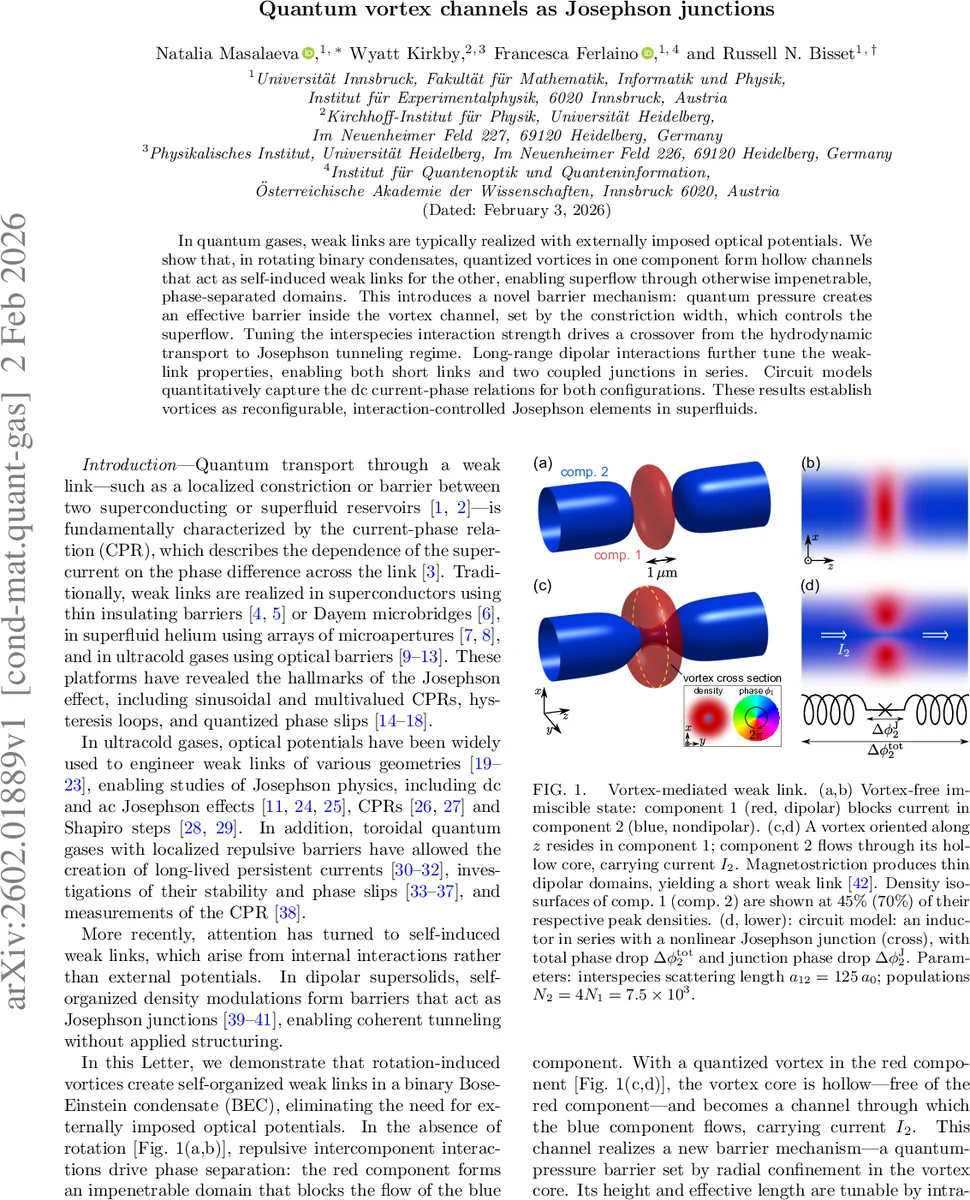
In quantum gases, weak links are typically realized with externally imposed optical potentials. We show that, in rotating binary condensates, quantized vortices in one component form hollow channels that act as self-induced weak links for the other, enabling superflow through otherwise impenetrable, phase-separated domains. This introduces a novel barrier mechanism: quantum pressure creates an effective barrier inside the vortex channel, set by the constriction width, which controls the superflow. Tuning the interspecies interaction strength drives a crossover from the hydrodynamic transport to Josephson tunneling regime. Long-range dipolar interactions further tune the weak-link properties, enabling both short links and two coupled junctions in series. Circuit models quantitatively capture the dc current-phase relations for both configurations. These results establish vortices as reconfigurable, interaction-controlled Josephson elements in superfluids.
💡 Research Summary
In this work the authors demonstrate a fundamentally new way to create weak links in ultracold atomic gases, exploiting the intrinsic structure of quantized vortices in a rotating binary Bose‑Einstein condensate (BEC). Traditionally, weak links—essential for Josephson physics—have been engineered with external potentials such as laser barriers, micro‑bridges, or arrays of apertures. Here, a vortex in one component of an immiscible two‑component BEC empties its core of that component, producing a hollow cylindrical channel. The second component can flow through this channel, thereby establishing a self‑induced weak link without any external structuring.
The key physical ingredient is the quantum‑pressure term that appears in the Gross‑Pitaevskii equation. When the flowing component is confined radially inside the vortex core, the quantum‑pressure contribution generates an effective potential barrier V_eff whose height scales as the inverse square of the core radius w (V_eff ∝ w⁻²). The core radius is set by the spin‑healing length ξ_s, which diverges as the interspecies scattering length a₁₂ approaches the miscibility threshold a_c (ξ_s ∝ |a₁₂ − a_c|⁻¹/²). Consequently, by tuning a₁₂—experimentally feasible via a Feshbach resonance—one can continuously vary both the width of the channel and the height of the effective barrier.
Two distinct geometrical configurations are investigated. In the “short‑junction” case a vortex is imprinted in the dipolar component (Dy) while the non‑dipolar component flows. The vortex length along the axial direction is comparable to the healing length of the flowing component (≈1 µm), so the channel is short. Numerical simulations of the coupled Gross‑Pitaevskii equations reveal that as a₁₂ is increased from 125 a₀ to 170 a₀ the current‑phase relation (CPR) evolves from an almost linear, hydrodynamic response (I ∝ Δφ) to a sinusoidal Josephson form (I = I_c sin Δφ). In the low‑a₁₂ regime the quantum‑pressure barrier is shallow (V_b < μ₂) and the flow is strongly coupled; in the high‑a₁₂ regime the barrier exceeds the chemical potential (V_b > μ₂), the density in the core is strongly depleted, and tunnelling dominates. This crossover is captured quantitatively by a Deaver‑Pierce circuit model consisting of a kinetic inductance L (derived from the transverse density profile) in series with an ideal Josephson element. The model reproduces the full CPR, including the multivalued hydrodynamic branch that is dynamically unstable.
The “long‑junction” configuration places the vortex in the non‑dipolar component, allowing the vortex line to extend over many healing lengths. Here long‑range dipolar interactions reshape the vortex core: the density of the flowing dipolar component develops two minima separated by a central bulge, effectively forming two Josephson junctions in series with a small reservoir in between. For strong interspecies repulsion (a₁₂ ≈ 220 a₀) the CPR is again sinusoidal, but as a₁₂ is reduced the single‑junction circuit fails to describe the data. An extended circuit model is introduced, adding a vortex‑inductance L_v that accounts for the kinetic energy stored in the central reservoir. The total phase drop is then Δφ_tot = Δφ_J1 + Δφ_J2 + (L + L_v)Iℏ, with Δφ_J1 = Δφ_J2. This model accurately reproduces the observed CPRs, including the shift of the zero‑current point to Δφ = 2π and the appearance of stable solutions up to Δφ ≈ 3π/2.
Experimentally, the required vortices can be generated by rotating the trap, phase‑imprinting techniques, or magnetostriction in dipolar gases. The vortex lattice that forms under steady rotation provides a natural array of weak links, analogous to aperture arrays in superfluid helium. Because the barrier properties are controlled solely by interaction parameters, the weak link can be switched in situ between a strongly coupled hydrodynamic conduit and a weakly coupled Josephson tunnel junction. This reconfigurability, together with the possibility of creating series or parallel junctions by adjusting vortex length and dipolar strength, opens a new toolbox for atomtronic circuits.
In summary, the paper establishes that quantized vortex cores in rotating binary condensates act as self‑organized, interaction‑tunable Josephson weak links. The authors provide a clear physical picture (quantum‑pressure barrier), demonstrate a controllable crossover from hydrodynamic to tunneling transport, and validate simple circuit models that capture the full current‑phase behavior. These findings broaden the landscape of quantum fluid engineering, offering a platform where weak links are generated intrinsically and can be dynamically programmed via interspecies scattering length and dipolar interactions.
Comments & Academic Discussion
Loading comments...
Leave a Comment