SOPRAG: Multi-view Graph Experts Retrieval for Industrial Standard Operating Procedures
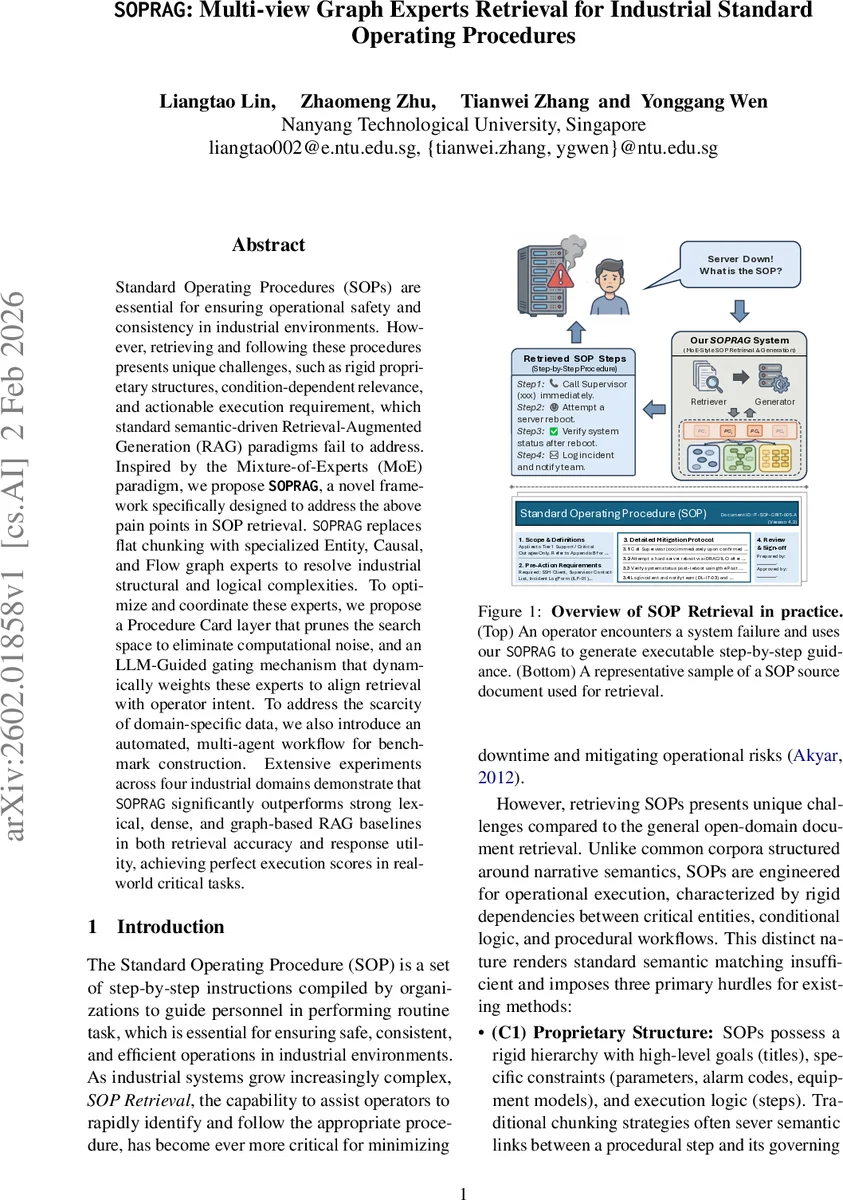
Standard Operating Procedures (SOPs) are essential for ensuring operational safety and consistency in industrial environments. However, retrieving and following these procedures presents unique challenges, such as rigid proprietary structures, condition-dependent relevance, and actionable execution requirement, which standard semantic-driven Retrieval-Augmented Generation (RAG) paradigms fail to address. Inspired by the Mixture-of-Experts (MoE) paradigm, we propose SOPRAG, a novel framework specifically designed to address the above pain points in SOP retrieval. SOPRAG replaces flat chunking with specialized Entity, Causal, and Flow graph experts to resolve industrial structural and logical complexities. To optimize and coordinate these experts, we propose a Procedure Card layer that prunes the search space to eliminate computational noise, and an LLM-Guided gating mechanism that dynamically weights these experts to align retrieval with operator intent. To address the scarcity of domain-specific data, we also introduce an automated, multi-agent workflow for benchmark construction. Extensive experiments across four industrial domains demonstrate that SOPRAG significantly outperforms strong lexical, dense, and graph-based RAG baselines in both retrieval accuracy and response utility, achieving perfect execution scores in real-world critical tasks.
💡 Research Summary
Paper Overview
The authors present SOPRAG, a Retrieval‑Augmented Generation (RAG) framework specifically engineered for industrial Standard Operating Procedures (SOPs). SOPs differ from typical open‑domain texts: they are highly structured, contain condition‑dependent logic, and must yield actionable, step‑by‑step guidance rather than a free‑form answer. Existing RAG pipelines, which rely on flat chunking and semantic similarity, cannot adequately capture these properties. SOPRAG addresses three identified challenges: (C1) Proprietary hierarchical structure, (C2) Condition‑dependent relevance, and (C3) Requirement for executable responses.
Key Architectural Components
-
Procedure Card (PC) Layer – Each SOP is abstracted into a lightweight “card” consisting of the document title and an LLM‑generated one‑sentence abstract. This mirrors how human operators first scan high‑level titles before delving into details, providing a sparse‑activation mechanism that dramatically reduces the candidate set (Top‑K PCs) for downstream processing.
-
Multi‑View Graph Experts – Three specialized graphs are built for every SOP:
- Entity Graph (G_E) links concrete domain entities (equipment IDs, alarm codes, parameters) directly to their corresponding PCs, ensuring queries that mention specific assets are routed to the correct procedure.
- Causal Graph (G_C) models symptom‑cause‑action relationships as directed edges, enabling diagnostic reasoning where relevance depends on underlying root causes rather than surface keywords.
- Flow Graph (G_F) captures the intra‑procedure step ordering (V_step, E_flow), preserving the procedural topology required for safe execution. This graph is later used as a structured prompt to generate step‑wise instructions.
-
LLM‑Guided Router (Gating Mechanism) – An LLM receives the user query, performs intent classification, and outputs a softmax weight vector w =
Comments & Academic Discussion
Loading comments...
Leave a Comment