Do designated market makers provide liquidity during downward extreme price movements?
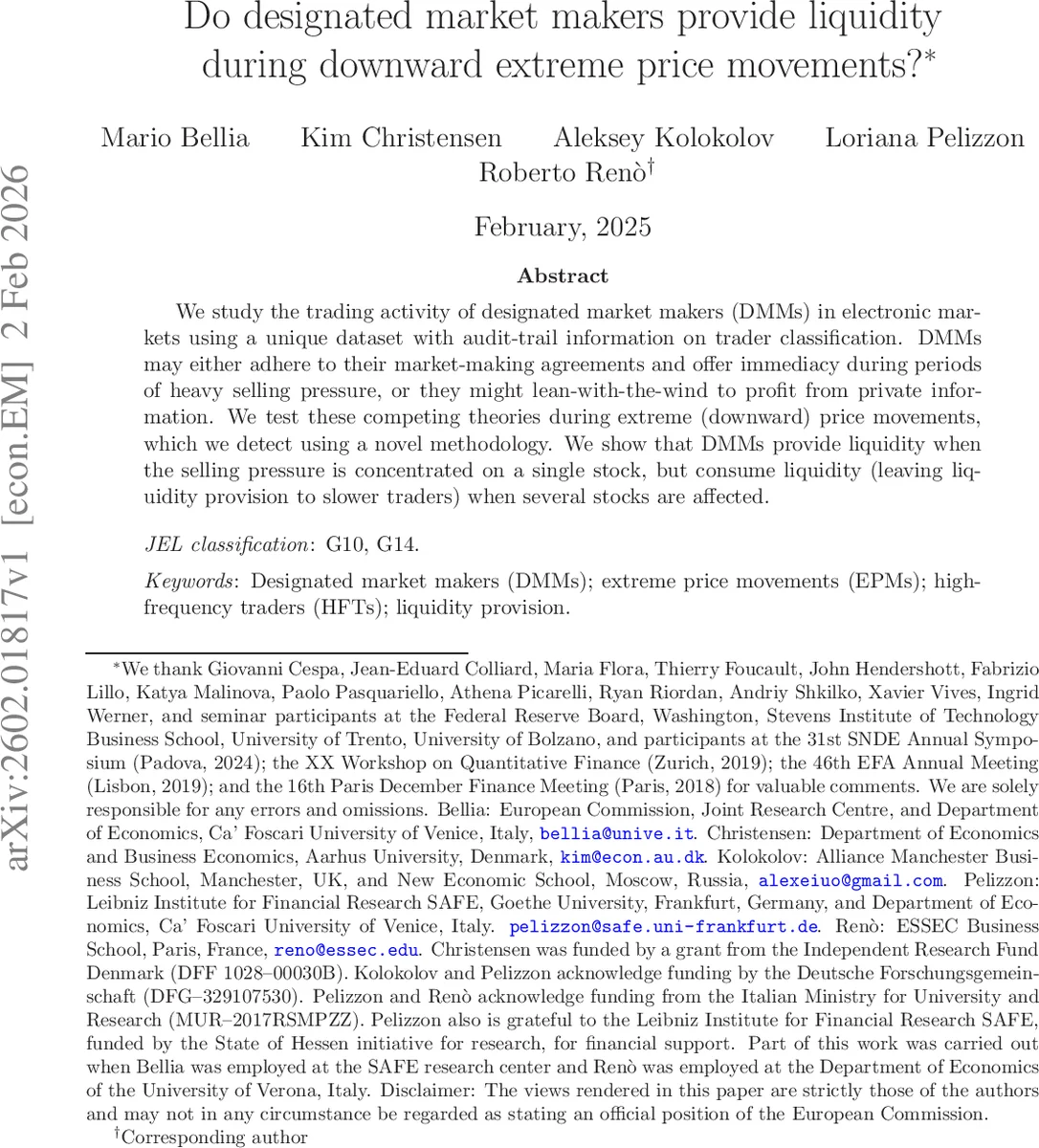
We study the trading activity of designated market makers (DMMs) in electronic markets using a unique dataset with audit-trail information on trader classification. DMMs may either adhere to their market-making agreements and offer immediacy during periods of heavy selling pressure, or they might lean-with-the-wind to profit from private information. We test these competing theories during extreme (downward) price movements, which we detect using a novel methodology. We show that DMMs provide liquidity when the selling pressure is concentrated on a single stock, but consume liquidity (leaving liquidity provision to slower traders) when several stocks are affected.
💡 Research Summary
**
This paper investigates whether designated market makers (DMMs) continue to provide liquidity during extreme downward price movements (EPMs) in electronic equity markets. Using a unique, high‑frequency audit‑trail dataset from the BEDOFIH database, the authors analyze tick‑by‑tick order‑level activity for 37 highly liquid CAC 40 stocks traded on NYSE Euronext Paris in 2013. The dataset contains explicit flags indicating whether a participant is a DMM, a high‑frequency trader (HFT), and the trader classification assigned by the exchange, allowing the authors to isolate DMM order flow from that of other market participants.
Methodology
Instead of conventional jump‑detection tests, the study adopts the “drift‑burst” approach introduced by Christensen et al. (2022) to identify periods where prices exhibit a sharp, sustained downward drift. This technique controls for volatility and isolates directional moves, making it well‑suited for detecting EPMs that are not simply price spikes but sustained trends. Detected downward bursts are then classified along a cross‑sectional dimension: (i) single‑stock EPMs, where the drift is observed in only one security, and (ii) multi‑stock EPMs, where several securities experience a simultaneous downward drift. This classification captures the breadth of market stress and allows the authors to test whether DMM behavior depends on the systemic nature of the shock.
Empirical Findings
-
Single‑stock EPMs – DMMs act as intended under their market‑making agreements. They predominantly submit passive limit sell orders at the best bid/ask, providing liquidity to the market. Net liquidity provision (the difference between passive and aggressive order volume) is positive, indicating that DMMs are net liquidity suppliers during these events. Their quoted spreads remain tight, and the rebate/fee schedule of the SLP (Supplemental Liquidity Provision) program yields a modest but positive expected profit.
-
Multi‑stock EPMs – DMMs reverse their stance. The net liquidity provision becomes negative as DMMs increase aggressive sell market orders, effectively consuming liquidity. In this regime, “slow” traders—typically institutional investors or non‑designated participants—step in as net buyers, supplying the liquidity that DMMs withdraw. The authors interpret this shift as a response to heightened adverse‑selection risk: a simultaneous downturn across several stocks suggests the presence of private information that could affect the DMM’s inventory, prompting a risk‑averse retreat from passive quoting.
Interpretation and Policy Implications
The SLP program requires DMMs to be present on both sides of the book at least 95 % of the time and to achieve a minimum passive execution rate of 0.7 % of volume. However, the program does not include explicit incentives for DMMs to maintain these obligations under extreme market stress. The cost of meeting the presence requirement across multiple securities during a multi‑stock EPM can be substantial, while the rebate structure (0.20–0.22 bps for providing liquidity) is insufficient to offset the potential loss from adverse selection. Consequently, DMMs find it optimal to withdraw or become aggressive sellers when the systemic risk is high.
These results echo the “lean‑with‑the‑wind” behavior documented for HFTs (van Kervel & Menkveld, 2019; Korájczyk & Murphy, 2019) and align with theoretical models of predatory or back‑running trading (Yang & Zhu, 2020; Brunnermeier & Pedersen, 2005). Even though DMMs are contractually designated liquidity providers, the empirical evidence shows that without stronger risk‑sharing mechanisms or additional performance‑based rebates, they behave similarly to unrestricted HFTs.
Robustness Checks
The authors compare drift‑burst identified EPMs with an alternative definition based on the 99.9 th percentile of absolute returns (as used by Brogaard et al., 2018). The two samples have limited overlap, yet the main findings persist across both definitions. Additionally, an alternative modeling framework inspired by Kirilenko et al. (2017) that treats order flow as a Hawkes process yields consistent patterns of DMM liquidity provision and consumption, reinforcing the robustness of the conclusions.
Contribution to the Literature
The paper extends the literature on liquidity provision in electronic markets by focusing on the role of designated market makers rather than generic HFTs. It demonstrates that DMMs do not uniformly act as stabilizing agents; their behavior is contingent on the cross‑sectional severity of price stress. This nuance adds to prior work showing that HFTs can both enhance market efficiency and increase fragility, and it highlights the importance of contract design in shaping market‑maker incentives.
Conclusion
Designated market makers provide liquidity during isolated, single‑stock downward shocks but withdraw or become aggressive sellers when a downward shock spreads across multiple securities. The current SLP compensation scheme does not sufficiently motivate DMMs to maintain their liquidity‑providing role under systemic stress, suggesting a need for revised incentive structures—such as higher rebates, loss‑sharing arrangements, or dynamic presence requirements—that align DMM risk exposure with their market‑making obligations. Future research could replicate the analysis in other jurisdictions, explore dynamic contract designs, or simulate the impact of alternative incentive schemes on market stability.
Comments & Academic Discussion
Loading comments...
Leave a Comment