N-dimensional Coulomb-Sturmians with noninteger quantum numbers
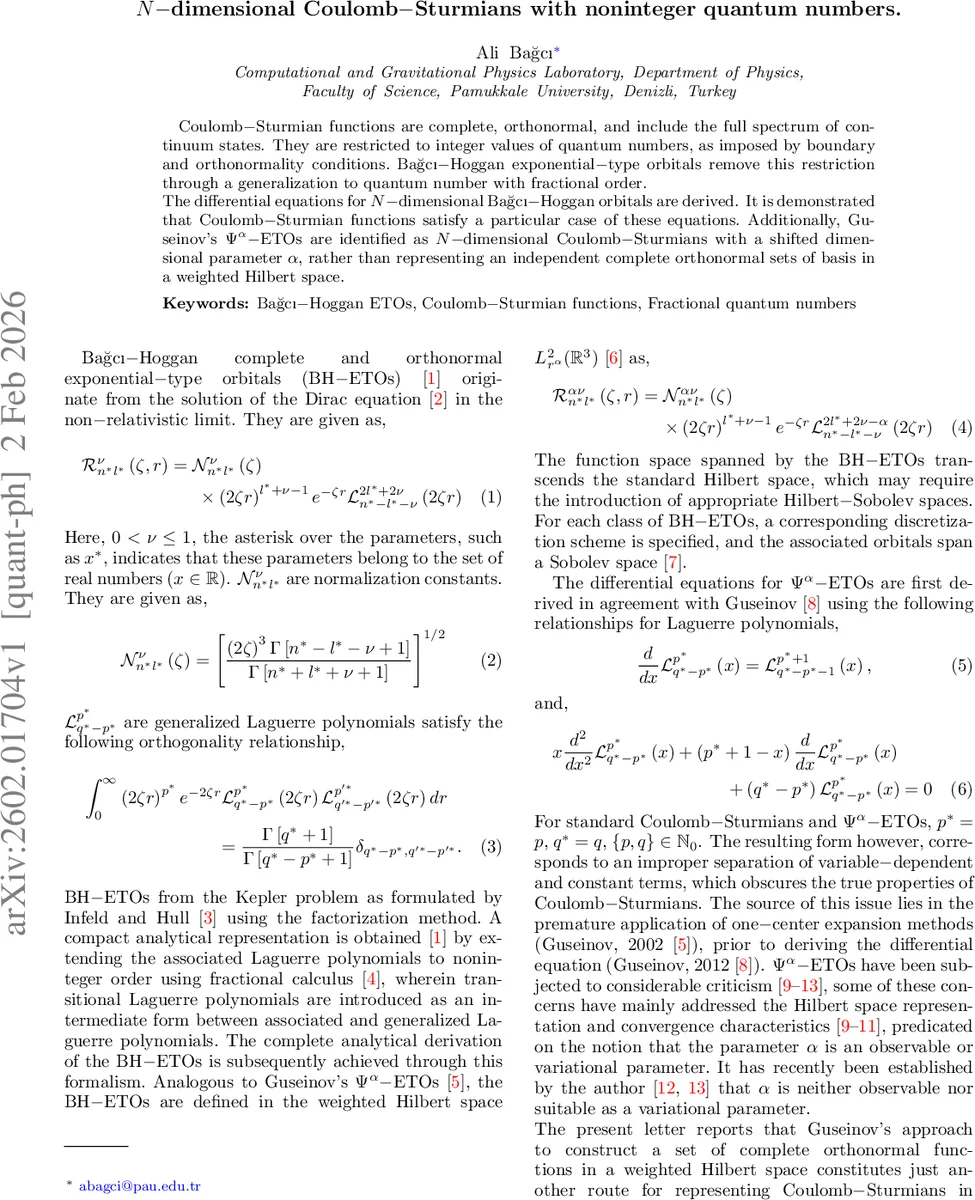
Coulomb-Sturmian functions are complete, orthonormal, and include the full spectrum of continuum states. They are restricted to integer values of quantum numbers, as imposed by boundary and orthonormality conditions. Bagci-Hoggan exponential-type orbitals remove this restriction through a generalization to quantum number with fractional order. The differential equations for N-dimensional Bagci-Hoggan orbitals are derived. It is demonstrated that Coulomb-Sturmian functions satisfy a particular case of these equations. Additionally, Guseinov’s Psi-alpha-ETOs are identified as N-dimensional Coulomb-Sturmians with a shifted dimensional parameter alpha, rather than representing an independent complete orthonormal sets of basis in a weighted Hilbert space.
💡 Research Summary
This paper presents a significant generalization of Coulomb-Sturmian functions by introducing Bagci-Hoggan Exponential-Type Orbitals (BH-ETOs), which remove the constraint of integer quantum numbers inherent in the traditional set. Coulomb-Sturmians, while complete, orthonormal, and encompassing the continuum spectrum, are limited by boundary conditions that enforce integer quantum numbers. The authors achieve this breakthrough by deriving BH-ETOs from the non-relativistic limit of the Dirac-Coulomb solution, employing fractional calculus to extend associated Laguerre polynomials to non-integer order via so-called “transitional Laguerre polynomials.”
The core mathematical definition of the radial part of BH-ETOs is provided, featuring a normalization constant, a power term with fractional quantum number ν (0 < ν ≤ 1), an exponential decay, and a generalized Laguerre polynomial. The study emphasizes that the function space spanned by BH-ETOs transcends the standard Hilbert space, potentially requiring the specification of appropriate Hilbert-Sobolev spaces for different classes of these orbitals.
A major critical analysis within the paper focuses on Guseinov’s Ψα-ETOs. These functions were proposed as a complete orthonormal set in a weighted Hilbert space L^2_rα(R^3). The paper meticulously derives the differential equation for Ψα-ETOs and demonstrates that, through algebraic manipulation and a change of variable, it reduces to the known differential equation for N-dimensional Coulomb-Sturmians, with the identification α = 4 - N. This proves that Ψα-ETOs are not an independent set but merely a representation of standard Coulomb-Sturmians (which correspond to BH-ETOs with ν=1) in a space with a shifted dimensional parameter. The parameter α is clarified to be related to dimensionality, not an observable or variational parameter as previously misconceived.
The paper then successfully generalizes BH-ETOs to N dimensions. The derived N-dimensional differential equation incorporates the fractional quantum number ν. A key insight is the redefinition of the effective angular momentum quantum number as l’* = l* + ν - 1. This allows the angular eigenvalue to take the canonical form l’(l’ + N - 2), which is precisely the eigenvalue of the Laplace-Beltrami operator on hyperspherical harmonics on an (N-1)-sphere. This establishes a clean connection between BH-ETOs and the geometric harmonics of higher-dimensional spaces. In the specific three-dimensional case, this formalism yields spherical harmonics with fractional angular momentum quantum numbers, suggesting a potential extension of Gegenbauer polynomials or a revision of the kinetic energy operator.
In conclusion, this work rigorously establishes BH-ETOs as the proper generalization of Coulomb-Sturmian functions to non-integer quantum numbers and N-dimensional spaces. It corrects a misunderstanding in the literature regarding the nature of Guseinov’s Ψα-ETOs, showing they are a subset of this more general framework. This advancement provides a more flexible and powerful set of basis functions for theoretical physics and computational chemistry, particularly for systems where higher-dimensional analysis or relativistic effects are important.
Comments & Academic Discussion
Loading comments...
Leave a Comment