Quantitative Convergence and Gaussian Fluctuations for Sequential Interacting Diffusions via Incremental Relative Entropy
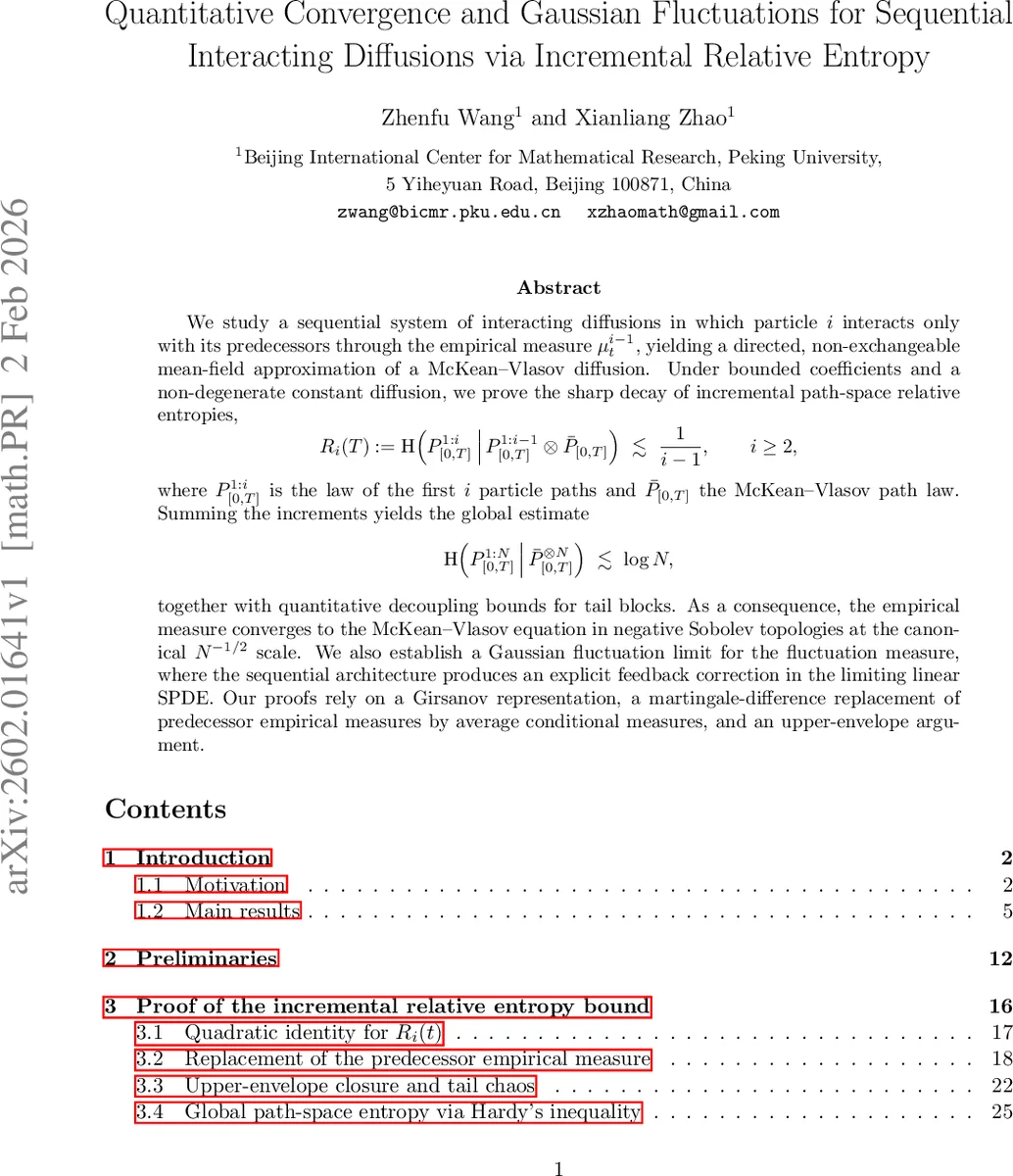
We study a sequential system of interacting diffusions in which particle $i$ interacts only with its predecessors through the empirical measure $μ_t^{i-1}$, yielding a directed, non-exchangeable mean-field approximation of a McKean–Vlasov diffusion. Under bounded coefficients and a non-degenerate constant diffusion, we prove the sharp decay of incremental path-space relative entropies, $$ R_i(T):=H\left(P^{1:i}{[0,T]}\vert P^{1:i-1}{[0,T]}\otimes \bar P_{[0,T]}\right) \ \lesssim\ \frac{1}{i-1}, \qquad i\ge2, $$ where $P^{1:i}{[0,T]}$ is the law of the first $i$ particle paths and $\bar P{[0,T]}$ the McKean–Vlasov path law. Summing the increments yields the global estimate $$ H \left(P^{1:N}{[0,T]}, \vert ,\bar P{[0,T]}^{\otimes N}\right)\ \lesssim\ \log N, $$ together with quantitative decoupling bounds for tail blocks. As a consequence, the empirical measure converges to the McKean–Vlasov equation in negative Sobolev topologies at the canonical $N^{-1/2}$ scale. We also establish a Gaussian fluctuation limit for the fluctuation measure, where the sequential architecture produces an explicit feedback correction in the limiting linear SPDE. Our proofs rely on a Girsanov representation, a martingale-difference replacement of predecessor empirical measures by average conditional measures, and an upper-envelope argument.
💡 Research Summary
This paper investigates a directed, non‑exchangeable particle system in which each particle interacts only with its predecessors through the empirical measure of the already simulated particles. The authors consider the sequential interacting diffusion model
\
Comments & Academic Discussion
Loading comments...
Leave a Comment