Research on World Models Is Not Merely Injecting World Knowledge into Specific Tasks
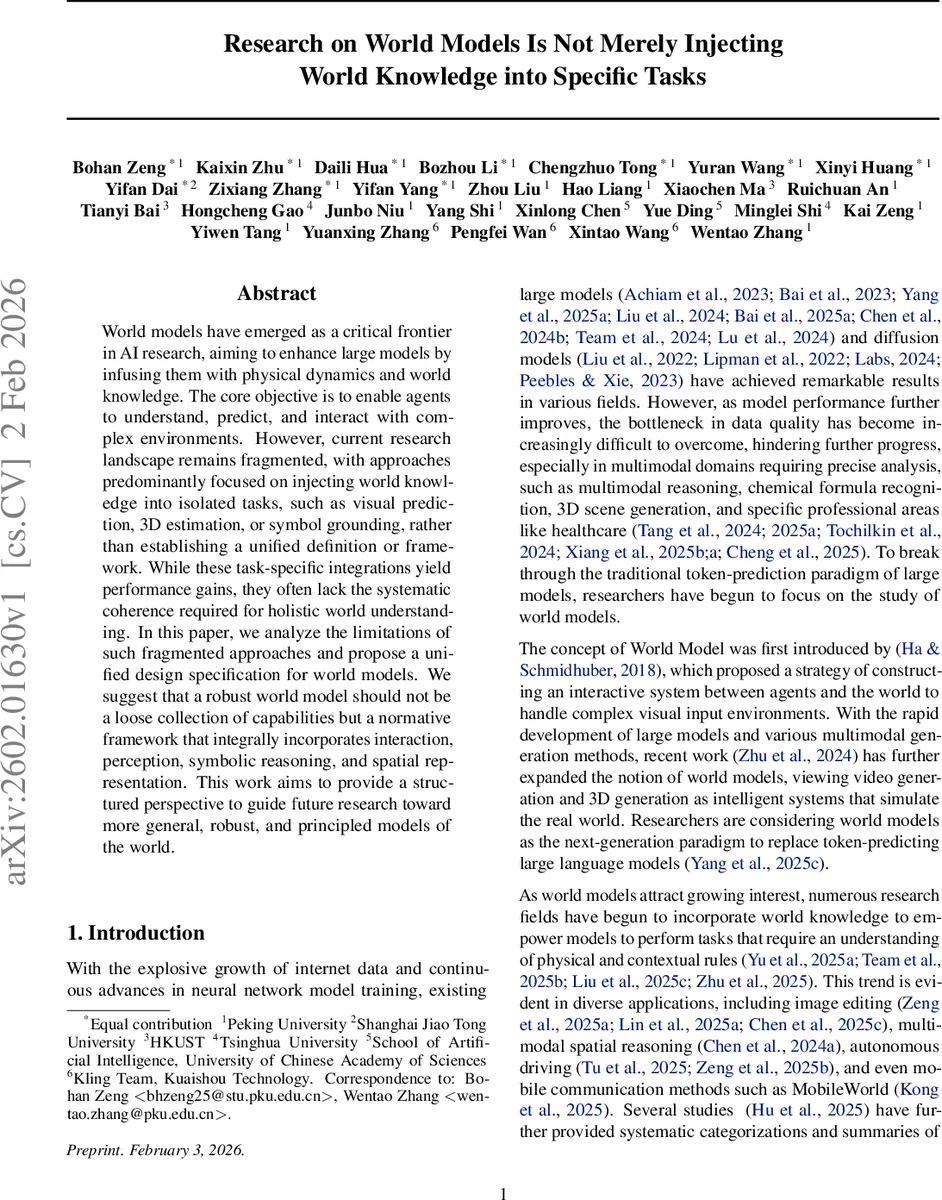
World models have emerged as a critical frontier in AI research, aiming to enhance large models by infusing them with physical dynamics and world knowledge. The core objective is to enable agents to understand, predict, and interact with complex environments. However, current research landscape remains fragmented, with approaches predominantly focused on injecting world knowledge into isolated tasks, such as visual prediction, 3D estimation, or symbol grounding, rather than establishing a unified definition or framework. While these task-specific integrations yield performance gains, they often lack the systematic coherence required for holistic world understanding. In this paper, we analyze the limitations of such fragmented approaches and propose a unified design specification for world models. We suggest that a robust world model should not be a loose collection of capabilities but a normative framework that integrally incorporates interaction, perception, symbolic reasoning, and spatial representation. This work aims to provide a structured perspective to guide future research toward more general, robust, and principled models of the world.
💡 Research Summary
The paper provides a critical overview of the emerging field of world models, which aim to go beyond token‑prediction paradigms by endowing large language, vision, and diffusion models with an understanding of physical dynamics and contextual rules. The authors argue that the current research landscape is fragmented: most works inject world knowledge into isolated tasks such as visual prediction, 3D reconstruction, or symbol grounding, typically via fine‑tuning or reinforcement‑learning pipelines that rely on task‑specific curated data. While these approaches yield performance gains on individual benchmarks, they fail to deliver a coherent, reusable, and long‑term representation of the world, limiting genuine physical understanding, temporal consistency, and cross‑modal reasoning.
To address these shortcomings, the authors propose a normative, unified world‑model framework composed of five essential components: Interaction, Reasoning, Memory, Multimodal Generation, and an explicit Environment module. Interaction serves as a bidirectional, multimodal interface that can ingest text, images, video, audio, point clouds, and meshes, and also parse and execute diverse user commands or low‑level control signals. Reasoning is split into explicit (text‑mediated, leveraging large language models for symbolic inference) and latent (continuous, operating directly in a unified latent space) pathways, allowing the system to balance transparency with fidelity to physical quantities. Memory extends beyond simple recurrent or transformer‑based state storage; it must dynamically categorize, associate, compress, and update multimodal experiences, providing structured, queryable knowledge that supports long‑term coherence. Multimodal Generation translates the outcomes of reasoning and memory into images, videos, 3D scenes, audio, or other modalities, which in turn can act as feedback to the environment. The Environment component integrates learnable simulators or generative models that enforce physical consistency and enable closed‑loop interaction with real or virtual worlds.
The paper details how each module addresses specific gaps in existing literature. For example, current vision‑language‑action agents lack robust long‑term memory and struggle with complex multimodal perception, while diffusion‑based generators, despite high visual fidelity, often violate spatio‑temporal commonsense. By unifying these capabilities, the proposed framework aspires to produce “holistic world understanding” that can support open‑ended tasks, autonomous driving, embodied robotics, and creative content generation in a principled manner.
Finally, the authors outline future research directions: developing physically grounded spatiotemporal representations, advancing embodied interaction control, and enabling autonomous modular evolution where components can be upgraded or replaced without breaking the overall system. The paper positions the unified framework as a roadmap for the community, urging a shift from fragmented, task‑specific knowledge injection toward a comprehensive, principled architecture that truly models the world.
Comments & Academic Discussion
Loading comments...
Leave a Comment