Milstein-type Schemes for Hyperbolic SPDEs
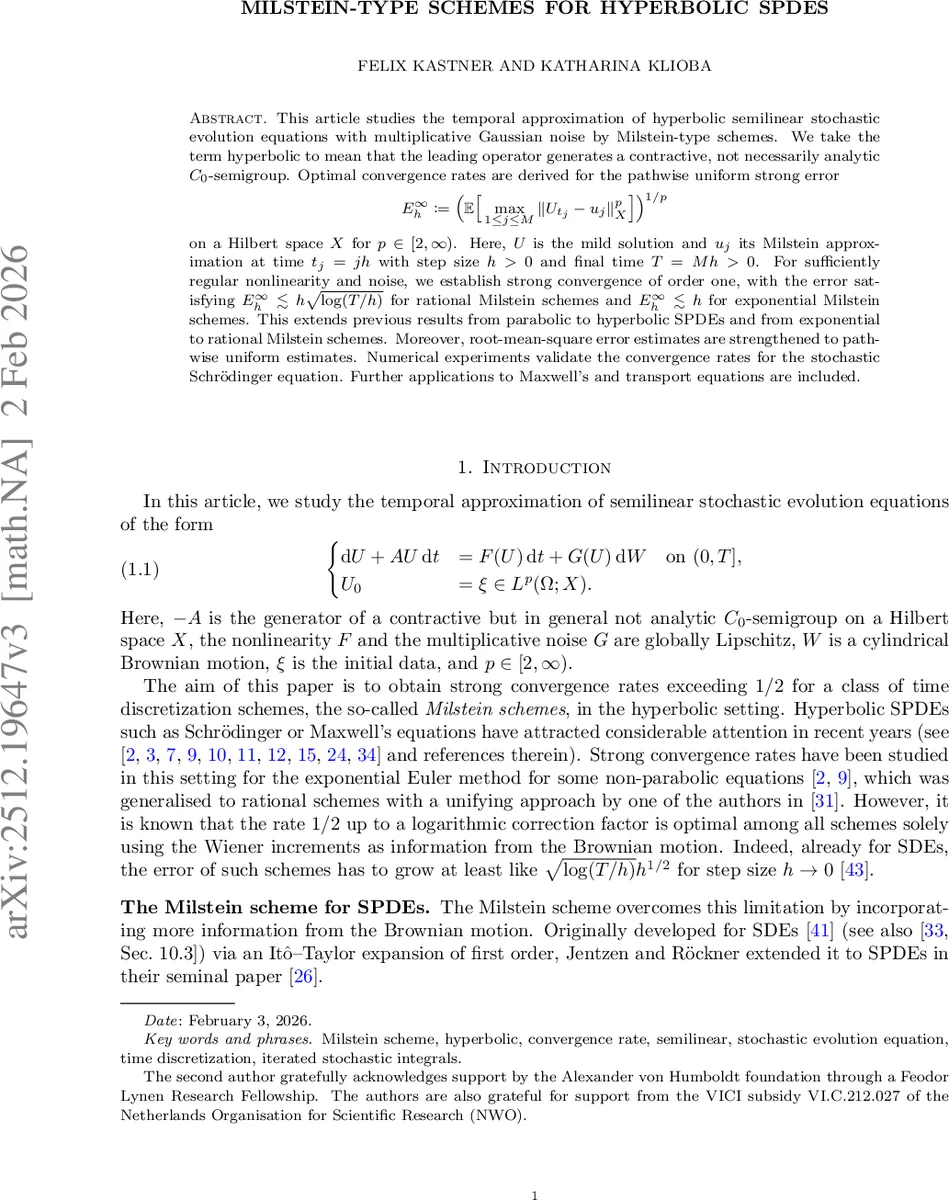
This article studies the temporal approximation of hyperbolic semilinear stochastic evolution equations with multiplicative Gaussian noise by Milstein-type schemes. We take the term hyperbolic to mean that the leading operator generates a contractive, not necessarily analytic $C_0$-semigroup. Optimal convergence rates are derived for the pathwise uniform strong error [ E_h^\infty := \Big(\mathbb{E}\Big[\max_{1\le j \le M}|U_{t_j}-u_j|_X^p\Big]\Big)^{1/p} ] on a Hilbert space $X$ for $p\in [2,\infty)$. Here, $U$ is the mild solution and $u_j$ its Milstein approximation at time $t_j=jh$ with step size $h>0$ and final time $T=Mh>0$. For sufficiently regular nonlinearity and noise, we establish strong convergence of order one, with the error satisfying $E_h^\infty\lesssim h\sqrt{\log(T/h)}$ for rational Milstein schemes and $E_h^\infty \lesssim h$ for exponential Milstein schemes. This extends previous results from parabolic to hyperbolic SPDEs and from exponential to rational Milstein schemes. Moreover, root-mean-square error estimates are strengthened to pathwise uniform estimates. Numerical experiments validate the convergence rates for the stochastic Schrödinger equation. Further applications to Maxwell’s and transport equations are included.
💡 Research Summary
This paper addresses the temporal discretisation of hyperbolic semilinear stochastic evolution equations driven by multiplicative Gaussian noise. The authors consider equations of the form
( dU + AU,dt = F(U),dt + G(U),dW,\qquad U(0)=\xi, )
where (-A) generates a contractive (C_{0})-semigroup (S(t)) on a Hilbert space (X). Unlike the parabolic setting, the semigroup is not assumed to be analytic; this captures models such as stochastic Schrödinger, Maxwell, and wave equations.
The main contribution is a rigorous error analysis of Milstein‑type time‑stepping schemes for such hyperbolic SPDEs. Two families of schemes are studied:
- Exponential Milstein scheme – the semigroup is used exactly, i.e. (R_{h}=S(h)).
- Rational Milstein schemes – the semigroup is approximated by a rational function of (-hA), for example the implicit Euler, Crank–Nicolson, BDF(2), or higher‑order A‑stable Runge–Kutta methods.
Both schemes are defined by the recursion
\
Comments & Academic Discussion
Loading comments...
Leave a Comment