$ ext{F-manifolds}$, F$_ ext{man}$-algebras and $ ext{Poisson-algebra}$ Distributions
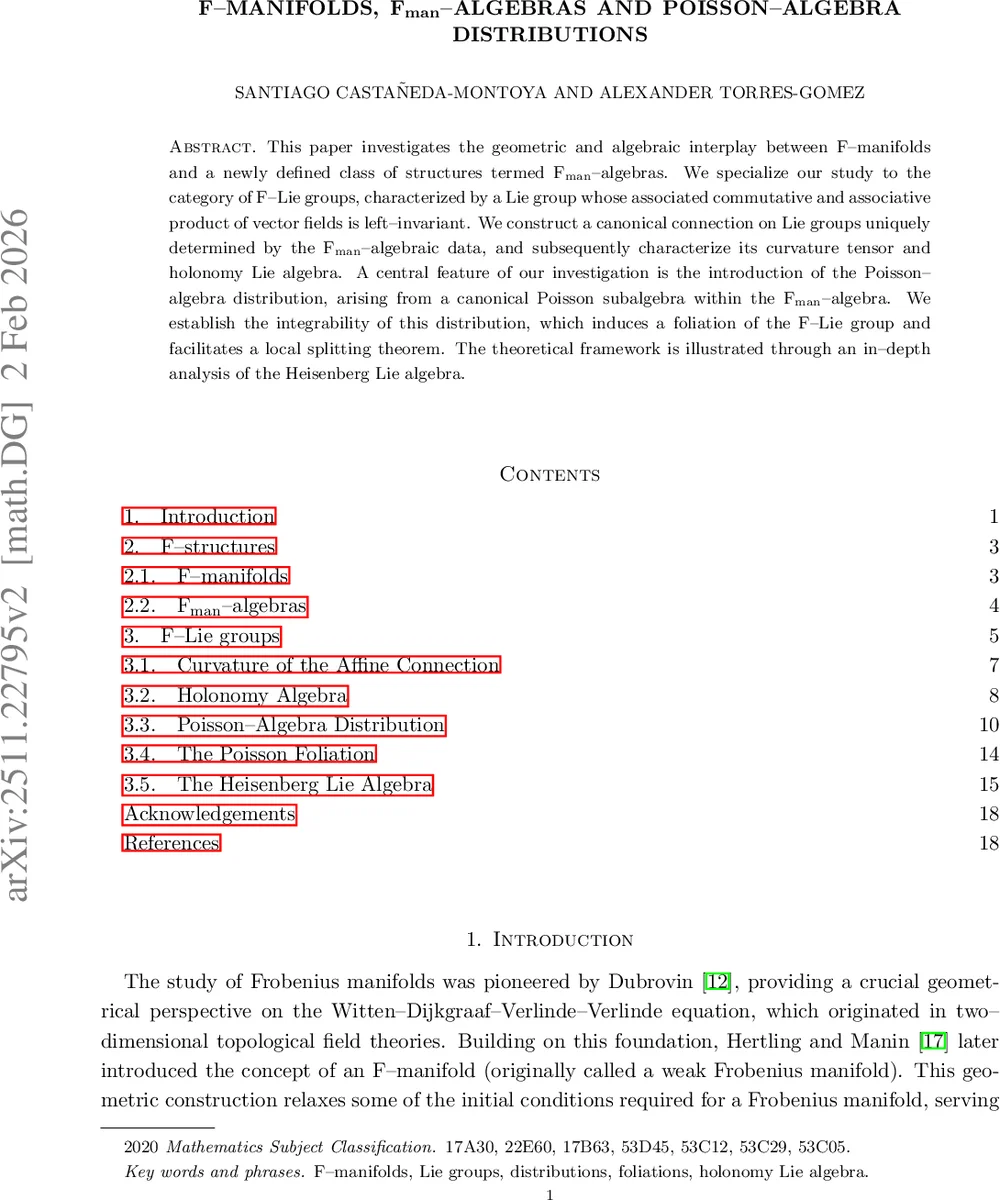
This paper investigates the geometric and algebraic interplay between F-manifolds and a newly defined class of structures termed F$\text{man}$-algebras. We specialize our study to the category of F-Lie groups, characterized by a Lie group whose associated commutative and associative product of vector fields is left-invariant. We construct a canonical connection on Lie groups uniquely determined by the F$\text{man}$-algebraic data, and subsequently characterize its curvature tensor and holonomy Lie algebra. A central feature of our investigation is the introduction of the Poisson-algebra distribution, arising from a canonical Poisson subalgebra within the F$_\text{man}$-algebra. We establish the integrability of this distribution, which induces a foliation of the F-Lie group and facilitates a local splitting theorem. The theoretical framework is illustrated through an in-depth analysis of the Heisenberg Lie algebra.
💡 Research Summary
The paper develops a systematic theory of “F‑Lie groups,” i.e., Lie groups equipped with a left‑invariant commutative‑associative product ◦ on their space of smooth vector fields. Starting from the classical notion of an F‑manifold— a smooth manifold M whose module of vector fields X(M) carries a commutative, associative product ◦ satisfying the Hertling‑Manin condition— the authors specialize to the case where M is a Lie group G and the product is left‑invariant. In this setting the left‑invariant vector fields X⁺(G) are identified with the Lie algebra 𝔤, and the product ◦ together with the Lie bracket induce a triple (𝔤, ◦,
Comments & Academic Discussion
Loading comments...
Leave a Comment