Terrain Costmap Generation via Scaled Preference Conditioning
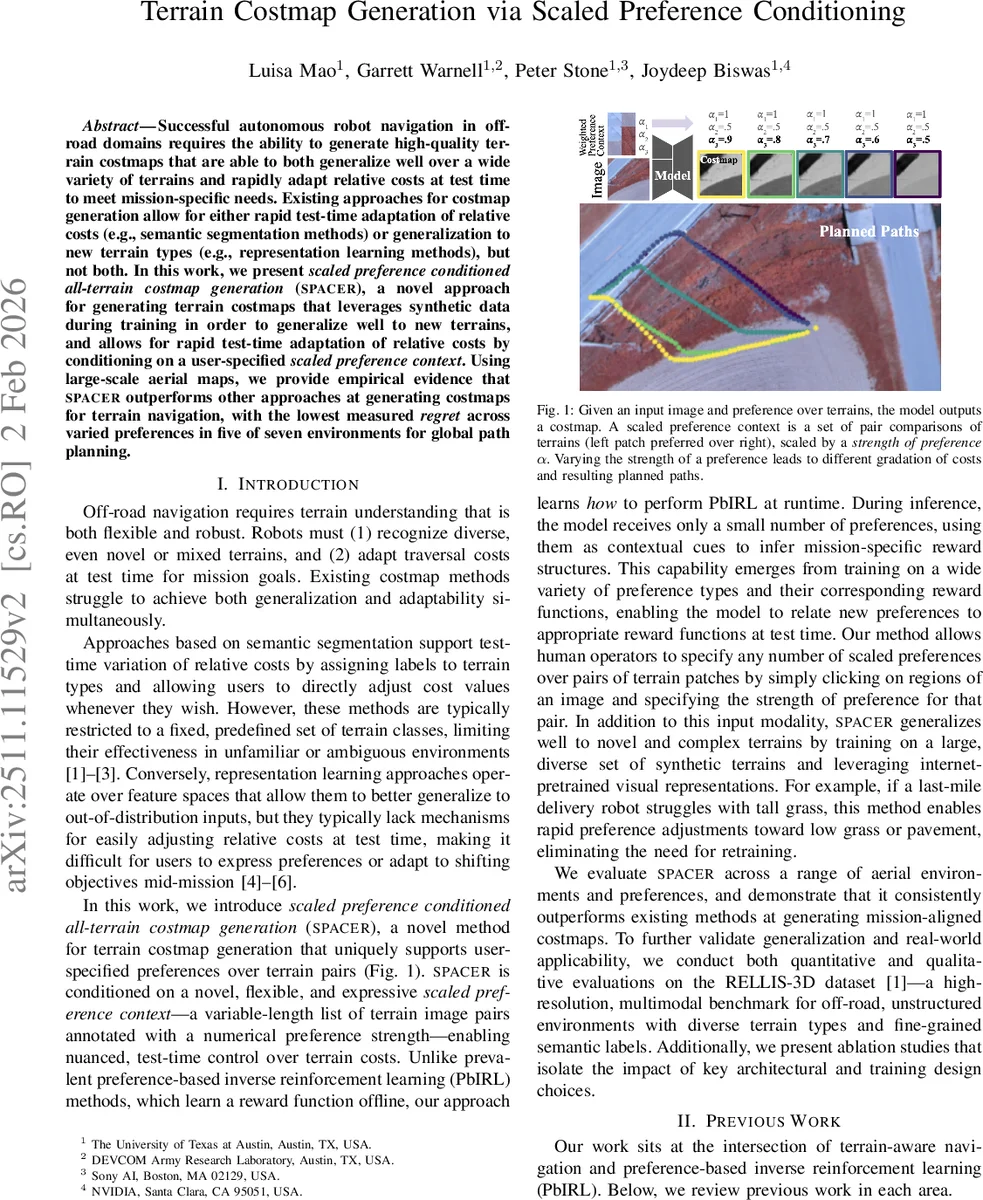
Successful autonomous robot navigation in off-road domains requires the ability to generate high-quality terrain costmaps that are able to both generalize well over a wide variety of terrains and rapidly adapt relative costs at test time to meet mission-specific needs. Existing approaches for costmap generation allow for either rapid test-time adaptation of relative costs (e.g., semantic segmentation methods) or generalization to new terrain types (e.g., representation learning methods), but not both. In this work, we present scaled preference conditioned all-terrain costmap generation (SPACER), a novel approach for generating terrain costmaps that leverages synthetic data during training in order to generalize well to new terrains, and allows for rapid test-time adaptation of relative costs by conditioning on a user-specified scaled preference context. Using large-scale aerial maps, we provide empirical evidence that SPACER outperforms other approaches at generating costmaps for terrain navigation, with the lowest measured regret across varied preferences in five of seven environments for global path planning.
💡 Research Summary
The paper tackles a fundamental challenge in off‑road autonomous navigation: producing terrain costmaps that both generalize to unseen environments and can be rapidly re‑weighted at test time to satisfy mission‑specific preferences. Existing approaches either rely on semantic segmentation, which allows easy cost tweaking but is limited to a fixed set of terrain classes, or on learned embeddings that generalize well but require costly retraining to change costs. The authors introduce Scaled Preference Conditioned All‑Terrain Costmap Generation (SPACER), a novel framework that bridges this gap by conditioning a costmap generator on a “scaled preference context” – a set of terrain‑pair comparisons each annotated with a scalar strength α∈
Comments & Academic Discussion
Loading comments...
Leave a Comment