NP-LoRA: Null Space Projection Unifies Subject and Style in LoRA Fusion
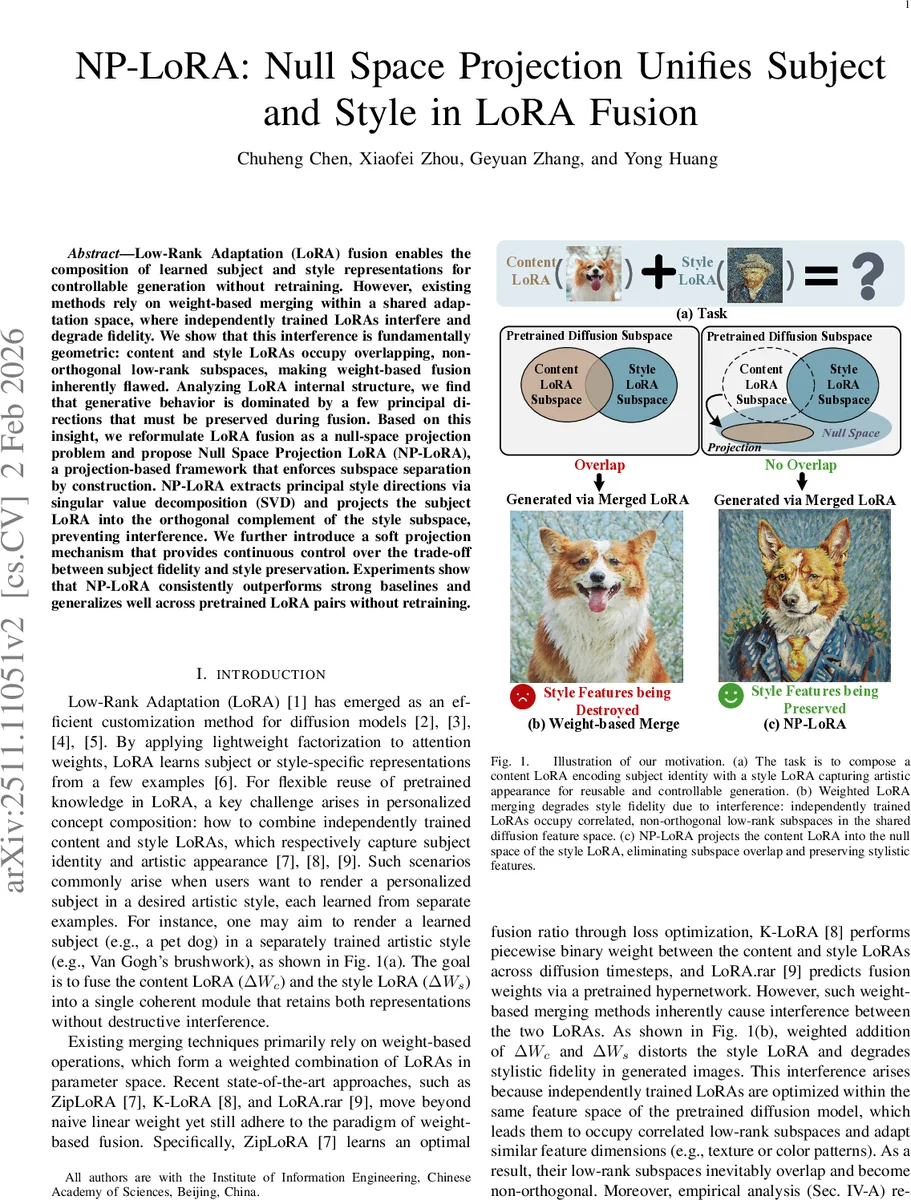
Low-Rank Adaptation (LoRA) fusion enables the composition of learned subject and style representations for controllable generation without retraining. However, existing methods rely on weight-based merging within a shared adaptation space, where independently trained LoRAs interfere and degrade fidelity. We show that this interference is fundamentally geometric: content and style LoRAs occupy overlapping, non-orthogonal low-rank subspaces, making weight-based fusion inherently flawed. Analyzing LoRA internal structure, we find that generative behavior is dominated by a few principal directions that must be preserved during fusion. Based on this insight, we reformulate LoRA fusion as a null-space projection problem and propose Null Space Projection LoRA (NP-LoRA), a projection-based framework that enforces subspace separation by construction. NP-LoRA extracts principal style directions via singular value decomposition (SVD) and projects the subject LoRA into the orthogonal complement of the style subspace, preventing interference. We further introduce a soft projection mechanism that provides continuous control over the trade-off between subject fidelity and style preservation. Experiments show that NP-LoRA consistently outperforms strong baselines and generalizes well across pretrained LoRA pairs without retraining.
💡 Research Summary
The paper “NP-LoRA: Null Space Projection Unifies Subject and Style in LoRA Fusion” addresses a critical challenge in the flexible reuse of customized diffusion models: the compositional fusion of independently trained Low-Rank Adaptation (LoRA) modules. Specifically, it tackles the problem of merging one LoRA that captures a specific subject identity (content) with another that captures a distinct artistic style, aiming to generate images faithful to both without any retraining.
The authors first identify a fundamental flaw in existing state-of-the-art fusion methods like ZipLoRA, K-LoRA, and LoRA.rar. These methods operate under a weight-based merging paradigm, performing weighted combinations or optimized blending of the LoRA parameters. The paper argues that this approach is inherently limited because independently trained content and style LoRAs are optimized within the same feature space of the pre-trained diffusion model. Consequently, they occupy overlapping, non-orthogonal low-rank subspaces. Through empirical analysis using Singular Value Decomposition (SVD), the authors demonstrate that a LoRA’s generative behavior is dominated by a few principal directions (corresponding to the top singular vectors). When these critical style directions are perturbed by content components during naive merging, severe interference occurs, leading to degraded stylistic fidelity in the generated images.
To solve this geometric interference problem, the paper reformulates LoRA fusion as a null-space projection task and proposes the NP-LoRA framework. The core methodology involves three key steps. First, it applies SVD to the style LoRA matrix to extract its top-k right singular vectors, which span the “style-critical subspace” containing the essential style information. Second, it constructs a projection operator that maps any vector onto the orthogonal complement (null space) of this style subspace. Third, it projects the content LoRA onto this null space, effectively stripping away any components that would interfere with the protected style directions. The resulting “style-purified” content component is then added to the original style LoRA to produce the final merged LoRA. This “Hard Projection” formulation guarantees, by construction, that the style subspace remains uncontaminated by content interference.
Recognizing that hard projection might overly suppress content details, the authors further introduce a “Soft Projection” mechanism. This is achieved by introducing a tunable parameter μ that continuously controls the projection strength. When μ=0, the operation reduces to simple weight addition; as μ increases, the projection becomes stronger, preserving more style at the potential cost of some content fidelity; and when μ→∞, it converges to the hard projection case. This provides users with intuitive and continuous control over the trade-off between subject faithfulness and style consistency.
Extensive experiments validate the effectiveness of NP-LoRA across multiple diffusion backbones (e.g., Stable Diffusion v1.5, SDXL) and diverse pre-trained content-style LoRA pairs. Both quantitative metrics (e.g., DINO-based identity preservation, CLIP-based style alignment) and qualitative human/LLM preference evaluations show that NP-LoRA consistently outperforms strong baselines in achieving superior style coherence while maintaining high subject fidelity. A significant advantage of NP-LoRA is that it is entirely training-free, requiring no additional optimization or fine-tuning, making it directly applicable to any existing pair of pre-trained LoRAs.
In summary, NP-LoRA offers a novel geometric perspective on LoRA fusion, replacing flawed weight-based merging with a principled projection-based approach. It provides an effective, interpretable, and practical solution for interference-free composition of subject and style representations in diffusion models.
Comments & Academic Discussion
Loading comments...
Leave a Comment